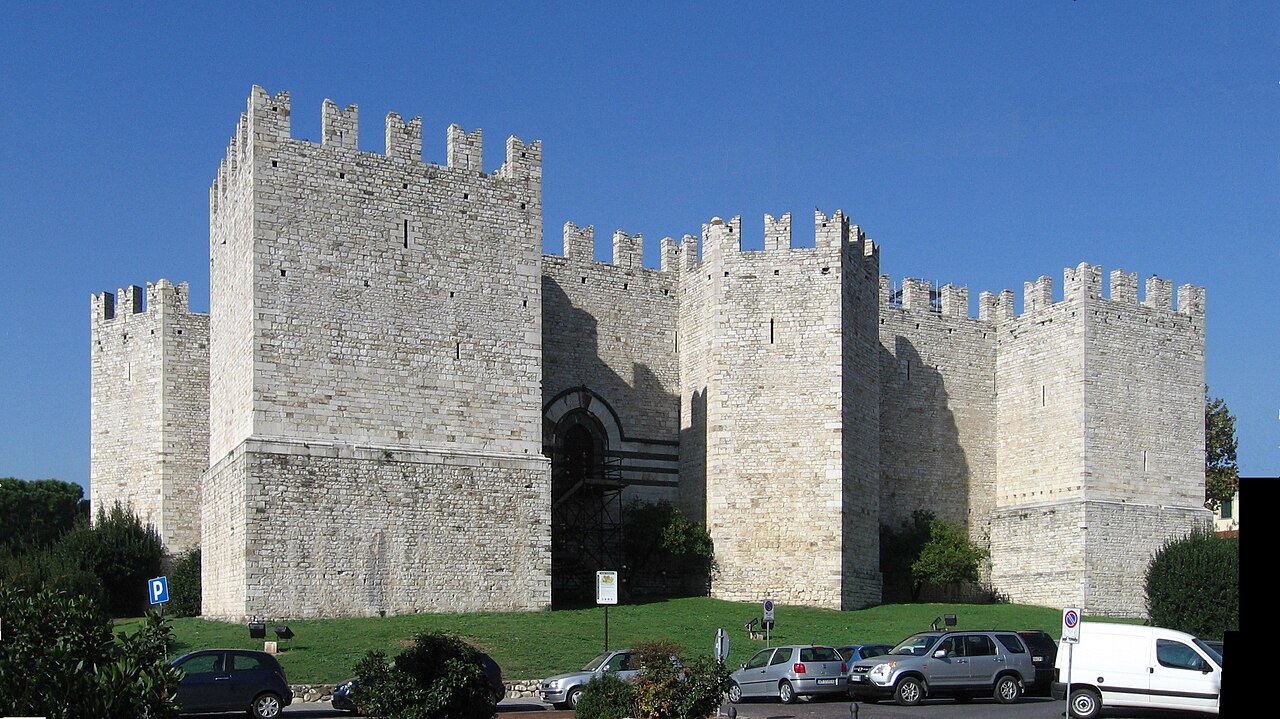
Castello Villanova
Castello Villanova stands as a remarkable example of a medieval hill castle nestled in the scenic municipality of Barberino di Mugello, Italy. Its origins trace back to the medieval period, when it was established by prominent local noble families who shaped the region's history. The castle’s enduring legacy is reflected in its fortified structures, religious buildings, and its evolving role within the social and administrative fabric of the Mugello countryside.
Early history and noble ownership
Originally constructed during the medieval era, Castello Villanova was first controlled by the influential Ubaldini family, particularly the branch known as de Villanova in the mid-13th century. This noble lineage was pivotal in establishing the castle as a fortified settlement, combining defense with governance and community functions. Subsequently, ownership transitioned to the Bettini family, a cadet line of the Ubaldini, further consolidating the castle’s aristocratic ties.
The castle's defensive perimeter was characterized by a circular stone wall, enclosing the settlement with a main entrance fortified by a gate topped by a tower. This layout was typical of small medieval fortifications designed to protect inhabitants and control access.
Religious significance and architectural features
Within the castle walls stood the church of San Jacopo, a central spiritual site rebuilt in 1334 under the patronage of the noble Cattani family. The church underscored the castle’s dual role as both a military stronghold and a religious center. By 1565, the church was formally annexed to the curia of Santa Maria a Colle Barucci by the Archbishop of Florence, integrating it into the broader ecclesiastical network.
The presence of a Compagnia within the walls suggests organized communal or religious activities, reflecting the castle’s social importance beyond mere defense. The walled enclosure included not only military structures but also residential and administrative buildings, supporting a small but vibrant community.
Administrative role and economic influence
Historical documents from the late 16th century, such as the “Piante di Popoli e Strade dei Capitani di Parte Guelfa”, describe Castello Villanova as a modest fortified settlement with social and administrative responsibilities. A 1563 statute from the Potesteria of Barberino di Mugello highlights the castle’s role in local governance, mentioning a councilor from Villanova serving in the Borsa del Consiglio, a council regulating economic activities. This demonstrates the castle’s integration into regional political and economic frameworks.
Transition to noble estate and 19th-century restoration
In the early 17th century, specifically 1611, the castle and its church were acquired by Marquis Ottavio Gerini. He incorporated the site into the vast estate of Villa Le Maschere, one of the largest rural villas in the Mugello region. This transition marked a shift from a defensive stronghold to a noble estate component, reflecting changes in land use and aristocratic lifestyle.
During the 19th century, Carlo Gerini undertook significant reconstruction of the castle ruins, restoring it in a style that emulated medieval architecture. This restoration preserved essential features such as the tower, gate, and an external staircase, adapting the castle for new functions including a school and a convent. This adaptive reuse illustrates the evolving relationship between historic architecture and community needs.
Modern conservation and cultural reuse
Conservation efforts intensified towards the end of the 20th century, culminating in a restoration completed in 1990 that focused on stabilizing the tower, gate, and staircase. These measures halted deterioration and preserved the castle’s medieval character. In the early 21st century, plans emerged to repurpose the castle and its surrounding park for hospitality and ceremonial uses, reflecting contemporary approaches to heritage management.
In 2003, Castello Villanova hosted a national assembly for the Registro Beta Montecarlo, signaling its renewed cultural significance and active engagement with community events. The castle’s location within the extensive park of Villa Le Maschere, notable for its tree-lined avenues and formal spatial layout, enhances its appeal as a historic and scenic venue.
Architectural remains and spatial organization
The surviving architectural elements of Castello Villanova include the well-preserved stone tower and entrance gate, alongside the external staircase providing access to upper levels. These features exemplify medieval defensive design adapted for residential and administrative purposes. The circular fortified enclosure once surrounded the settlement, evidencing typical medieval military architecture aimed at protection and control.
The church of San Jacopo remains a central feature within the castle grounds, embodying the site’s spiritual heritage. The careful restoration efforts have maintained the castle’s historic fabric, allowing visitors to appreciate its layered history and architectural significance.
Photographic documentation captures the castle’s ancient portal, courtyard, and the formal tree-lined avenue leading to the entrance, illustrating a carefully planned spatial arrangement that combines defense, residence, and aesthetic considerations.
Cultural and historical significance today
Today, Castello Villanova stands as a testament to the rich medieval heritage of the Mugello region. Its preservation and adaptive reuse demonstrate the value placed on historic structures as cultural assets. The castle’s integration into the Villa Le Maschere estate and its ongoing use for events and educational purposes ensure that its legacy continues to resonate within the local community and beyond.
Visitors to Castello Villanova can explore its restored towers, medieval gates, and the church of San Jacopo, gaining insight into the architectural styles, noble lineages, and historical developments that shaped this enduring hill castle. The site offers a unique window into the social, religious, and defensive aspects of medieval life in Tuscany.
Frequently asked questions (FAQ)
- How do I visit Castello Villanova?
- Castello Villanova is located in Barberino di Mugello, Tuscany. Visitors should check local tourism websites or contact the municipality for current visiting hours and any guided tours available.
- What is the historical significance of Castello Villanova?
- Castello Villanova was a medieval fortified settlement owned by noble families such as the Ubaldini and Bettini. It played a role in local governance, defense, and religious life, with its church of San Jacopo being a notable spiritual center.
- When was the church of San Jacopo rebuilt?
- The church of San Jacopo within Castello Villanova was rebuilt in 1334 under the patronage of the noble Cattani family, emphasizing its religious importance in the medieval period.
- Can I see the restored medieval features at Castello Villanova?
- Yes, key features such as the tower, entrance gate, and external staircase have been restored, allowing visitors to appreciate the castle's medieval defensive architecture.
- Is Castello Villanova part of a larger estate?
- Yes, since 1611, Castello Villanova has been part of the Villa Le Maschere estate, one of the largest rural villas in the Mugello region, which includes extensive parklands and historical buildings.
Information
Website
Visit websiteSources & official resources
Verify the information above using these authoritative references.
Loading map...
Visitor reviews
No reviews yet. Been here? Write the first review and help other travelers!
Write the first reviewVisited this castle? Share your experience
Your review helps other travelers and adds first-hand knowledge to our encyclopedia.