Rio Pusteria Close
Rio Pusteria Close, also known as Mühlbacher Klause in German, is a significant hill castle located near the town of Rio di Pusteria (Mühlbach) in the South Tyrol province of the Trentino-Alto Adige region in Italy. This fortress stands as a testament to the strategic military and customs control points that shaped the borderlands of medieval Europe. Its position commanding the narrow passage of the Pusteria valley made it a critical defensive and administrative site from its origins in the 13th century through to the early modern period.
The current structure was principally built under the direction of Duke Sigmund of Tyrol between 1458 and the 1480s, replacing an earlier fortification that dated back to the 13th century and was located approximately 600 meters west of the present site. This earlier fort, initially known as the Haslacher Klause, was established by the noble houses of Meinhard and Albert of Gorizia in 1269 to mark the border between the County of Tyrol and the County of Gorizia. The castle's role as a border post and toll station was vital, as it controlled passage and customs duties on the road that ran directly through its courtyard, a route used by travelers from regions such as Treviso and Venice.
Historical significance and evolution
The Mühlbacher Klause served as a fortified border post until the early 16th century when the death of the last Count of Gorizia around 1500 led to the disappearance of the border and a shift in the castle's strategic importance. The site was repeatedly involved in regional conflicts, including an unsuccessful siege during the 1526 peasant uprisings and damage sustained during the War of the Spanish Succession in 1703 and the Tyrolean Rebellion against Bavarian forces in 1809.
Following these conflicts, the fortress lost its military function and was sold to local inhabitants who dismantled many of the internal buildings for materials, though the outer walls were left intact. It was not until 1978, when traffic was rerouted away from the site, that restoration efforts began to preserve the remaining structures.
Architectural layout and features
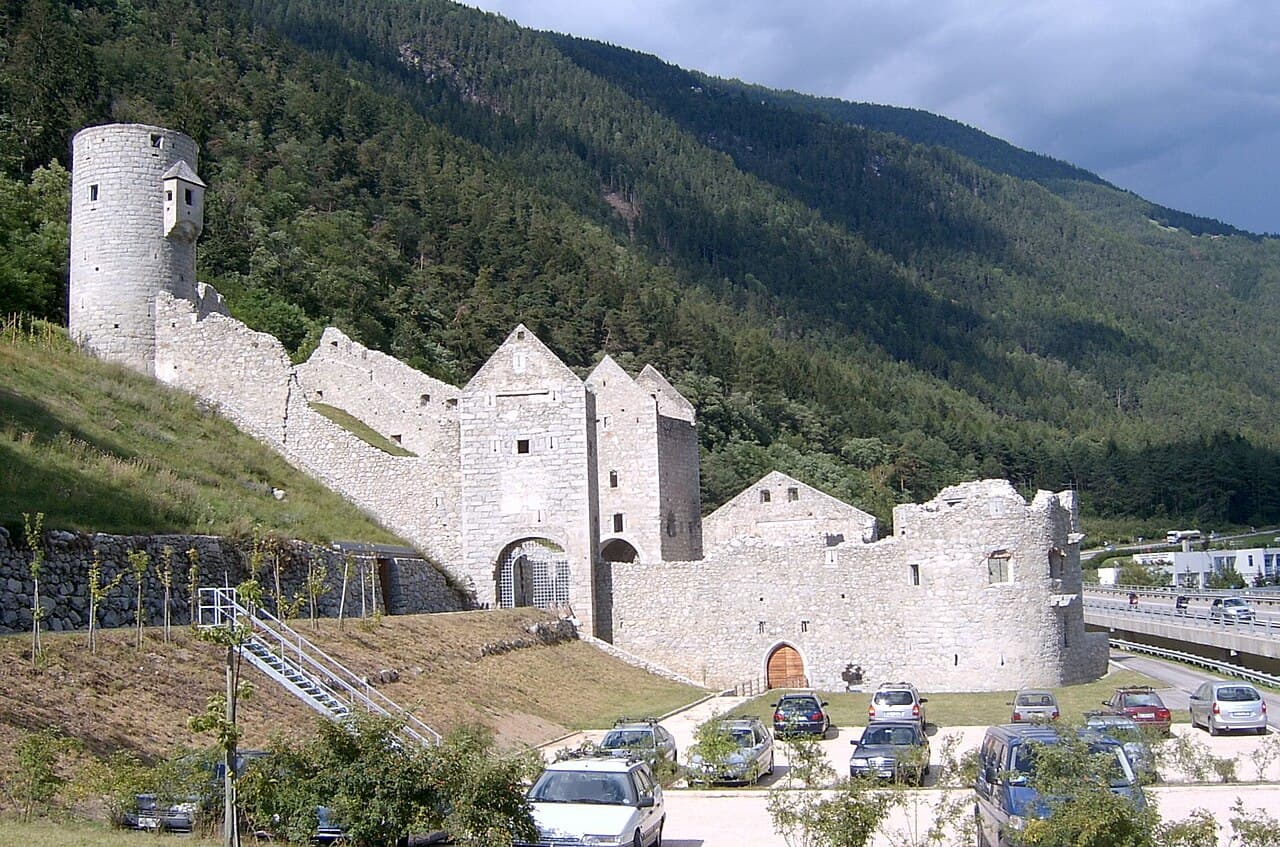
The castle is an irregular quadrilateral fortification with circular towers at its corners, designed to control the valley road that passes through it. The complex climbs the mountainside from the flat valley bottom near the Pusteria river, reflecting the natural topography in its defensive design.
Gate towers and defensive walls
The fortress is divided by the valley road which passes between two main gate towers: the Vintler Gate to the east and the Chapel Gate to the west. These gates formed the primary controlled access points through the castle, emphasizing its role as a customs checkpoint and military stronghold. From the northeastern tower, a fortified wall extends up the wooded mountain crest, providing an elevated defensive position.
Residential and functional buildings
On the valley-facing side of the castle lies a multi-story residential building that historically housed customs officials and administrators. An administration wing once annexed to this building was destroyed by a flood in the 18th century. The ground floor of the toll house, still preserved, includes spaces that served as smithies and stables, indicating the castle's role in supporting both military and logistical functions.
Upper and lower sections
The fortress is divided into an upper defensive section and a lower residential/agricultural area. The upper section originally contained two round towers, though only the left tower remains intact today. The right tower and some external walls were removed during the construction of the Puster Valley railway line, which altered the original fortifications.
Archaeological and historical context
Long before the medieval fortress, the site held strategic importance during the Roman era. Archaeological evidence points to a Roman road barrier from the Augustan period that controlled movement along the Via Julia Augusta, regulating travel between the Roman provinces of Noricum and Raetia. This ancient control point underscores the location's long-standing significance as a gateway through the Alps.
Later history and preservation
The castle saw its last major military action during the French War in the early 19th century when Napoleon’s troops encountered the Tyrolean militia. Additionally, a 20th-century ruined bunker near the Chapel Gate reflects the site's continued military relevance into modern times.
Despite the dismantling of many interior structures after the fortress was sold to local residents, the surviving outer walls and gate towers continue to convey the castle’s historical role. Restoration efforts since the late 20th century have focused on preserving these stone fortifications and stabilizing the ruins, allowing visitors to appreciate the castle's imposing presence and historical importance.
Visiting Rio Pusteria Close
The castle is accessible to visitors primarily during the summer months, offering a unique glimpse into the history of border fortifications in the Alps. Its location adjacent to the modern E66 highway places it directly alongside the southern walls, making it a visible landmark for travelers through the valley. A small entrance fee is charged for tours, which provide insight into the castle’s complex history, architecture, and its role in regional conflicts and trade.
Visitors can explore the remaining towers, gatehouses, and sections of the defensive walls, as well as the remnants of the chapel dedicated to the Holy Trinity. The site also features a milestone commemorating the 1813 baptism of fire of the Tyrolean Kaiserjäger troops, linking the fortress to the broader military history of the region.
Rio Pusteria Close stands as a remarkable example of a multi-functional medieval fortress that combined military defense, customs control, and residential functions, reflecting the complex political and economic landscape of the Tyrolean borderlands from the High Middle Ages through the early modern era.
Frequently asked questions (FAQ)
- How do I get to Rio Pusteria Close?
- Rio Pusteria Close is easily accessible by car and public transport. If you are traveling by train, the nearest station is in Bressanone, from where you can take a bus or a taxi to the castle. There are also parking facilities available for visitors arriving by car.
- What is the historical significance of Rio Pusteria Close?
- Rio Pusteria Close dates back to the Middle Ages and served as a defensive stronghold in the region. It played a crucial role in the local history, often being a site of conflict and power struggles. Today, it stands as a testament to the architectural and cultural heritage of the area.
- When was Rio Pusteria Close built?
- The construction of Rio Pusteria Close began in the 13th century, with various renovations and expansions occurring over the centuries. Its strategic location was chosen to oversee important trade routes in the region. This long history contributes to its rich cultural narrative.
- Can I take a guided tour of the castle?
- Yes, guided tours are available for visitors who wish to learn more about the history and architecture of Rio Pusteria Close. These tours provide in-depth insights into the castle's past, the surrounding landscape, and the unique features of the architecture. It is advisable to book in advance during peak tourist seasons.
- Why is Rio Pusteria Close popular among tourists?
- Rio Pusteria Close is popular for its stunning views and picturesque setting, as well as its rich history and well-preserved architecture. Visitors enjoy exploring the castle's grounds and discovering its fascinating stories. The combination of natural beauty and historical significance makes it a must-visit destination.
- Is it possible to visit Rio Pusteria Close year-round?
- Yes, Rio Pusteria Close is open year-round, although the opening hours may vary by season. It is best to check the official website or contact the castle administration for the most current information on visiting hours. Winter visits can offer a unique charm, while spring and summer provide beautiful landscapes.
- What are the ticket prices for visiting Rio Pusteria Close?
- Ticket prices for Rio Pusteria Close are generally affordable, with discounts available for students, seniors, and families. Children under a certain age may enter for free. It is recommended to check the official website for the most updated pricing information before your visit.
- What is the best time to visit Rio Pusteria Close?
- The best time to visit Rio Pusteria Close is during the late spring and early fall when the weather is pleasant and the surrounding landscape is in full bloom. Summer can be busy with tourists, while winter offers a quiet and serene atmosphere. Consider visiting during weekdays for a more tranquil experience.
- Are there any nearby attractions to explore?
- Yes, there are several nearby attractions that complement a visit to Rio Pusteria Close. The charming town of Bressanone, with its beautiful cathedral and historical center, is just a short drive away. Additionally, outdoor enthusiasts can enjoy hiking trails and breathtaking views in the surrounding mountains.
Photo gallery

Information
Sources & official resources
Verify the information above using these authoritative references.
Loading map...
Visitor reviews
No reviews yet. Been here? Write the first review and help other travelers!
Write the first reviewVisited this castle? Share your experience
Your review helps other travelers and adds first-hand knowledge to our encyclopedia.