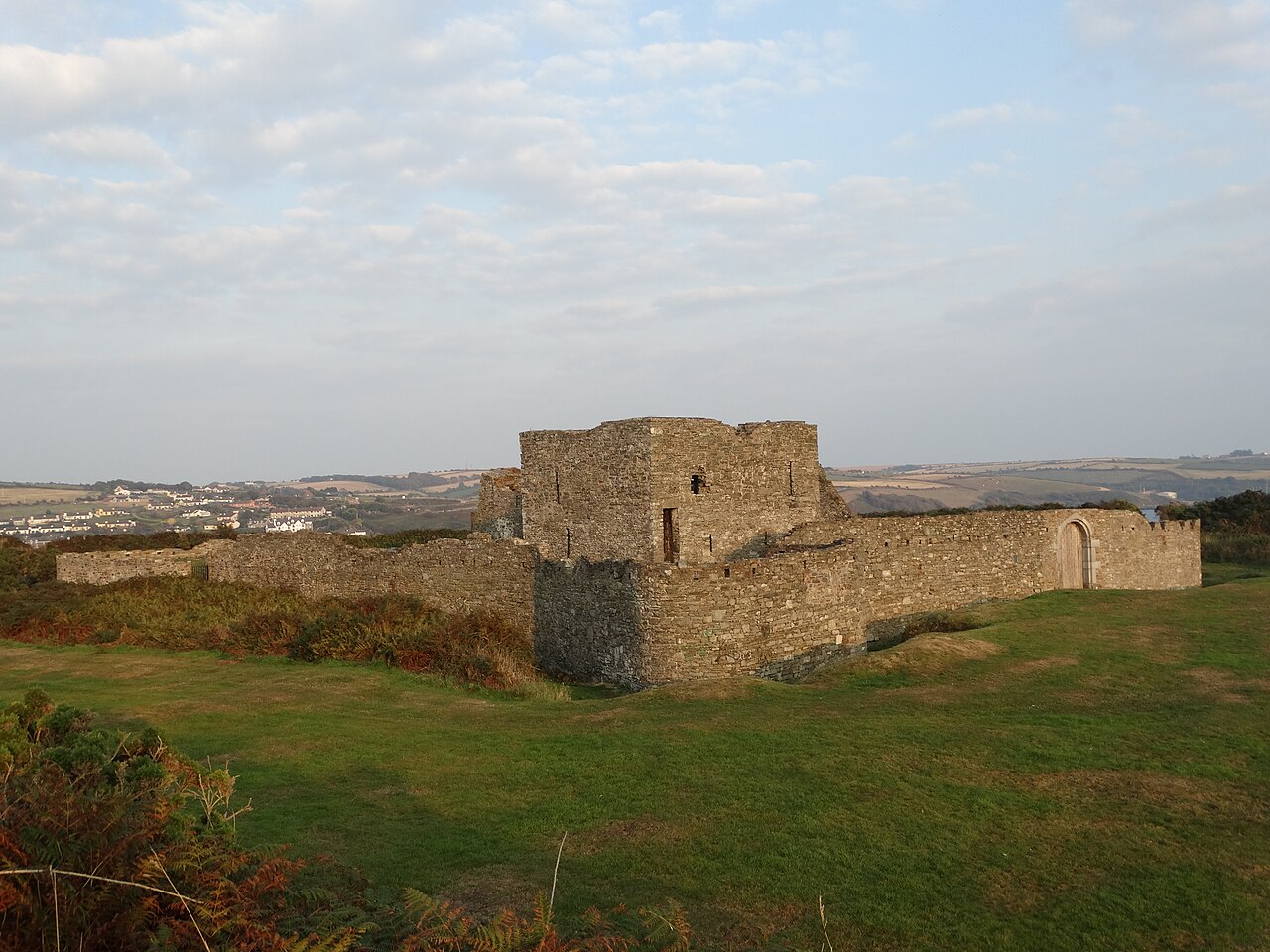
Ringrone Castle
Ringrone Castle is a medieval fortress situated on a hill overlooking the river Bandon, south of the historic town of Kinsale in County Cork, Ireland. This strategic location provided commanding views over the surrounding landscape and the important port of Kinsale, making it a vital defensive site during the medieval period.
The Norman origins and early history
The lands encompassing Ringrone Castle were originally granted by King Henry II of England to the Norman knight Milo de Cogan following the Anglo-Norman invasion of Ireland in the late 12th century. His son, Richard de Cogan, inherited these lands. Richard's only daughter married Milo de Courcy, a grandson of the renowned Norman knight Sir John de Courcy. As part of her dowry, the lands included Ringrone Castle and Old Head Castle.
In approximately 1223, Milo de Courcy undertook the construction of new castles at both Ringrone and Old Head. While Old Head Castle served as the baronial residence, Ringrone Castle was primarily a military installation, garrisoned heavily to protect the port of Kinsale and the ferry crossing that was crucial for trade and transport.
Architectural features and defensive role
Though much of the original structure has not survived, what remains of Ringrone Castle offers insights into its medieval military architecture. The surviving fragment is a four-story tower wall featuring vaulted ceilings over the first and third floors. The presence of vaults indicates the use of stone construction techniques typical of the early 13th century, designed to provide strength and fire resistance.
The tower's north wall doorway likely served as a controlled access point. The castle's location on a hill would have enhanced its defensive capabilities, allowing defenders to spot approaching enemies from a distance and control access to the river and ferry.
Role in the Battle of Kinsale and later history
In the autumn of 1600, during the turbulent period of the Nine Years' War in Ireland, Ringrone Castle was held by Spanish forces allied with the Irish against the English Crown. The castle's strategic position made it a key point of defense for the Spanish and their Irish allies.
The castle was captured by English forces during the Battle of Kinsale, a decisive conflict that marked the decline of Gaelic power in Ireland. The English army employed heavy artillery, including cannons, to breach the castle's defenses, demonstrating the evolution of siege warfare and the increasing importance of gunpowder weapons in the early modern period.
Present condition and visitor information
Today, Ringrone Castle stands as a ruin, with only a single wall fragment of the tower remaining. This fragment rises to four stories and shows clear evidence of the original vaulted ceilings and doorway. While not as grand or well-preserved as some other castles in the region, the ruin offers a tangible connection to the area's Norman and early modern history.
The site is freely accessible to visitors and is located near other historical landmarks, including James Fort, which played a significant role in the defense of Kinsale. Visitors can explore the remains and appreciate the castle's strategic setting overlooking the river and the surrounding countryside.
Frequently asked questions (FAQ)
- How do I get to Ringrone Castle from Kinsale?
- Ringrone Castle is located south of Kinsale on a hill overlooking the river Bandon. Visitors can reach the site by car or on foot via local roads and walking paths leading from Kinsale. Parking is available nearby, and the castle is freely accessible.
- What is the historical significance of Ringrone Castle?
- Ringrone Castle was built around 1223 by Milo de Courcy as a defensive stronghold protecting the port of Kinsale and the ferry crossing. It played a role in the Battle of Kinsale in 1600 when it was held by Spanish forces and captured by the English after a cannon siege.
- Can I visit Ringrone Castle year-round?
- Yes, Ringrone Castle is an open ruin with free access throughout the year. There are no formal visiting hours, but visitors should plan their visit during daylight for safety and better viewing conditions.
- What architectural features remain at Ringrone Castle?
- The main surviving feature is a four-story tower wall fragment with vaulted ceilings on the first and third floors and a doorway in the north wall. These elements reflect the castle's 13th-century Gothic military architecture.
- Is Ringrone Castle accessible for people with mobility issues?
- As an open ruin situated on a hill, access to Ringrone Castle may be challenging for visitors with mobility issues. The terrain includes uneven ground and no formal pathways or facilities.
Information
Loading map...
Visitor reviews
No reviews yet. Been here? Write the first review and help other travelers!
Write the first reviewVisited this castle? Share your experience
Your review helps other travelers and adds first-hand knowledge to our encyclopedia.