Rihemberk Castle — Slovenia castle

Rihemberk Castle

Rihemberk Castle: historic hilltop fortress in Branik, Slovenia
Branik, Slovenia
High Medieval (11th–13th c.)
Partially Restored

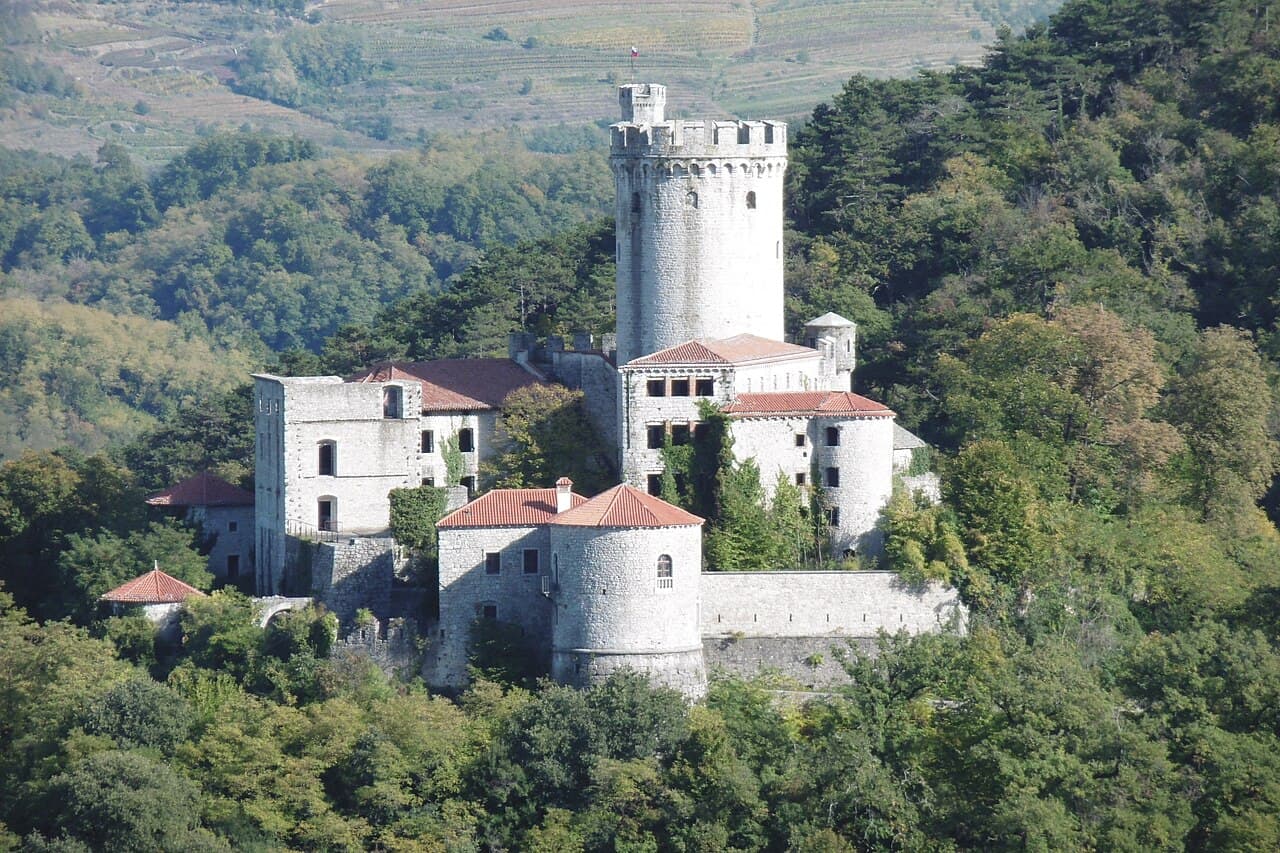
Rihemberk Castle, also known locally as Grad Rihemberk or Grad Branik, is a prominent hill castle perched above the village of Branik in Slovenia. This historic fortress stands on a mountain slope that bears the marks of earlier Roman military presence, believed to have been the site of a Roman castrum, highlighting its long-standing strategic importance.

The castle's origins date back to the 12th century, placing it firmly in the high medieval period. It was initially constructed to control vital crossroads traversing the Karst region, facilitating movement towards Trieste and the Friuli Plain. The first recorded owner was the Patriarch of Aquileia, who entrusted the castle's guardianship to appointed noble families.

Early history and ownership

By 1232, the castle was under the guardianship of the Reifenberg family, a noble house that played a significant role in the region. Their male line became extinct in 1371, after which the castle passed to the influential Counts of Gorizia. The Counts held the castle until 1500, when the last count died, and the castle along with their other possessions was absorbed by the Habsburg Empire under Emperor Maximilian I.

In 1528, the castle was loaned by Archduke Ferdinand I of Habsburg to the noble Lantieri family. The Lantieri Counts formally acquired ownership in 1649 and undertook significant renovations, including the addition of a palatial residential tract. This period marked a transition from purely military fortification to a more comfortable noble residence.

Architectural evolution

Medieval foundations and defensive features

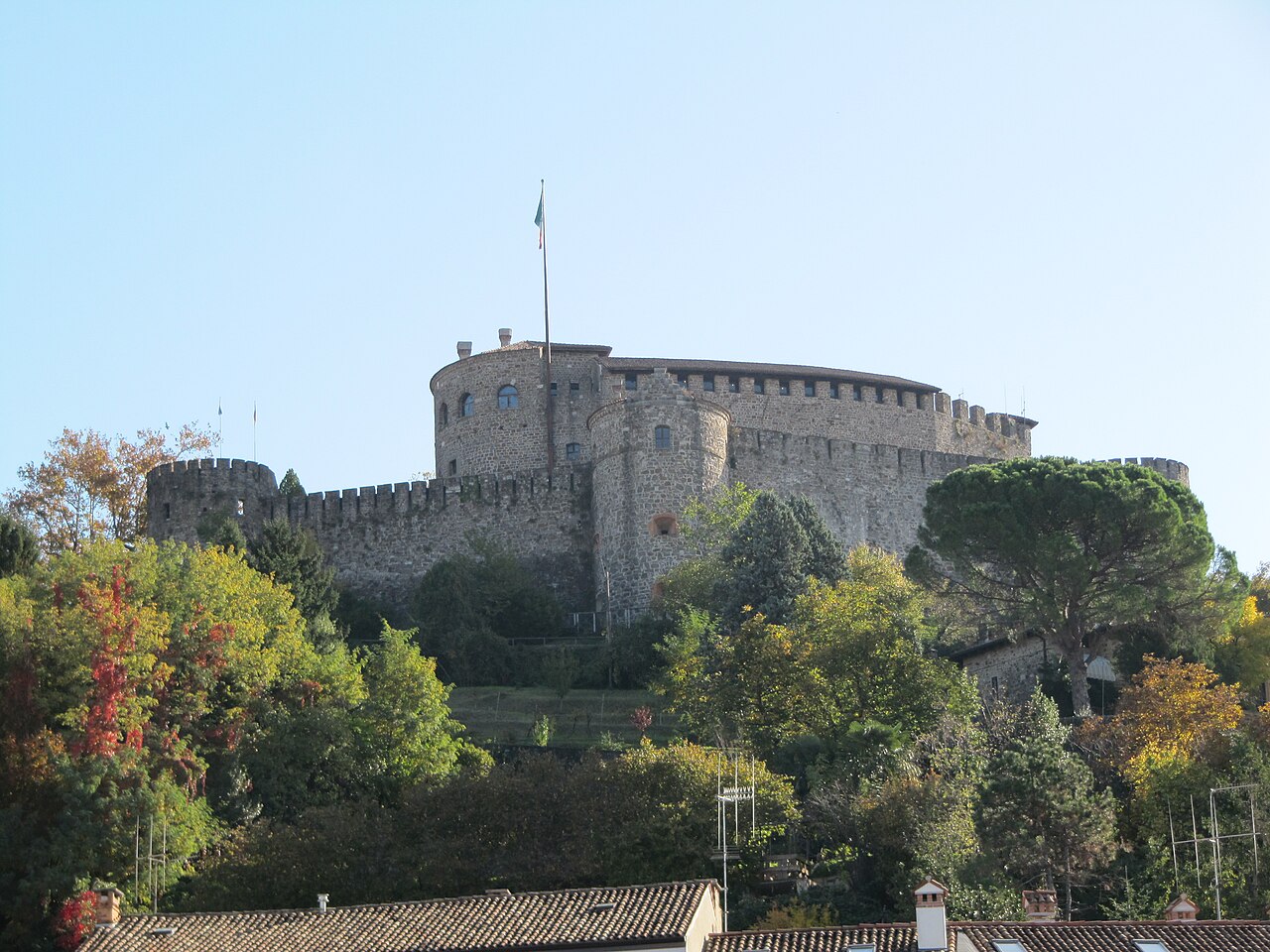
The castle retains visible Romanesque foundations from its original 12th-century construction. The core of the complex is centered around a 13th-century round keep, a typical defensive structure of the time designed for both residence and stronghold. Surrounding the keep, the castle's defensive walls were enhanced during the Renaissance with the addition of corner turrets dating from the 16th century, reflecting evolving military architecture.

Renaissance and baroque modifications

During the Renaissance, the castle underwent substantial expansion, including the addition of a residential tract along the inner wall circuit and the creation of a courtyard. The baroque period saw further transformation, notably with the addition of the palatio by the Lantieri family. The castle chapel contains Gothic elements, indicating stylistic layering over centuries.

19th-century romantic restoration

In the 19th century, the castle was remodeled in the Romantic Neo-Gothic style, characterized by the addition of decorative crenellations and other stylistic features that enhanced its picturesque silhouette, aligning with the era's fascination with medieval revival architecture.

20th-century history and damage

The castle remained in the possession of the Lantieri family until the end of World War II. During the war, on the night of 22–23 July 1944, partisan resistance fighters attacked the castle, blowing it up and setting it on fire to prevent its use by German forces as a military outpost. This assault resulted in severe damage and the destruction of all furnishings.

After the war, the castle was nationalized by the Yugoslav communist authorities. Partial restoration efforts began in the 1980s, aiming to stabilize the structure and recover some of its historical character, though full reconstruction of all prewar elements has not been completed.

Cultural significance and current status

Rihemberk Castle offers stunning views over the Branica valley and the surrounding Vipava Valley, making it a site of both historical and scenic interest. In recent decades, the castle has been used for cultural events and activities, reflecting its role as a heritage landmark.

After a period of closure, the castle reopened to visitors in 2017, with access available on weekends and holidays during the summer months. This reopening has enhanced public engagement with the site, allowing visitors to explore its rich history and architectural features firsthand.

Architectural highlights and surrounding features

  • The castle's 13th-century round keep serves as the focal point of the complex, exemplifying medieval defensive design.
  • Renaissance defensive walls with 16th-century corner turrets demonstrate the adaptation of fortifications to changing military needs.
  • The baroque palatial residential tract reflects the castle's transition to a noble residence with enhanced comfort and style.
  • Gothic elements in the castle chapel highlight the layering of architectural styles over centuries.
  • The Romantic Neo-Gothic crenellations added in the 19th century contribute to the castle's picturesque appearance.
  • A partially preserved walled garden on the south slope suggests the presence of formal landscaping during the baroque period.
  • The castle's strategic location above key routes underscores its historical military and administrative importance.

Rihemberk Castle stands as a testament to the complex history of the Karst region, embodying centuries of architectural evolution, noble lineage, and the turbulent history of Central Europe. Its preservation and reopening invite visitors to engage deeply with Slovenia's medieval heritage and the layered narratives embedded in its stone walls.

Frequently asked questions (FAQ)

How do I get to Rihemberk Castle?
Rihemberk Castle is located in Branik, Slovenia, and is accessible by car. Parking is available near the castle, and public transport options may include regional buses that connect to nearby towns.
What is the historical significance of Rihemberk Castle?
Rihemberk Castle dates back to the 12th century and played a crucial role in the defense of the region. It has witnessed various historical events and changes in power, making it an important landmark in Slovenian history.
When was Rihemberk Castle built?
The construction of Rihemberk Castle began in the 12th century, with various modifications made over the centuries. Its architecture reflects the medieval military style, showcasing the evolution of castle design in Slovenia.
Can I tour Rihemberk Castle?
Yes, visitors can tour Rihemberk Castle and explore its fascinating rooms and grounds. Guided tours are available, providing insights into the castle's history and architecture.
Why is Rihemberk Castle considered an architectural gem?
Rihemberk Castle is considered an architectural gem due to its well-preserved structures and unique blend of medieval and Renaissance styles. The castle's design features impressive stonework and panoramic views of the surrounding landscape.
Is it possible to host events at Rihemberk Castle?
Yes, Rihemberk Castle offers facilities for various events, including weddings and corporate gatherings. The scenic backdrop and historical ambiance make it a popular choice for special occasions.
What are the opening hours for Rihemberk Castle?
Rihemberk Castle typically opens to visitors from late spring through early autumn, with specific hours varying by season. It is advisable to check the official website for the most current opening hours before planning your visit.
What is the ticket price for visiting Rihemberk Castle?
Ticket prices for Rihemberk Castle vary depending on the age of the visitor and whether a guided tour is included. Discounts may be available for children, students, and seniors, so it's worth checking for any promotions.
When is the best time to visit Rihemberk Castle?
The best time to visit Rihemberk Castle is during the late spring and early autumn when the weather is mild and the surrounding landscapes are vibrant. Visiting during these seasons allows for a more enjoyable experience and stunning views.
Are there any nearby attractions to visit?
Yes, there are several nearby attractions, including the picturesque village of Branik and the beautiful wine region of Goriška Brda. Visitors can also explore nearby hiking trails and enjoy the stunning natural scenery of the area.

Photo gallery

Rihemberk Castle
Click to view

Photo by Alessandro Sgambati•CC BY-SA 4.0

1 photo • Click any image to view in full screen

Information

Hill Castle

Loading map...

Visitor reviews

No reviews yet. Been here? Write the first review and help other travelers!

Write the first review

Visited this castle? Share your experience

Your review helps other travelers and adds first-hand knowledge to our encyclopedia.

Write a review

(5/5)

0/2000 characters

Your review will be visible after admin approval

Nearby castles

13.4 km

Vipava Castle

Vipava, Slovenia

Vipava Castle, locally called Stari Grad meaning "Old Castle," is a notable medieval fortress ruin perched on a mountainous spur north of the town of Vipava in Slovenia. Known also by its German name Alt Wippach, it lies near the Italian border, north of Trieste, commanding strategic views over the Upper Vipava valley. This castle is a significant example of Romanesque military architecture from the High Medieval period. Origins and early history The castle was most likely constructed in the 12th century by the Patriarchate of Aquileia, a powerful ecclesiastical state that controlled the region. Although the first written mention of the castle itself is from 1275 under the name castrum Wipaci superioris (Upper Vipava Castle), a knight named Wiluiuns de Wippach is recorded in 1154, indicating the presence of a knightly family associated with the site. The castle served as the residence of the Knights of Vipava until the mid-14th century, marking its importance as a feudal stronghold in the region. Changing ownership and political significance Following the departure of the Knights of Vipava, the castle passed through the hands of numerous noble families, reflecting the turbulent political landscape of the area. Among its owners were the Knights of Rihemberk, the Šneperskies from Snežnik, the Habsburgs (who acquired it in 1344), the Weissenfelsers (Belopeški), the Counts of Celje, and the Herberstein family who took possession in 1487. In the first half of the 16th century, the castle was briefly occupied by the Venetians, a reflection of the ongoing conflicts between regional powers. However, the Habsburgs soon regained control. After 1577, the castle belonged to the Lanthieri Counts, who eventually abandoned it in the 17th century when they built a more comfortable palace in Vipava town below. Since then, the castle has gradually fallen into ruin. Architectural features and layout The ruins of Vipava Castle reveal a fortress with a rectangular ground plan. The complex included two palatial residential buildings and a mighty keep or defensive tower, which served as the stronghold's principal defensive feature. The castle's thick Romanesque walls enclosed the courtyard and protected the inhabitants from attacks. The remains of the walls and towers still outline the castle's original layout, providing insight into medieval fortification design in the region. The castle's elevated position on a mountain spur allowed for excellent surveillance of the surrounding valley, a key strategic advantage. Its design reflects typical High Medieval military architecture with a focus on defense and control over the surrounding lands. Decline and present condition After the Lanthieri Counts ceased using Vipava Castle in the 17th century, the fortress fell into disrepair. The construction of a new palace in the town below made the castle obsolete as a noble residence. Over the centuries, natural decay and lack of maintenance reduced the castle to ruins. Today, Vipava Castle stands as a partially preserved medieval ruin, accessible only by footpaths, as it cannot be reached by car. Despite its ruined state, the castle remains a popular destination for hikers and visitors due to its panoramic views of the Upper Vipava valley. The approximately 30-minute walk from Vipava town to the castle provides a scenic route through the Slovenian countryside. Vipava Castle in cultural and historical context Vipava Castle's history reflects the complex feudal and political dynamics of the Slovenian Littoral region during the Middle Ages. Its succession of owners, including prominent noble families and the Habsburg dynasty, illustrates the castle's role in regional power struggles. The brief Venetian occupation highlights the strategic importance of the site in broader Adriatic conflicts. Today, the castle is valued both as a cultural heritage site and a natural landmark. Its ruins offer a tangible connection to Slovenia's medieval past and serve as a reminder of the region's historical ties to the Patriarchate of Aquileia and Central European noble lineages. Visitor information Vipava Castle is open to the public year-round as an outdoor ruin. Visitors should prepare for a moderate hike as the castle is reachable only by foot. The site does not have facilities or ticketed entry, making it a free attraction. The best time to visit is during spring to autumn when the weather is favorable for hiking and sightseeing. Nearby attractions While visiting Vipava Castle, travelers can explore the charming town of Vipava, known for its wine production and historical architecture. The surrounding Vipava valley offers numerous hiking and cycling trails, making the area a popular destination for outdoor enthusiasts.

High Medieval (11th–13th c.)
Details
15 km

Miren Castle Church

Miren, Slovenia

Miren Castle Church stands on a hill in Miren, Slovenia, a site with a layered history marked by both medieval fortifications and religious significance. Originally, the hill was home to a castle, lending the site its name, but today it is dominated by a complex of ecclesiastical buildings that have evolved over centuries. The legendary origins of Miren Castle hill Local tradition tells of a noble ruler named King Miren, revered by the people for his generosity and kindness. According to legend, he founded the settlement of Miren to provide homes for impoverished peasants, establishing a community that would endure through the centuries. While the historical accuracy of this tale remains uncertain, it remains an important part of the cultural identity of Miren's inhabitants. Medieval beginnings and early religious structures The earliest documented structure on the hill was the Church of Our Lady, constructed in 1488. This church served as a spiritual center for the local community and underwent significant changes over time. It was rebuilt in 1753, reflecting architectural updates of the period, but was ultimately destroyed on 30 May 1914, a loss that marked the end of an era for the original building. Hermit habitation and monastic presence Between the early 18th century and mid-18th century, specifically from around 1700 to 1756, the castle hill was home to hermits who lived in seclusion. Their presence contributed to the site's spiritual atmosphere and laid the groundwork for the later monastic developments. Construction and evolution of the current church The current monastic church dedicated to Our Lady of Sorrows was built in 1886, replacing previous structures and reaffirming the hill's religious importance. This church is a focal point for pilgrims and visitors alike, embodying the continuity of faith on the site. Destruction and restoration through the world wars The church suffered complete destruction during both World War I and World War II, reflecting the turbulent history of the region. Each time, it was rebuilt, demonstrating the resilience of the community and their commitment to preserving this sacred place. Artistic heritage and interior decoration In 1958, the church's interior was adorned with frescoes by the Slovenian artist Tone Kralj. These frescoes add significant artistic value to the church, combining religious themes with a distinctive style that enhances the spiritual experience of visitors. Architectural and cultural significance The Miren Castle Church represents a blend of historical layers, from its origins as a fortified hill to its current status as a pilgrimage destination. The church's architecture reflects 19th-century ecclesiastical design with later artistic interventions, while the site itself is a symbol of local heritage and faith. Current status and visitor experience Today, the church remains an active place of worship and pilgrimage, attracting visitors interested in its history, architecture, and art. Its location on the hill offers panoramic views of the surrounding landscape, enhancing the spiritual ambiance. The site is well-maintained and accessible to the public, with ongoing efforts to preserve its cultural and historical significance.

Modern (19th–20th c.)
Details
16.4 km
Gorizia Castle — Italy castle

Gorizia Castle

Gorizia, Italy

Gorizia Castle, locally known as Castello di Gorizia, stands as a prominent medieval fortress overlooking the city of Gorizia in the Friuli-Venezia Giulia region of northeastern Italy. Perched on a strategic hill 155 meters above sea level, the castle has witnessed over a millennium of history, evolving from an early medieval stronghold to a Renaissance fortress, and now serves as a cultural monument housing the Museum of the Middle Ages of Gorizia. The origins of Gorizia Castle trace back to the 11th century, when initial wooden defensive structures typical of the era, such as a motte-and-bailey with a moat and palisade, were replaced by more permanent stone constructions. The earliest stone keep, dating from this period, remains partially visible today within the castle's central courtyard, offering a tangible connection to its medieval roots. The castle's significance grew in the 12th century when it became the seat of the Counts of Gorizia, with Henry IV of Spanheim recorded as the first known count in 1146. This noble lineage expanded their influence across northeastern Italy and parts of present-day Austria and Slovenia, gradually enlarging and fortifying the castle to reflect their growing power. Medieval foundations and expansions Throughout the 13th century, Gorizia Castle underwent substantial expansion. A lordly palace and a two-storey building were added within the castle walls, enhancing its residential and administrative functions. Outside the castle's defensive palisade, a fortified hamlet developed, where residents were required to build masonry homes and assist in the castle's defense, underscoring the fortress's role as a community stronghold. The castle's architectural form during this period is documented by a city seal from 1307, granted by Albert II, which depicts a stylized keep similar to the castle's known structure. By the mid-14th century, the castle's appearance was comparable to that of Bruck Castle near Lienz, reflecting regional architectural influences. Transition to habsburg and venetian control The death of Leonhard, the last Count of Gorizia, in 1500 marked the end of the House of Gorizia's rule. The castle and its county passed to Maximilian I, Holy Roman Emperor and head of the Habsburg dynasty. Despite efforts to reinforce the castle's defenses, it was captured in 1508 by the Republic of Venice, which claimed the territory based on its ties to the Patriarchate of Aquileia. During Venetian occupation, which lasted just over a year until 1509, the castle underwent significant modifications to adapt to Renaissance warfare, particularly the use of firearms. This included the demolition of the original 11th-century stone keep to make way for modern fortifications such as bastions and reinforced walls. The Venetian coat of arms and a 16th-century statue of the Lion of Saint Mark, the symbol of Venice, remain prominent features above the castle's main entrance, commemorating this brief but impactful period. Early modern transformations and military use Following the Venetian retreat, the castle reverted to Habsburg control and gradually lost its medieval character. By the 17th century, it functioned primarily as a prison and military barracks. The 18th century saw further enhancements including the construction of bastions, powder magazines, and thick defensive walls. Notably, some of these fortification works were supervised by the renowned mathematician and astronomer Edmond Halley, reflecting an innovative approach to military architecture. Damage and restoration in the 20th century Gorizia Castle suffered extensive damage during World War I due to aerial bombardments, reducing it to ruins after centuries of use. Between 1934 and 1937, a major restoration led by architect Ferdinando Forlati, assisted by military engineers and the Trieste Belle Arti authority, sought to restore the castle to its medieval appearance. This involved removing Renaissance-era white plaster and reconstructing stone façades, reviving the castle's original medieval aesthetic. During World War II, the castle was occupied by German troops, and its northeast garden was used for executions, adding a somber chapter to its long history. Museum and present-day significance Today, Gorizia Castle houses the Museum of the Middle Ages of Gorizia, featuring original medieval furniture, reproductions of weapons, and siege engines that illustrate the castle's military and domestic history. The central courtyard still reveals the remains of the original 11th-century tower, connecting visitors directly to its medieval origins. The castle is surrounded by a public park, offering scenic views of the city and a tranquil setting for visitors. Its well-preserved medieval stonework and layered architectural elements make it a significant cultural and historical landmark in the Friuli-Venezia Giulia region. Gorizia Castle's enduring presence reflects the complex history of northeastern Italy, shaped by medieval nobility, Renaissance warfare, Habsburg and Venetian influences, and modern restoration efforts. It stands as a testament to the region's strategic importance and rich heritage, inviting exploration and study of its architectural evolution and historical narratives.

High Medieval (11th–13th c.)
Details