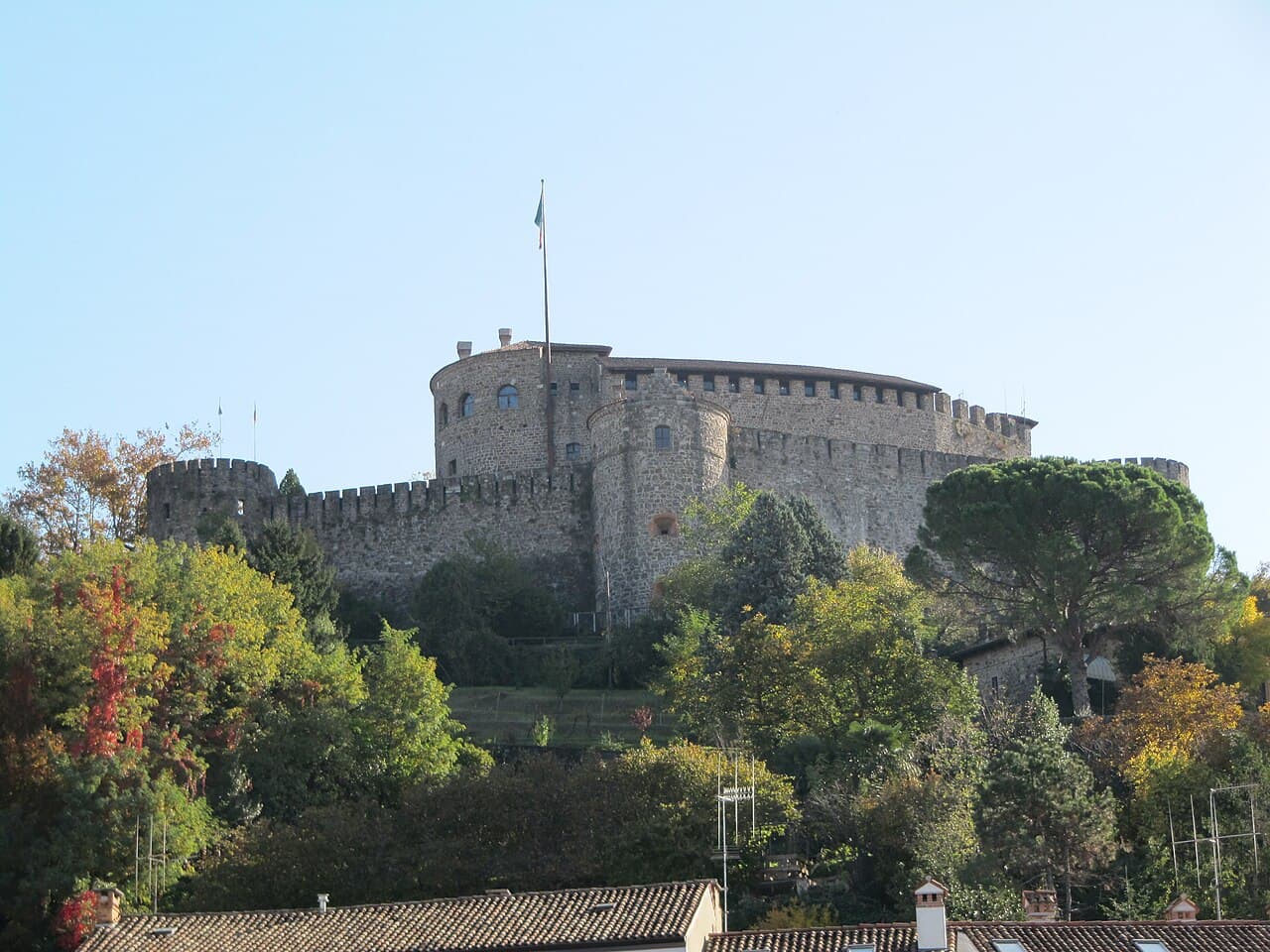
Gorizia Castle
Gorizia Castle, locally known as Castello di Gorizia, stands as a prominent medieval fortress overlooking the city of Gorizia in the Friuli-Venezia Giulia region of northeastern Italy. Perched on a strategic hill 155 meters above sea level, the castle has witnessed over a millennium of history, evolving from an early medieval stronghold to a Renaissance fortress, and now serves as a cultural monument housing the Museum of the Middle Ages of Gorizia.
The origins of Gorizia Castle trace back to the 11th century, when initial wooden defensive structures typical of the era, such as a motte-and-bailey with a moat and palisade, were replaced by more permanent stone constructions. The earliest stone keep, dating from this period, remains partially visible today within the castle's central courtyard, offering a tangible connection to its medieval roots. The castle's significance grew in the 12th century when it became the seat of the Counts of Gorizia, with Henry IV of Spanheim recorded as the first known count in 1146. This noble lineage expanded their influence across northeastern Italy and parts of present-day Austria and Slovenia, gradually enlarging and fortifying the castle to reflect their growing power.
Medieval foundations and expansions
Throughout the 13th century, Gorizia Castle underwent substantial expansion. A lordly palace and a two-storey building were added within the castle walls, enhancing its residential and administrative functions. Outside the castle's defensive palisade, a fortified hamlet developed, where residents were required to build masonry homes and assist in the castle's defense, underscoring the fortress's role as a community stronghold.
The castle's architectural form during this period is documented by a city seal from 1307, granted by Albert II, which depicts a stylized keep similar to the castle's known structure. By the mid-14th century, the castle's appearance was comparable to that of Bruck Castle near Lienz, reflecting regional architectural influences.
Transition to habsburg and venetian control
The death of Leonhard, the last Count of Gorizia, in 1500 marked the end of the House of Gorizia's rule. The castle and its county passed to Maximilian I, Holy Roman Emperor and head of the Habsburg dynasty. Despite efforts to reinforce the castle's defenses, it was captured in 1508 by the Republic of Venice, which claimed the territory based on its ties to the Patriarchate of Aquileia.
During Venetian occupation, which lasted just over a year until 1509, the castle underwent significant modifications to adapt to Renaissance warfare, particularly the use of firearms. This included the demolition of the original 11th-century stone keep to make way for modern fortifications such as bastions and reinforced walls. The Venetian coat of arms and a 16th-century statue of the Lion of Saint Mark, the symbol of Venice, remain prominent features above the castle's main entrance, commemorating this brief but impactful period.
Early modern transformations and military use
Following the Venetian retreat, the castle reverted to Habsburg control and gradually lost its medieval character. By the 17th century, it functioned primarily as a prison and military barracks. The 18th century saw further enhancements including the construction of bastions, powder magazines, and thick defensive walls. Notably, some of these fortification works were supervised by the renowned mathematician and astronomer Edmond Halley, reflecting an innovative approach to military architecture.
Damage and restoration in the 20th century
Gorizia Castle suffered extensive damage during World War I due to aerial bombardments, reducing it to ruins after centuries of use. Between 1934 and 1937, a major restoration led by architect Ferdinando Forlati, assisted by military engineers and the Trieste Belle Arti authority, sought to restore the castle to its medieval appearance. This involved removing Renaissance-era white plaster and reconstructing stone façades, reviving the castle's original medieval aesthetic.
During World War II, the castle was occupied by German troops, and its northeast garden was used for executions, adding a somber chapter to its long history.
Museum and present-day significance
Today, Gorizia Castle houses the Museum of the Middle Ages of Gorizia, featuring original medieval furniture, reproductions of weapons, and siege engines that illustrate the castle's military and domestic history. The central courtyard still reveals the remains of the original 11th-century tower, connecting visitors directly to its medieval origins.
The castle is surrounded by a public park, offering scenic views of the city and a tranquil setting for visitors. Its well-preserved medieval stonework and layered architectural elements make it a significant cultural and historical landmark in the Friuli-Venezia Giulia region.
Gorizia Castle's enduring presence reflects the complex history of northeastern Italy, shaped by medieval nobility, Renaissance warfare, Habsburg and Venetian influences, and modern restoration efforts. It stands as a testament to the region's strategic importance and rich heritage, inviting exploration and study of its architectural evolution and historical narratives.
Frequently asked questions (FAQ)
- How do I get to Gorizia Castle?
- Gorizia Castle is located in the heart of Gorizia, Italy, easily accessible by public transportation or car. If traveling by train, the castle is about a 15-minute walk from the Gorizia train station.
- What is the historical significance of Gorizia Castle?
- Gorizia Castle dates back to the 11th century and has served as a strategic fortress throughout its history. It played a crucial role in the defense of the region and reflects the architectural evolution from the Middle Ages to the Renaissance.
- When was Gorizia Castle last renovated?
- The last significant renovations of Gorizia Castle took place in the late 20th century, aimed at preserving its historical integrity while making it accessible to visitors. Ongoing maintenance ensures that the castle remains a prominent landmark and cultural site.
- Can I take guided tours of Gorizia Castle?
- Yes, guided tours are available and provide a deeper insight into the castle's rich history and architectural features. These tours are offered in multiple languages and can be booked in advance or on-site.
- Why is Gorizia Castle a popular tourist attraction?
- Gorizia Castle is popular for its stunning views of the surrounding area and its well-preserved architecture. Visitors are drawn to its historical significance, scenic beauty, and the cultural events often held within its walls.
- Is it possible to visit Gorizia Castle with children?
- Absolutely, Gorizia Castle is family-friendly and offers various activities that can engage children. The castle grounds are spacious, allowing for exploration, and there are educational exhibits suitable for young visitors.
- What are the opening hours of Gorizia Castle?
- Gorizia Castle is typically open from 9 AM to 7 PM during the summer months and has shorter hours in the winter. It’s advisable to check the official website for seasonal changes and holiday hours before your visit.
- What are the ticket prices for Gorizia Castle?
- Ticket prices for Gorizia Castle are generally affordable, with discounts available for students and seniors. Family tickets are also offered, making it a great value for visitors looking to explore the historical site together.
- When is the best time to visit Gorizia Castle?
- The best time to visit Gorizia Castle is during the spring and early autumn when the weather is pleasant and the gardens are in bloom. These seasons also see fewer crowds, allowing for a more enjoyable experience.
- Are there nearby attractions to visit after Gorizia Castle?
- Yes, there are several nearby attractions, including the charming historic center of Gorizia, the nearby Nova Gorica in Slovenia, and various parks and museums. These sites complement your visit to Gorizia Castle and offer a broader cultural experience.
Photo gallery

Photo by Limonadis•Public domain
Information
Sources & official resources
Verify the information above using these authoritative references.
Loading map...
Visitor reviews
No reviews yet. Been here? Write the first review and help other travelers!
Write the first reviewVisited this castle? Share your experience
Your review helps other travelers and adds first-hand knowledge to our encyclopedia.


