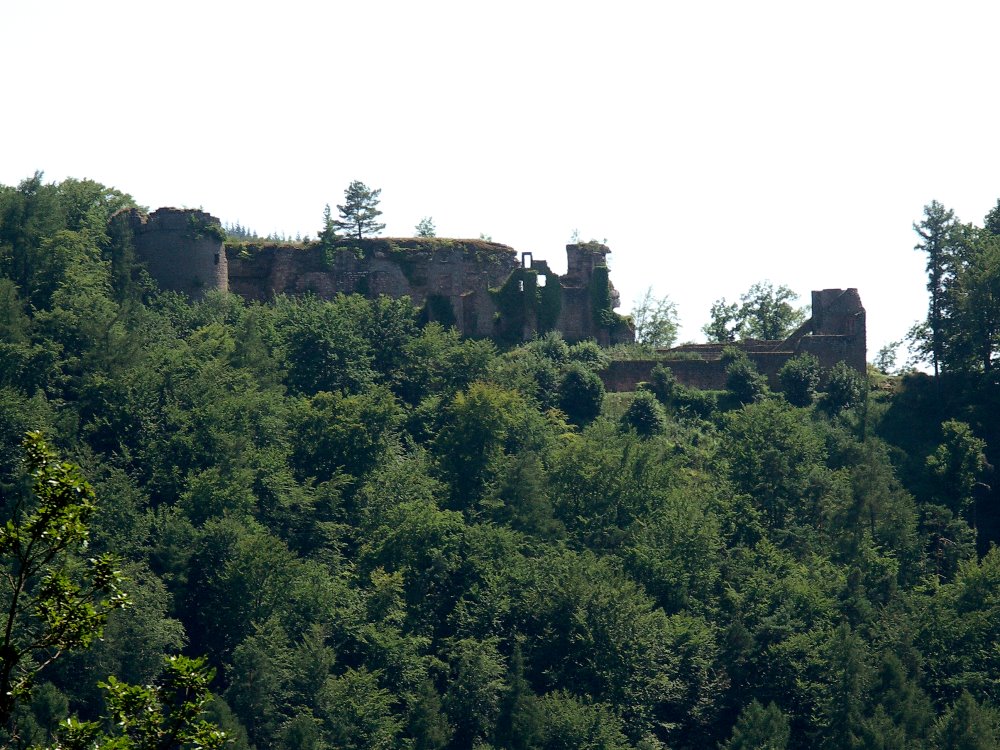
Rietburg Castle
Rietburg Castle stands as a significant medieval ruin located near Edenkoben in the German region of Rhineland-Palatinate. Constructed between 1200 and 1204, it was originally established by the noble lords of Riet, who were initially vassals of the Benedictine abbey of Weißenburg in North Alsace. Over time, these lords became ministeriales and feudatories to the powerful Hohenstaufen dynasty, reflecting the castle's strategic and political importance during the High Medieval period.
Historical background and early significance
The castle's foundation during the early 13th century places it firmly within the High Medieval era, a time when castles were crucial for territorial control and defense. The lords of Riet used the castle as a stronghold to assert their influence in the region. Its location near the Rhine Plain provided both a defensive advantage and oversight of important trade routes. The castle's association with the Benedictine abbey of Weißenburg highlights the intertwined nature of ecclesiastical and secular power during this period.
Architectural features and layout
While much of Rietburg Castle now lies in ruins, archaeological studies and remaining structures reveal characteristic features of a High Medieval hill castle. The castle was built on a rocky outcrop, providing natural defenses augmented by constructed fortifications. It likely featured a keep (donjon) as the central stronghold, surrounded by curtain walls and defensive towers. The castle’s design would have included a gatehouse, battlements, and a courtyard, typical of German medieval fortifications of the era.
Defensive adaptations
The castle's position on elevated terrain allowed defenders to monitor approaching enemies and control access routes. The natural rock formations were integrated into the defensive walls, making direct assaults difficult. The presence of a moat or ditch is uncertain, but the steep slopes around the site would have served as natural barriers.
Conflicts and damage through the centuries
Rietburg Castle witnessed several military conflicts that shaped its history. In 1470, during the Weißenburg Feud, a regional conflict between Prince-Elector Frederick the Victorious of the Palatinate and his cousin Duke Louis the Black of Palatinate-Zweibrücken, the castle was heavily shelled by troops from the Leiningen family. Despite the damage, the castle remained inhabitable, demonstrating the resilience of its fortifications.
The castle survived the Palatine Peasants' War of 1525 without damage, indicating either its strong defenses or a lack of direct involvement in the uprising. However, the castle's fate was sealed during the Thirty Years' War (1618–1648), a devastating conflict that ravaged much of Central Europe. It was destroyed during this period and was never rebuilt, leaving it in a ruined state.
Modern developments and tourism
Since 1954, the Rietburgbahn chair lift has provided visitors with access from the Rhine Plain up to a terrace on the eastern side of the castle ruins. This lift has made the site more accessible and allows for panoramic views of the surrounding landscape, including the Rhine valley and nearby vineyards.
The lower station of the chair lift is conveniently located near the Villa Ludwigshöhe, a stately residence constructed between 1846 and 1852 by order of King Louis I of Bavaria. This proximity links the medieval heritage of the castle with 19th-century Bavarian architectural history.
Preservation and visitor experience
Today, Rietburg Castle remains a partially preserved ruin, attracting tourists interested in medieval history and castle architecture. The site offers hiking opportunities, historical interpretation, and scenic views, making it a popular destination in the Palatinate region.
Visitors can explore the remaining walls and towers, gaining insight into the castle's defensive structures and medieval lifestyle. The combination of natural beauty and historical significance provides a compelling experience for those interested in Germany's castle heritage.
Information
Loading map...
Visitor reviews
No reviews yet. Been here? Write the first review and help other travelers!
Write the first reviewVisited this castle? Share your experience
Your review helps other travelers and adds first-hand knowledge to our encyclopedia.