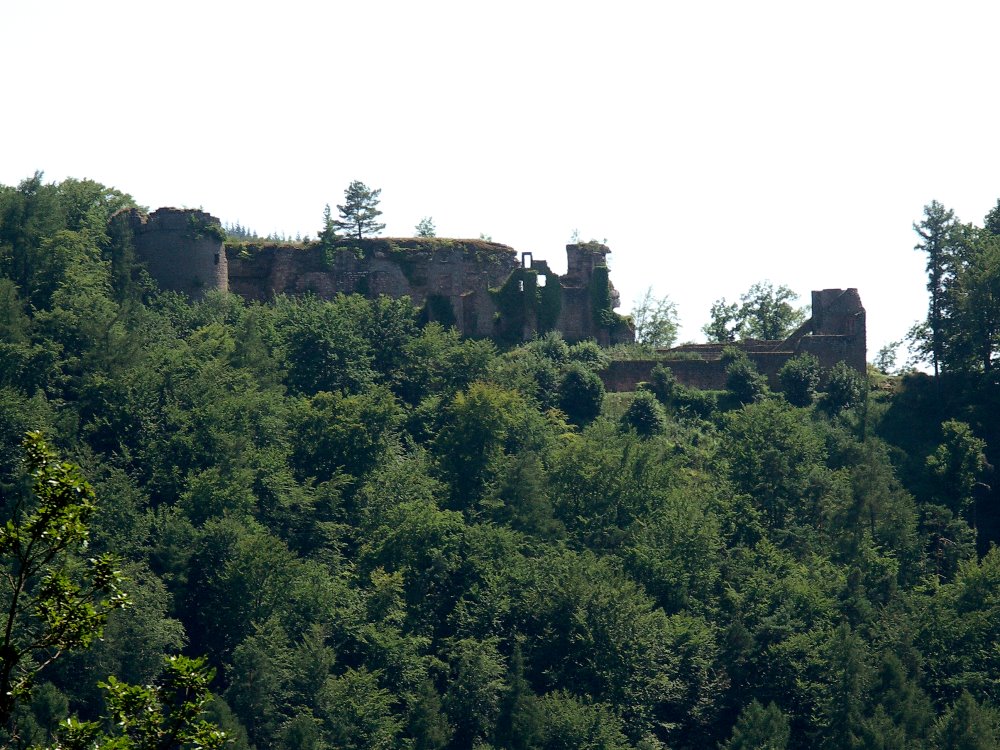
Meistersel Castle
Meistersel Castle is a significant high medieval ruin located near Annweiler in the Palatinate Forest of Germany. Situated on a commanding 492-metre-high hilltop overlooking the Modenbach valley, this castle stands near the Three Beeches pass (Drei Buchen) on the historic route from Ramberg to Edenkoben. Its strategic position provided oversight of important medieval trade and military routes.
Constructed originally in the 11th century, Meistersel Castle is among the oldest fortifications in the Palatinate region. The castle's earliest documentary mention dates to around 1100 AD. It was likely established as a protective outpost for the nearby Trifels imperial castle, which served as a residence and treasury for the Holy Roman Emperors. The castle’s role was to guard the approaches to Trifels and control movement through the valley.
Historical background and ownership
In the 12th century, Meistersel was granted as a fief to knightly ministeriales, who were unfree knights serving the emperor or local lords. The castle’s name derives from the German words Meister (master) and Saal (hall), indicating it may have functioned as the residence of a master of the hall or chamberlain, a key official managing the imperial household at Trifels.
Its alternative name, Modeneck, is linked to the nearby stream, further anchoring the castle in its natural landscape. The castle’s history reflects the feudal system of the Holy Roman Empire, where ministeriales held important administrative and military responsibilities.
Architectural evolution and layout
The core structures visible today date from around 1300, following substantial renovation and rebuilding efforts. The castle was constructed as a hill castle, utilizing the natural elevation for defense. Its design includes typical medieval features such as stone curtain walls, defensive towers, and a gatehouse that controlled access to the inner courtyard.
Meistersel’s architecture reflects the transition from early medieval wooden fortifications to more durable stone construction. The castle’s layout was adapted to the rocky hilltop terrain, with terraced walls and a compact footprint to maximize defensibility.
Defensive structures
The castle’s fortifications included battlements and arrow slits for archers, enabling defenders to repel attackers effectively. The elevated position also allowed for early warning of approaching enemies. While much of the superstructure is now in ruins, remnants of the keep and residential chambers remain discernible.
Residential and functional spaces
Within the walls, the castle contained living quarters for the lord and his retinue, a great hall for gatherings and administration, and storage rooms. The name "Meistersel" suggests the presence of a significant hall used by the castle's master or chamberlain, emphasizing its administrative importance.
Role during conflicts and decline
During the Peasants' War of 1525, Meistersel Castle was attacked and looted by rebellious peasants. This widespread uprising targeted feudal authorities and their symbols, including castles. After the assault, the castle was abandoned and fell into ruin, as it lost its strategic and administrative significance.
Since then, Meistersel has remained a ruin, with preservation efforts focusing on stabilizing the existing walls and making the site accessible to visitors. Its ruined state offers insights into medieval castle construction and feudal society in the Palatinate region.
Geographical and cultural significance
Meistersel Castle's location in the Palatinate Forest places it within a rich natural and historical landscape. The forested hills and valleys provided natural defense and resources for medieval inhabitants. The castle’s proximity to the Trifels Castle, a major imperial seat, highlights its role in the broader network of imperial fortifications.
Today, the castle is a popular destination for hikers and history enthusiasts exploring the Palatinate region. The ruins offer panoramic views of the surrounding countryside and serve as a tangible connection to the region's medieval past.
Visiting Meistersel Castle
Visitors to Meistersel Castle can explore the ruins via marked hiking trails originating from nearby towns such as Ramberg and Annweiler. The site is open year-round and does not charge an entrance fee, making it an accessible destination for those interested in medieval architecture and history.
Informational signage at the site provides context about the castle’s history and architectural features. The combination of natural beauty and historical significance makes Meistersel a noteworthy example of a high medieval hill castle in Germany.
Information
Loading map...
Visitor reviews
No reviews yet. Been here? Write the first review and help other travelers!
Write the first reviewVisited this castle? Share your experience
Your review helps other travelers and adds first-hand knowledge to our encyclopedia.