Richmond Castle
Richmond Castle stands as a prominent example of a Norman hill castle in North Yorkshire, England. Founded shortly after the Norman Conquest, it occupies a strategic elevated position overlooking the town of Richmond and the River Swale. The castle's name derives from the original term "Riche Mount," meaning "the strong hill," a testament to its commanding defensive location.
The castle's construction began in 1071 under the direction of Alan Rufus, a Breton nobleman closely allied with William the Conqueror. Designed primarily as a military stronghold, Richmond Castle was intended to secure Norman control over the surrounding territory and suppress local resistance. Its early existence is documented in the Domesday Book of 1086, which references a "castlery" at Richmond, confirming its importance in the Norman administrative and defensive network.
Early construction and architectural development
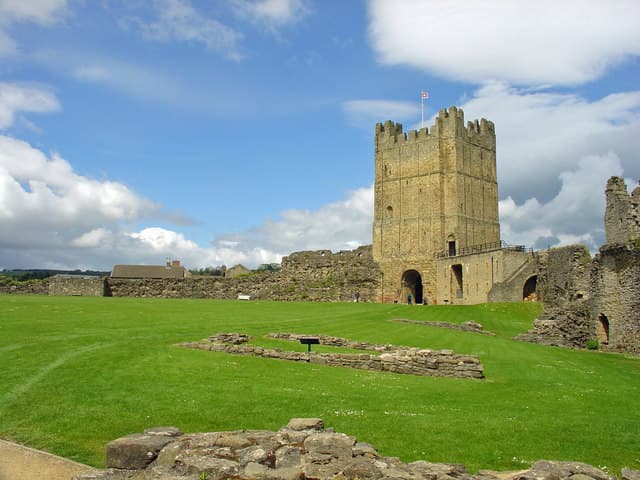
The initial fortifications likely consisted of timber structures and earthworks typical of early Norman castles. However, during the 12th century, significant stone construction transformed Richmond Castle into a formidable fortress. Duke Conan IV of Brittany, the great-nephew of Alan Rufus, commissioned the building of the castle's iconic keep, which rises approximately 100 feet high. The keep was constructed from light-hued sandstone, notable for its thick walls measuring around 11 feet, designed to withstand siege warfare.
Following the seizure of the Earldom of Richmond by King Henry II in 1158, the castle underwent further enhancements. Henry II is credited with completing the keep's construction and reinforcing the castle's defenses by adding additional towers and a barbican, an outer fortified gateway that provided a controlled and defensible entrance. These improvements reflected evolving medieval military architecture and the need to protect against increasingly sophisticated attacks.
Medieval significance and royal patronage
Throughout the 12th and 13th centuries, Richmond Castle remained an important royal stronghold. Monarchs such as King Henry III and Edward I contributed to the castle's upkeep and modernization. Edward I focused on improving the keep's interior, adapting it for both defensive and residential purposes. By the late 14th century, however, the castle's military role diminished as the political landscape of England changed, leading to its gradual decline.
By 1538, much of Richmond Castle had fallen into ruin, a fate common to many medieval fortresses that lost strategic importance. Despite this decline, the castle's imposing keep and remaining stonework continued to dominate the Richmond skyline.
19th and 20th century revival and military use
The castle experienced a resurgence of interest in the 19th century during a period of growing appreciation for historic monuments. Restoration efforts focused on the keep, which was repurposed as the headquarters for the North Yorkshire Militia starting in 1855. During this period, a military barracks was constructed within the castle's courtyard to support its new function, although this structure was later removed in 1931 to restore the castle's original layout.
Between 1908 and 1910, Robert Baden-Powell, the founder of the Boy Scouts movement, resided at Richmond Castle while commanding the Northern Territorial Army. The castle's military significance extended into the First World War, when it was used as a base and prison. Notably, the castle detained conscientious objectors known as the "Richmond Sixteen," who were initially sentenced to death before their sentences were commuted to forced labor, highlighting the castle's role in wartime justice.
Architectural features and castle layout
Richmond Castle's layout is characterized by a triangular central enclosure, an outer enclosure to the east, a dominant keep at the northern corner, and a small protective area surrounding the keep itself. This design reflects typical medieval defensive priorities, combining strong fortifications with administrative and residential functions.
The keep remains the most striking feature, standing about 100 feet tall with walls approximately 11 feet thick. Built from honey-coloured sandstone, it retains a restored roof and floors that allow visitors to explore its upper levels and enjoy panoramic views over Richmond. The basement of the keep intriguingly contains the original 11th-century main gate arch, which was incorporated into the keep's foundations when the entrance was moved for enhanced security.
The castle's barbican guards the main gate, serving as a controlled entry point where visitors and goods could be inspected before entering the main enclosure. This feature underscores the emphasis on securing access and controlling movement within the fortress.
Opposite the main enclosure and overlooking the nearby river is the Cockpit, a separate bailey or courtyard believed to have functioned as a garden area. Historical drawings from 1674 depict balconies overlooking the riverside section of Scolland’s Hall, the castle's great hall, indicating the site's complex social and domestic arrangements.
Within the central enclosure, a chapel dedicated to the Holy Trinity served the spiritual needs of the castle's inhabitants and garrison, highlighting the integration of religious practice within the castle complex.
Historical discoveries and cultural significance
One of the castle's remarkable archaeological finds is the preservation of the original main gate arch from the 11th century, which was later enclosed within the keep's basement during the 12th-century expansions. This feature provides a tangible connection to the castle's earliest phase and Norman origins.
The castle's cell block contains around 2,300 graffiti inscriptions made by prisoners detained there from the 19th century through the 1970s. Among these are marks left by the World War I conscientious objectors, offering an invaluable historical record of their presence and experiences.
Richmond Castle is also steeped in local folklore and legend. Tales of King Arthur and his knights resting in a cave beneath the castle add a mythical dimension to the site. Additionally, stories of ghostly drumming noises attributed to a lost drummer boy in an underground tunnel contribute to the castle's rich cultural imagination.
Preservation and visitor experience
Today, Richmond Castle is recognized as a scheduled monument and a Grade I listed building, underscoring its national heritage importance. The castle is well preserved with ongoing conservation efforts ensuring its survival for future generations.
Visitors can explore the keep, walk the castle walls, and learn about its varied history through onsite information. The panoramic views from the keep provide a unique perspective on Richmond and the surrounding countryside. The castle's blend of military architecture, historical layers, and cultural stories make it a compelling destination for those interested in medieval history and Norman heritage.
Frequently asked questions (FAQ)
- How do I get to Richmond Castle?
- Richmond Castle is located in the market town of Richmond, North Yorkshire. It is accessible by car and public transport, with local bus services connecting Richmond to nearby towns and rail stations.
- What are the opening hours for Richmond Castle?
- The castle is typically open to visitors during daylight hours, often from 10:00 to 16:00 daily, but it is advisable to check the official website or local tourist information for seasonal variations.
- Is there an admission fee to visit Richmond Castle?
- Admission fees may apply, with discounts available for children, seniors, and groups. Some events or special tours might have separate charges. Check the official site for current ticket prices.
- What is the historical significance of Richmond Castle?
- Richmond Castle was a key Norman stronghold established shortly after the conquest of England. It played an important role in controlling northern England and has connections to notable historical figures such as Alan Rufus and King Henry II.
- Can I explore the keep and other parts of the castle?
- Yes, visitors can access the restored keep, including its upper floors, which offer panoramic views. Other parts of the castle, including the walls and courtyards, are also open for exploration.
- Are there any legends or ghost stories associated with Richmond Castle?
- Local folklore includes tales of King Arthur and his knights resting beneath the castle and reports of ghostly drumming noises attributed to a lost drummer boy in the underground tunnels.
- Is Richmond Castle accessible for visitors with mobility issues?
- Due to the castle’s medieval construction and terrain, some areas may be challenging for those with limited mobility. However, efforts are made to accommodate visitors, and it is recommended to contact the site in advance for specific accessibility information.
Photo gallery

Information
Website
Visit websiteSources & official resources
Verify the information above using these authoritative references.
Loading map...
Visitor reviews
No reviews yet. Been here? Write the first review and help other travelers!
Write the first reviewVisited this castle? Share your experience
Your review helps other travelers and adds first-hand knowledge to our encyclopedia.