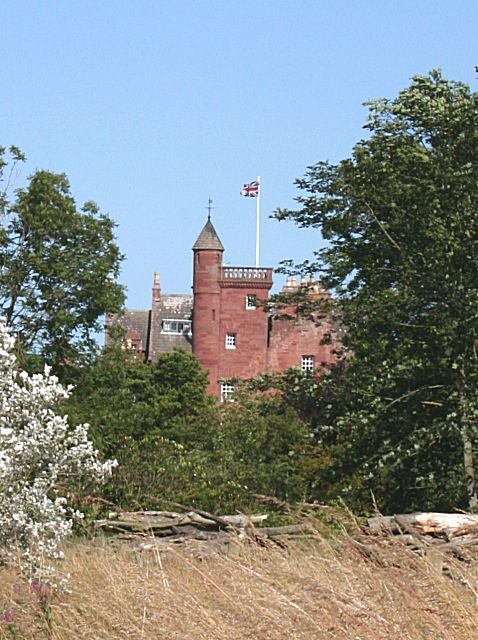
Red Castle
Red Castle stands as a significant high medieval hill castle located in Montrose, Angus, Scotland, overlooking the North Sea coast at Lunan Bay. Constructed in the 12th century primarily from the region's characteristic red sandstone, this fortress was originally established by King William the Lion in the late 1100s to defend against frequent Viking incursions. Beyond its military function, the castle also served as a royal hunting lodge, illustrating its dual role as a defensive stronghold and noble residence during the high medieval period.
Early history and royal connections
The earliest phase of Red Castle's construction was directly commissioned by King William I of Scotland, known as William the Lion, who recognized the strategic importance of securing the vulnerable eastern coastline of Scotland. The castle's position on elevated ground provided commanding views over Lunan Bay and the mouth of the Lunan Water, crucial for monitoring maritime activity and potential threats.
In 1194, William the Lion granted the castle and its surrounding lands near the village of Inverkeilor to Walter de Berkeley, the Great Chamberlain of Scotland. This transfer marked the beginning of the castle's association with prominent Scottish noble families. Upon Walter's death, ownership passed through marriage to Ingram de Balliol, who undertook significant rebuilding efforts, enhancing the castle's fortifications and residential quarters. The Balliol family maintained control for approximately two generations, until the early 14th century.
Ownership transitions and political upheaval
Following the death of the childless Ingram de Balliol around 1305, the castle passed to Henry de Fishburn, a descendant through the Balliol line. However, the turbulent period of Scottish history marked by the rise of Robert the Bruce led to the forfeiture of the castle. In 1328, Robert the Bruce granted Red Castle to the Earl of Ross, reflecting the shifting allegiances and land reallocations typical of the era.
The castle's name, rubeum castrum, Latin for "Red Castle," appears in documents from 1286, highlighting the distinctive red sandstone that defines its appearance and gives the castle its enduring name.
Siege and conflict in the late 16th century
The late 1500s brought renewed conflict to Red Castle during the turbulent times of Scottish noble rivalries. In 1579, James Gray, son of Patrick Gray, 4th Lord Gray, married Lady Elizabeth Beaton, the castle's owner. After a falling out with Lady Beaton, James Gray, with the assistance of his brother Andrew of Dunninald, laid siege to the castle for two years. This prolonged siege culminated in the castle's inhabitants being driven out by fire.
The severity of the siege prompted intervention by King James VI, who ordered John Erskine of Dun and his son Robert to bring siege engines and expel Gray, with support from the townspeople of Dundee. Following the siege, an inventory of the castle's contents was taken, and safe conduct was granted to John Stewart of Baldynneis, a poet and son of Elizabeth Beaton, to appear before the king. The conflict resulted in royal pardons for those involved in the siege, including Andrew Gray in 1582.
Decline and later history
By the late 16th century, Red Castle's strategic and residential importance waned. In 1590, the area near the castle was associated with a shipment of 12,000 gold crowns intended to support the Catholic cause in Scotland, linking the site to broader religious and political struggles of the period.
After this era, the castle gradually fell into decline. Although parts of the structure remained roofed until approximately 1770, it ceased to function as a noble residence. The last known occupant was James Rait, a minister from Inverkeilor, marking the end of the castle's residential use.
Today, Red Castle is recognized as a scheduled monument and has been protected as a category A listed building since 1971, underscoring its cultural and historical significance within Scotland's heritage.
Architectural features and surviving remains
Red Castle occupies a commanding position on a hill overlooking Lunan Bay, with views extending over the North Sea. The surviving ruins primarily consist of a 15th-century rectangular tower and a portion of the east curtain wall, which measures approximately two meters thick, reflecting its defensive purpose.
The castle's construction prominently features the local red sandstone, which not only provided durable building material but also gave the castle its distinctive appearance and name. The keep, dating from the 15th century, served as the fortified residence and last line of defense within the castle complex. The surrounding enceinte or curtain wall, parts of which may date back to the 13th century, enclosed the castle grounds and provided protection against attackers.
The tower's precarious location near the edge of the hill has led to concerns about its structural stability, with reports from 1999 describing it as being in "imminent danger of collapse." Preservation efforts are crucial to maintaining what remains of this historic fortress.
Archaeological significance
Archaeological excavations below the castle have uncovered a midden, or refuse heap, which is actively eroding and yielding numerous artifacts. These finds have been instrumental in shedding light on the daily lives of the castle's former inhabitants and are preserved in the Montrose Museum. The artifacts include domestic items and materials related to the castle's occupation over several centuries.
Visibility and location
Red Castle's ruins are prominently visible from major transportation routes, including the A92 road and the Edinburgh to Aberdeen railway line. Its strategic coastal location and distinctive red sandstone ruins make it a notable landmark along Scotland's eastern coastline.
Frequently asked questions (FAQ)
- How do I get to Red Castle?
- Red Castle is located in Montrose, United Kingdom, easily accessible by car and public transport. If traveling by train, the nearest station is Montrose, from which you can take a short taxi ride or enjoy a scenic walk to the castle.
- What is the historical significance of Red Castle?
- Red Castle dates back to the 13th century and is an important landmark in Scottish history. It has witnessed numerous historical events and changes in ownership, reflecting the turbulent history of the region.
- When was Red Castle built?
- Red Castle was originally constructed in the early 1200s, making it one of the oldest castles in Scotland. Over the centuries, it has undergone various renovations and restorations, preserving its historical integrity.
- Can I take guided tours of Red Castle?
- Yes, guided tours of Red Castle are available during the visiting season. Knowledgeable guides share fascinating stories about the castle's history, architecture, and the notable figures associated with it.
- Why is Red Castle famous for its architecture?
- Red Castle is renowned for its impressive medieval architecture, featuring a mix of defensive structures and residential quarters. The castle's design includes thick stone walls, tall towers, and intricate details that showcase the craftsmanship of its time.
- Is it possible to visit Red Castle year-round?
- Red Castle is typically open to visitors from April to October, with specific opening hours that may vary. During the winter months, access may be limited, so it's best to check ahead before planning your visit.
- What are the ticket prices for visiting Red Castle?
- Ticket prices for Red Castle vary based on age and group size, with discounts available for children and families. It's advisable to check the official website for the most current pricing and any special offers.
- What is the best time to visit Red Castle?
- The best time to visit Red Castle is during the summer months, from June to August, when the weather is typically milder and the gardens are in full bloom. Spring and early autumn can also be beautiful, offering fewer crowds and pleasant views.
- Are there any nearby attractions to Red Castle?
- Yes, several attractions are located near Red Castle, including Montrose Beach and the Montrose Basin Wildlife Reserve. Visitors can also explore local shops and restaurants in the charming town of Montrose after their visit to the castle.
Information
Website
Visit websiteSources & official resources
Verify the information above using these authoritative references.
Loading map...
Visitor reviews
No reviews yet. Been here? Write the first review and help other travelers!
Write the first reviewVisited this castle? Share your experience
Your review helps other travelers and adds first-hand knowledge to our encyclopedia.