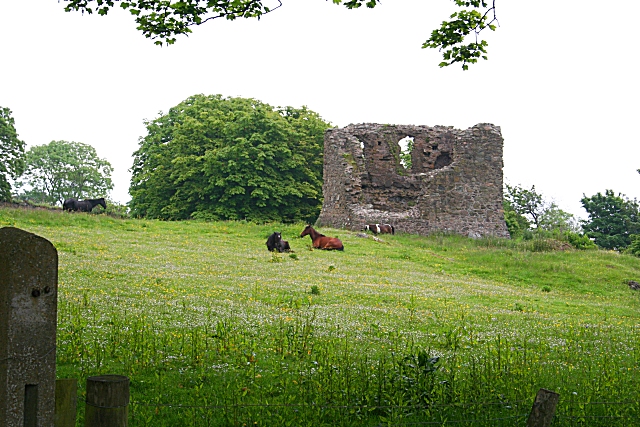
Red Bay Castle
Red Bay Castle stands on a prominent headland north of Glenariff and south of Cushendall along the scenic Causeway Coastal Route in County Antrim, Northern Ireland. This 13th-century hill castle occupies a strategic position overlooking the sea, commanding panoramic views that have underscored its military and political significance throughout the medieval and early modern periods.
The castle's origins trace back to the High Medieval period, when the Anglo-Norman Bissett family established the first fortification here. John and Walter Bissett, banished from Scotland in 1224 after being implicated in the murder of their uncle, built the initial castle on an earlier motte-and-bailey site. This early structure formed the foundation for the successive stone castle that would dominate the headland for centuries.
Historical background and ownership
The Bissetts' arrival in the region marked a significant shift in local power dynamics. Despite Ireland not being fully under English rule at the time, King Henry III granted Walter de Bisset extensive estates in the Barony of Glenarm, enabling the family to establish their stronghold at Red Bay. The castle became a focal point of Anglo-Norman influence in the area.
Through marriage alliances, Red Bay Castle passed into the hands of the MacDonnell family, a powerful Gaelic-Norman dynasty. John Mor MacDonald, the first Lord of Dunnyveg, secured the castle by marrying Margery Bissett, uniting two influential lineages. The MacDonnells undertook significant enhancements and expansions during the 16th century, reinforcing the castle's role as a regional seat of power.
Conflict and destruction in the 16th century
The 16th century was marked by intense conflict in Ulster, and Red Bay Castle was repeatedly embroiled in these struggles. In 1565, the castle was attacked and burned by Shane O'Neill, chieftain of the O'Neills of Tyrone, during his campaign to assert dominance over northern Ireland. This attack devastated the fortress, but Sorley Boy MacDonnell later rebuilt it, restoring its defensive capabilities.
17th-century restoration and final destruction
After a period of decline, the castle saw restoration efforts in 1604, briefly reviving its strategic importance. However, the tumult of the mid-17th century brought its final destruction. In 1652, during the Cromwellian conquest of Ireland, forces loyal to Oliver Cromwell demolished Red Bay Castle as part of their campaign to suppress Irish resistance. Since then, the castle has remained in ruins.
Architectural features and remains
Red Bay Castle is classified as a hill castle, built atop a rocky headland that provided natural defensive advantages. It occupies the site of an earlier Anglo-Norman motte, a raised earthwork typical of early medieval fortifications. The castle's successive rebuildings and expansions, particularly under the MacDonnells, resulted in a complex layering of stone structures.
Today, the castle survives as a small ruin with limited distinctive architectural features visible. The remains primarily consist of foundational stonework that hints at the castle's former layout and scale. Although detailed records of its architectural elements are scarce, the site’s location and surviving structures reflect its historical function as a fortified residence and military stronghold.
The castle's position on the headland offers commanding views across the surrounding landscape and the sea, emphasizing its strategic importance for controlling coastal access and monitoring maritime activity. This vantage point also contributes to the site's enduring cultural and heritage significance.
Access and preservation
Currently, Red Bay Castle is situated on private farmland, and public access is generally restricted. The site remains a valuable archaeological and historical landmark, representing centuries of conflict, alliance, and territorial control in Northern Ireland. Its ruined state serves as a tangible reminder of the region's turbulent past and the legacy of the families who shaped its history.
While the castle itself offers limited physical remains, its historical narrative and scenic location continue to attract interest from historians, archaeologists, and visitors exploring the rich heritage of County Antrim and the Causeway Coast.
Frequently asked questions (FAQ)
- How do I visit Red Bay Castle?
- Red Bay Castle is located on private farmland near Glenariff, County Antrim, and public access is generally restricted. Visitors should respect property boundaries and check local guidelines before planning a visit.
- What is the historical significance of Red Bay Castle?
- Red Bay Castle played a key role in the medieval and early modern history of Northern Ireland, serving as a stronghold for the Bissett and MacDonnell families and witnessing significant conflicts such as the attack by Shane O'Neill in 1565.
- When was Red Bay Castle originally built?
- The first castle at Red Bay was built in the 13th century by the Bissett family on an earlier motte-and-bailey site, marking its origins in the High Medieval period.
- Why was Red Bay Castle destroyed?
- The castle was destroyed multiple times due to regional conflicts, including being burned by Shane O'Neill in 1565 and finally demolished by Cromwellian forces in 1652 during the conquest of Ireland.
- Are there any notable architectural features at Red Bay Castle?
- Today, Red Bay Castle is mostly a ruin with limited visible architectural features. It was originally built on a motte and expanded in the 16th century, but only foundational stonework remains.
Information
Address
Kilnadore Road, Northern Ireland
Loading map...
Visitor reviews
No reviews yet. Been here? Write the first review and help other travelers!
Write the first reviewVisited this castle? Share your experience
Your review helps other travelers and adds first-hand knowledge to our encyclopedia.