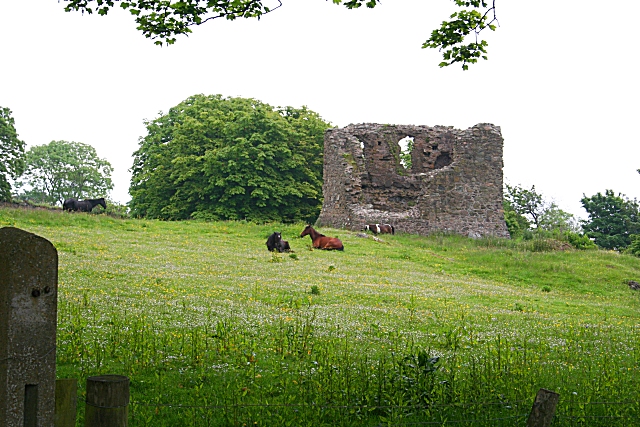
Castle Carra
Castle Carra is a remarkable example of a late medieval square tower house located in a field north of the coastal village of Cushendun, County Antrim, Northern Ireland. This castle, dating back to the early 14th century, stands on a site of significant historical importance, built over a Mesolithic flint working site. Its strategic position near the coast and the harbor of Cushendun, known as Murlough Bay, highlights its role in regional power struggles and defense during the medieval period.
Architectural features and construction
Castle Carra is characterized by its square tower house design, typical of the period, with a surrounding bawn—a defensive walled courtyard. The castle's dimensions resemble those of a tower house, but it also exhibits characteristics of a hall house, suggesting a blend of residential and defensive functions. The bawn was later fortified with a circular flanker equipped with gunloops facing inland, an enhancement attributed to Captain William Bowen in the late 16th century. This feature reflects the adaptation of the castle's defenses to the evolving military technology of the time, particularly the use of firearms.
Historical context and notable events
Ownership and conflicts in the 16th century
The castle has a rich history intertwined with prominent Irish figures and turbulent events. In 1565, it was owned by Shane O'Neill, a powerful self-proclaimed Earl of Ulster. During this time, Sorley Boy McDonnell, a notable Irish chieftain, was imprisoned within Castle Carra. The complex relationship between the O'Neills and the McDonnells culminated in a dramatic event in 1567. After being defeated by Shane O'Neill, the McDonnells hosted him at Castle Carra for two days of hunting and feasting. On the third day, amid a quarrel, they assassinated O'Neill to avenge their earlier defeat. His head was severed and sent to the representatives of Queen Elizabeth I in Dublin, symbolizing the intense political and clan rivalries of the era.
Siege and defense
In 1585, the castle was besieged by English forces during a period of increasing English intervention in Ireland. Donnell Gorm McDonnell was trapped inside the tower, but his father, Sorley Boy McDonnell, then aged eighty, heroically landed from Scotland and successfully drove off the besiegers. This event underscores the castle's strategic military importance and the resilience of its defenders during the turbulent Elizabethan conquest of Ireland.
Later ownership and usage
By around 1730, Castle Carra was occupied by the Lynch family, a notable Anglo-Irish lineage. The castle's lands had passed through various hands, including surrender to the Crown in the 1570s and a grant to Captain William Bowen. The Lynch family, including Sir Roebuck Lynch and later Sir Henry Lynch, 3rd Baronet, held the castle and its surrounding lands into the 19th century. The Cromwellian confiscations of the early 17th century also impacted ownership, with compensation lands granted at Castle Carra.
Cultural significance and current state
At the end of the medieval period, the ruins of Castle Carra were repurposed as a children's cemetery, adding a layer of cultural and social history to the site. Today, the castle stands in a state of ruins, overgrown with ivy and surrounded by private farmland. The field is used for grazing horses and llamas, which act as informal guardians of the site, limiting public access. Despite its ruined condition, Castle Carra remains an evocative monument to the complex history of Northern Ireland's medieval past.
Archaeological importance
The castle's foundation on a Mesolithic flint working site highlights the long-term human significance of the location, extending far beyond the medieval period. This archaeological context enriches the understanding of the site, revealing layers of human activity from prehistoric times through the medieval era.
Visiting information and accessibility
Castle Carra is situated approximately 2.5 kilometers west of Carnacon, on the east bank of Lough Carra. The castle lies on private property, and access is generally restricted. Visitors should be aware of the presence of grazing animals, including llamas, which are protective of the area. Due to its condition and location, the site is best appreciated from a distance or with permission from the landowners.
Frequently asked questions (FAQ)
- How do I get to Castle Carra?
- Castle Carra is located in Cushendun, accessible by car or public transport from nearby towns. The nearest major city is Ballymena, which is approximately 25 miles away. There is ample parking available for visitors who choose to drive.
- What is the historical significance of Castle Carra?
- Castle Carra was built in the 16th century and served as a stronghold for the local Gaelic chieftains. Its strategic position allowed it to control the surrounding lands and waterways, making it a key site in the region's history. Today, it stands as a testament to the turbulent past of Northern Ireland.
- When was Castle Carra built?
- Castle Carra was constructed in the late 1500s, during a period of significant conflict and change in Ireland. Its architecture reflects the defensive needs of the time, featuring thick walls and a commanding view of the surrounding area. This makes it a fascinating site for those interested in medieval history.
- Can I take photographs inside Castle Carra?
- Yes, visitors are welcome to take photographs both inside and outside Castle Carra. However, it is advisable to be respectful of the historical artifacts and the surrounding environment while taking pictures. This allows everyone to enjoy the beauty of the castle without disruption.
- Why is Castle Carra a popular tourist destination?
- Castle Carra attracts visitors due to its rich history, stunning architecture, and picturesque location overlooking the countryside. The castle offers a unique glimpse into Ireland's past and provides opportunities for exploration and photography. Additionally, its proximity to the scenic Antrim Coast enhances its appeal.
- Is it possible to enter Castle Carra?
- Access to Castle Carra may vary depending on preservation efforts and scheduled maintenance. While certain areas may be open for exploration, some sections could be restricted for safety reasons. It’s best to check in advance for any visitor guidelines before planning your visit.
- What are the opening hours for Castle Carra?
- Castle Carra typically opens to visitors from 10 AM to 5 PM, but hours may vary seasonally. It is recommended to check the official website or contact local tourism information for the most current opening times. This ensures a smooth visit without unexpected closures.
- What are some nearby attractions to Castle Carra?
- Visitors to Castle Carra can enjoy other nearby attractions, including the beautiful Cushendun Beach and the picturesque village of Cushendun itself. The famous Giant's Causeway is also within a short drive, providing an excellent opportunity for a full day of exploration. These sites complement a visit to Castle Carra beautifully.
- What are the ticket prices for Castle Carra?
- Ticket prices for Castle Carra can vary, but they are generally affordable, making it accessible for families and individuals alike. Special discounts may be available for students, seniors, or groups. It's advisable to check for any promotional offers before your visit to get the best deal.
Information
Address
Torr Road, Cushendun, County Antrim, Northern Ireland
Loading map...
Visitor reviews
No reviews yet. Been here? Write the first review and help other travelers!
Write the first reviewVisited this castle? Share your experience
Your review helps other travelers and adds first-hand knowledge to our encyclopedia.