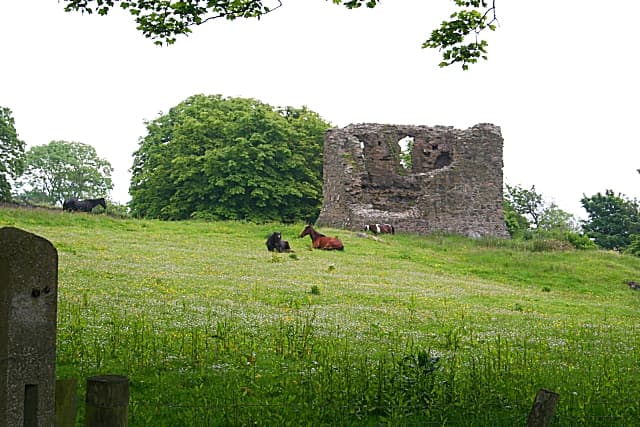
Carra Castle
Carra Castle, located just north of Cushendun in County Antrim, Northern Ireland, stands as a significant medieval ruin with a history stretching back to the early 14th century. This hill castle was constructed during the late medieval period and occupies a site that reveals layers of human activity dating to the Mesolithic era, as evidenced by archaeological finds of flint tool production beneath its foundations. The castle's strategic position near the coastal edge of Cushendun harbour provided commanding views over the surrounding waters, an important factor in its defensive and residential functions.
Medieval origins and strategic importance
Built primarily from rough, uncut local stone, Carra Castle was designed as a square tower house, a style that melded the defensive features of a tower with the communal living spaces of a hall house. This architectural form was common in Ireland during the 14th to 16th centuries, reflecting the need for fortified residences that also served as noble homes. The castle's robust stone walls and elevated position on a hill made it a formidable stronghold during the turbulent medieval era.
Historical significance and clan conflicts
Throughout the 16th century, Carra Castle played a pivotal role in the power struggles among Irish noble families. It was notably held by Shane O’Neill, an influential Irish king known for his resistance against English rule. In 1565, the castle was used to imprison Sorley Boy McDonnell, a prominent chieftain of the McDonnell clan. Following his defeat by O’Neill, the McDonnells hosted a hunting and feasting event at the castle, which ended violently with the death of O’Neill at the hands of the McDonnells. His severed head was sent to the English authorities at Dublin Castle, marking a grim chapter in the castle's history.
In 1585, the castle was the site of a siege when Donnell Gorm MacDonnell was besieged by English forces. The siege was lifted when Sorley Boy McDonnell arrived by sea and successfully drove off the attackers, demonstrating the castle's strategic maritime significance. By the early 18th century, ownership of the castle had passed to the Lynch family, indicating a shift from military to domestic use.
Architectural features and current condition
The surviving ruins of Carra Castle today include the remains of the square tower house, characterized by its substantial stone walls and simple, functional design. Unlike many other castles, Carra Castle lacks decorative elements such as inscriptions or altars, emphasizing its utilitarian purpose. The structure combines the defensive qualities of a tower house with the spatial arrangement of a hall house, featuring a large communal room that would have served as the main living and gathering area.
Over the centuries, the castle has fallen into ruin, with its walls partially standing and overgrown with ivy and natural vegetation. The site remains a visible monument to the layered history of the region, from prehistoric toolmakers to medieval kings and clans. The nearby area also served as a children's burial ground during medieval times, adding to the site's cultural significance.
Archaeological and cultural importance
Archaeological investigations at the site have revealed Mesolithic flint-working remains beneath the castle, highlighting the long-term human occupation of the location. This continuity of use from prehistoric times through the medieval period adds depth to the understanding of Carra Castle's place in Irish history. The castle's ruins provide valuable insights into medieval construction techniques and the social dynamics of the period.
Today, Carra Castle is recognized as an important historical and archaeological site in Northern Ireland. Its ruins offer a tangible connection to the complex history of clan rivalries, English-Irish conflicts, and everyday life in medieval Ireland. Visitors to the site can appreciate the castle's strategic setting and imagine the events that unfolded within its walls centuries ago.
Frequently asked questions (FAQ)
- What is the historical significance of Carra Castle?
- Carra Castle was a key stronghold in 16th-century Ireland, associated with notable figures like Shane O’Neill and Sorley Boy McDonnell, and witnessed important clan conflicts.
- Can visitors access the ruins of Carra Castle?
- The ruins of Carra Castle are located in a field near Cushendun and can be viewed from the outside, but there are no formal visitor facilities or guided tours on site.
- When was Carra Castle built and what architectural style does it represent?
- Carra Castle was built in the 14th century and is an example of a late medieval square tower house, combining defensive features with residential hall house elements.
- Why is the location of Carra Castle strategically important?
- Situated on a hill near the coast and Cushendun harbour, Carra Castle offered strategic oversight of maritime routes and surrounding lands, crucial for defense and control.
- What archaeological findings have been discovered at Carra Castle?
- Archaeological evidence includes Mesolithic flint-working remains beneath the castle, indicating the site’s long history of human activity before the medieval period.
Photo gallery

Information
Website
Visit websiteSources & official resources
Verify the information above using these authoritative references.
Loading map...
Visitor reviews
No reviews yet. Been here? Write the first review and help other travelers!
Write the first reviewVisited this castle? Share your experience
Your review helps other travelers and adds first-hand knowledge to our encyclopedia.



