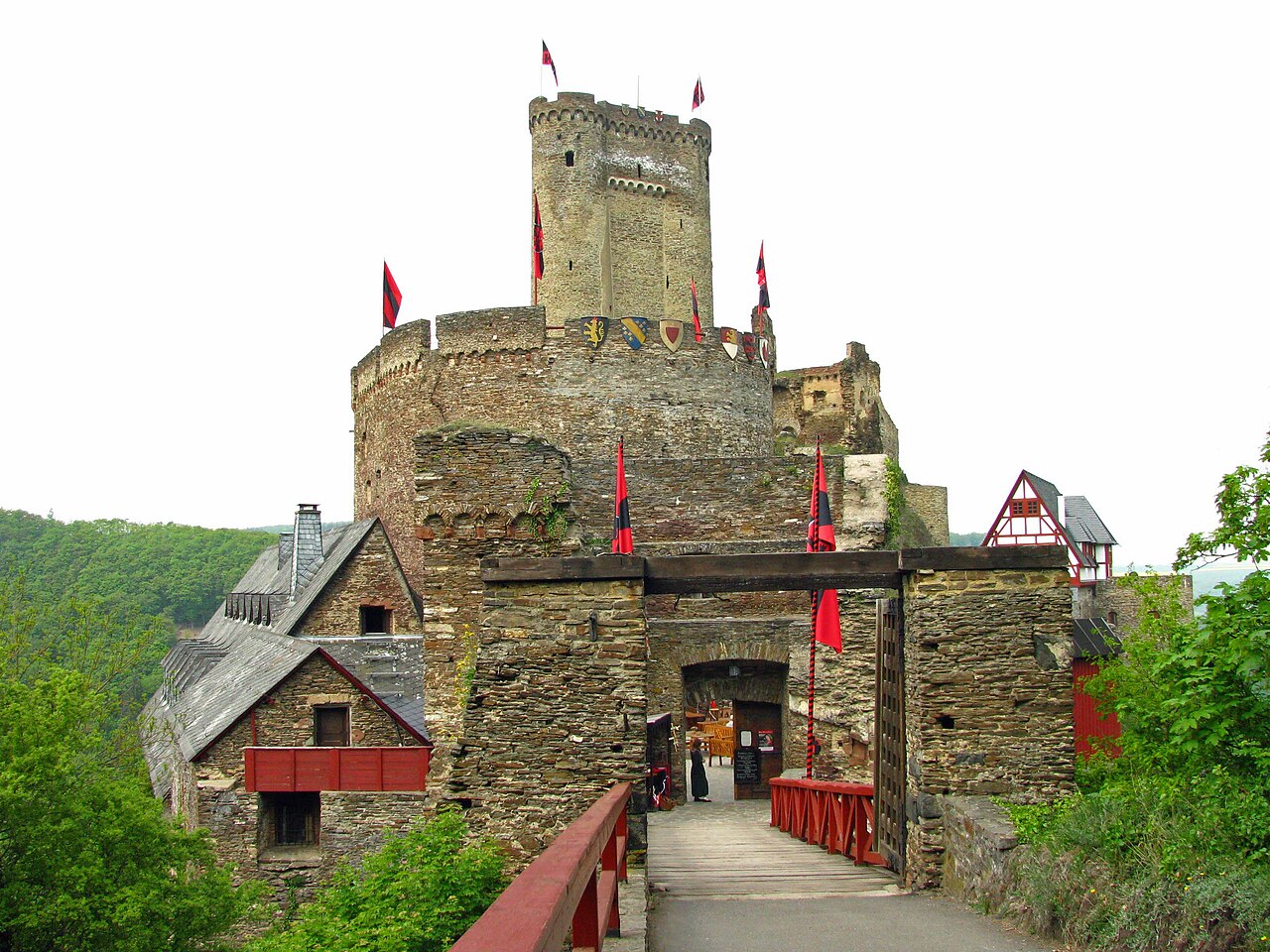
Rauschenburg Castle
Rauschenburg Castle is a late medieval fortress ruin situated above the Ehrbach stream in the parish of Mermuth, within the Hunsrück-Mittelrhein region of Germany. Constructed in 1332 by Archbishop Baldwin of Luxembourg during the Eltz Feud, this castle served as a strategic counter-fortress to subdue rebellious vassals holding the nearby castles of Waldeck, Schöneck, and Ehrenburg. Its primary purpose was to assert the authority of the Archbishopric of Trier over these joint tenants who challenged their feudal obligations.
Historical context and strategic importance
The castle's construction came at a time of feudal conflict in the region, where the Archbishopric sought to consolidate power over local noble families. The Eltz Feud was a notable conflict involving multiple castles and their occupants resisting ecclesiastical overlordship. By erecting Rauschenburg as a counter castle, Archbishop Baldwin effectively established a military foothold to control the surrounding area and suppress the uprising.
Over time, the castle was enfeoffed to various noble families, including the Schönecks, von Eichs, Waldbott of Bassenheim, and Boos of Waldeck. This division of tenancy reflects the castle's role as a shared stronghold within the feudal system, balancing power among regional aristocracy while maintaining allegiance to Trier.
Architectural layout and defensive features
Rauschenburg Castle is characterized by its pentagonal enceinte, a defensive wall enclosing the main castle area. Surrounding this inner wall, almost the entire site is further protected by a second, lower defensive wall, enhancing its fortification against attackers. The castle's location on a saddle above the Ehrbach stream provided natural defensive advantages, with a neck ditch cutting across the uphill side. This ditch served as the first line of defense, impeding any direct assault from higher ground.
The remains of the gateway and the foundations of the bridge that once spanned the neck ditch are still visible, offering insight into the castle's original access points. The site is accessible today via two surviving gates, while a third gate in the southeastern section of the outer wall was likely sealed during the Middle Ages, possibly to strengthen defenses or control movement.
The inner bailey and residential structures
Within the inner bailey, visitors can observe the ruins of residential buildings that housed the castle's occupants. These structures would have included living quarters, administrative rooms, and service areas essential to the functioning of the castle as both a military and domestic center.
The bergfried and towers
At the center of the western part of the enceinte stand the remains of a tower, believed to be the original bergfried. This tower likely served as the main stronghold and lookout point, a common feature in castles of this period designed to provide a final refuge during sieges and to assert dominance over the surrounding landscape.
Cultural and heritage significance
Today, Rauschenburg Castle remains a partially preserved medieval ruin that attracts visitors interested in medieval architecture and feudal history. Its strategic design, historical associations with the Archbishopric of Trier, and connection to the Eltz Feud make it a valuable site for understanding the complex power dynamics of the late medieval period in this part of Germany.
The castle's ruins provide a tangible link to the region's turbulent past, illustrating the military and political strategies employed by ecclesiastical rulers to maintain control over rebellious nobles. Preservation efforts focus on maintaining the structural remains, including the enceinte walls, gates, and tower foundations, to allow ongoing study and public engagement.
Visiting Rauschenburg Castle
Visitors to Rauschenburg Castle can explore the ruins set in a scenic landscape above the Ehrbach stream. The site offers an evocative glimpse into medieval fortification techniques, with visible defensive features such as the neck ditch and multiple layers of walls. While the castle is a ruin, its layout and surviving elements provide valuable insights into the architectural and military design principles of the 14th century.
The castle's location in the Hunsrück-Mittelrhein region makes it accessible for those interested in combining historical exploration with the natural beauty of the surrounding German countryside.
Information
Loading map...
Visitor reviews
No reviews yet. Been here? Write the first review and help other travelers!
Write the first reviewVisited this castle? Share your experience
Your review helps other travelers and adds first-hand knowledge to our encyclopedia.