Râșnov
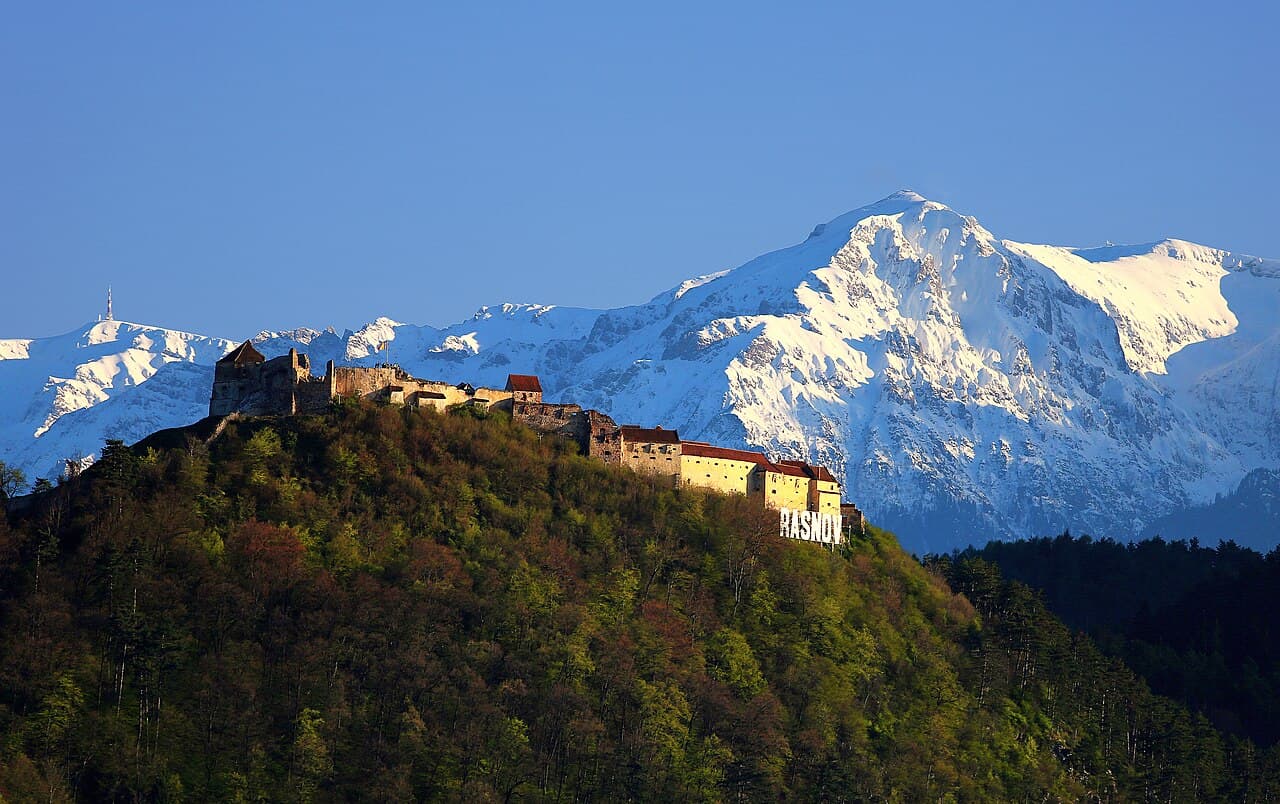
Râșnov Fortress, located in the town of Râșnov in the Brașov region of Romania, is a remarkable example of a Renaissance bastioned fortress that served as a vital refuge for local communities during times of conflict. Perched atop a prominent hill, this fortress is one of the best-preserved examples of so-called "peasant castles" unique to the Transylvanian region. These fortifications were specifically designed as refuges for villagers, rather than noble residences, providing shelter and protection during invasions and sieges.
The strategic location of Râșnov Fortress on a raised plateau with steep natural cliffs on several sides offered formidable defense advantages. The fortress complex extends over a length of approximately 300 meters and a width close to 150 meters, encompassing both upper and lower sections separated by a fortified wall running along rocky outcrops. This natural topography was expertly integrated into the fortress's defensive design, with steep slopes and a sheer cliff forming natural barriers that complemented the man-made fortifications.
Early history and origins
The hill where Râșnov Fortress stands has been occupied since the Iron Age, with archaeological evidence indicating a settlement during the Roman period known as Cumidava, inhabited by the Dacians. The medieval fortress's origins are often linked to the Teutonic Knights, who were invited to the Burzenland region by King Andrew II of Hungary in 1211. However, their presence was short-lived, as they were expelled in 1225 due to political conflicts aimed at reducing Hungarian influence. Some historians debate the extent of the Teutonic Knights' role in the fortress's initial construction, citing a lack of definitive evidence.
The first documented mention of the fortress dates back to 1331, where it is noted as one of two castles that withstood a devastating Tatar invasion ravaging the Burzenland area. Initially, the fortress belonged to the local lords of Râșnov, who likely built the first defensive walls and a rectangular chapel dedicated to Saint George with a semicircular apse. By the mid-14th century, the fortress came under royal administration, though the local lords retained some influence through appointed governors.
Fortification and community refuge role
With the increasing threat of Ottoman incursions in the 15th century, King Sigismund of Luxembourg transferred ownership of the fortress to the local community in 1427. From this point onward, Râșnov Fortress served as a communal refuge for the inhabitants of Râșnov, Cristian, and Vulcan villages. Significant fortification efforts throughout the 15th and 16th centuries transformed the site into a robust bastioned fortress capable of withstanding prolonged sieges.
The fortress's defensive walls reached heights of about 5 meters and were over a meter thick, reinforced by multiple bastions. The eastern side was particularly well-fortified, featuring a large semicircular barbican approximately 20 meters in diameter with two defensive levels and a central five-sided, two-story tower. These structures were adapted for the use of firearms, reflecting advances in military technology during the Renaissance period. Additional defensive towers included a rectangular tower on the northern end and a triangular tower on the southern wall, both designed for gunpowder weaponry.
Access to the fortress was controlled through the eastern entrance, which passed through the square Báthory Tower into the outer courtyard, known as the "courtyard before the fortress" or "fortress garden." This area housed essential facilities such as stables, workshops, and vegetable gardens, supporting the community during sieges. The 14th-century chapel of Saint George also stood in this outer courtyard.
The fortress as a small fortified town
Inside the upper fortress, the Saxon inhabitants constructed over 80 houses along narrow cobbled streets, along with a school, creating a fortified village within the walls. This setup allowed the local population to take refuge with their families and possessions, effectively turning the fortress into a small, self-sufficient town during times of danger.
Sieges, resilience, and later history
Despite multiple sieges, Râșnov Fortress was captured only once, in 1612, during a campaign by the Transylvanian prince Gabriel Báthory aimed at curbing Saxon autonomy. His forces surrounded the fortress, cutting off the defenders' water supply, which forced their surrender on April 3rd. The following year, the fortress was ransomed back by the Saxons for 3,000 florins. This experience prompted the construction of a deep well, completed between 1623 and 1640, reaching a depth of 146 meters. This well significantly enhanced the fortress's capacity to endure sieges by securing an internal water source.
In 1650, a new church was built at the highest point of the upper fortress, marking continued community investment in the site. However, in 1718, a devastating fire caused significant damage, though the fortress was subsequently rebuilt. Another major setback occurred in 1802 when a strong earthquake caused extensive structural damage, including cracked walls and collapsed buildings.
The fortress last served as a refuge during the Hungarian Revolution of 1848-49. After 1850, its military importance declined, and it was gradually abandoned, falling into ruin. A lone guard remained to watch over the site, using bells to warn of fires.
Modern restoration and cultural significance
In 1923, the Râșnov town council offered the fortress to Prince Carol of Romania, but he showed little interest. Plans for restoration emerged in 1937 but were halted by the 1940 earthquake and World War II. Conservation efforts began in the 1950s, with further restoration in the 1990s allowing public access. Today, Râșnov Fortress stands as a striking landmark visible from afar, embodying the unique heritage of the Transylvanian Saxons' communal defense architecture.
Unlike noble castles, these "peasant castles" lack grand residential palaces but feature extensive defensive infrastructure designed to protect entire communities. Visitors can explore partially restored walls, bastions, barbicans, and a deep well, as well as more than 30 houses lining the fortress's narrow streets. Some buildings now serve as shops and galleries, though many advocate for their use as museum spaces to better interpret the fortress's historical role and daily life.
The fortress offers panoramic views of the surrounding landscape, providing a tangible connection to the region's turbulent history and the resilience of its people. It remains an important cultural and historical monument, attracting tourists interested in medieval military architecture and Transylvanian heritage.
Frequently asked questions (FAQ)
- How do I get to Râșnov Castle?
- Râșnov Castle is easily accessible by car, with ample parking available nearby. If using public transport, you can take a train to Râșnov and then a short taxi ride or a pleasant walk to the castle.
- What is the historical significance of Râșnov Castle?
- Râșnov Castle dates back to the 13th century and played a crucial role in defending the region against invasions. Its strategic location provided a vital lookout point and shelter for the local population during turbulent times.
- When was Râșnov Castle built?
- Construction of Râșnov Castle began in 1211, making it one of the oldest fortifications in the region. The castle was expanded and fortified over the centuries, reflecting the architectural styles of different eras.
- Can I explore the castle grounds?
- Yes, visitors can freely explore the extensive grounds of Râșnov Castle. There are various paths leading to the castle walls, offering stunning views of the surrounding landscape and opportunities for photography.
- Why is Râșnov Castle popular among tourists?
- Râșnov Castle is popular due to its impressive medieval architecture, rich history, and breathtaking views of the Carpathian Mountains. It also features fascinating exhibitions that bring the castle's past to life for visitors.
- Is it possible to visit Râșnov Castle year-round?
- Yes, Râșnov Castle is open to visitors year-round, although hours may vary seasonally. It’s advisable to check the official website for the most current opening hours before planning your visit.
- What are the ticket prices for visiting Râșnov Castle?
- As of now, the ticket prices for Râșnov Castle are quite reasonable, typically around 20 RON for adults and discounted rates for children and students. Tickets can be purchased on-site or sometimes online for convenience.
- What is the best time to visit Râșnov Castle?
- The best time to visit Râșnov Castle is during the spring and early autumn months when the weather is mild and the landscape is vibrant. Summer can be crowded, while winter offers a unique charm with snow-covered views.
- Are there any nearby attractions to visit after Râșnov Castle?
- Yes, after exploring Râșnov Castle, visitors can check out the nearby Bran Castle, famously associated with the Dracula legend, as well as the scenic Piatra Craiului National Park for hiking and nature walks.
Photo gallery

Information
Loading map...
Visitor reviews
No reviews yet. Been here? Write the first review and help other travelers!
Write the first reviewVisited this castle? Share your experience
Your review helps other travelers and adds first-hand knowledge to our encyclopedia.