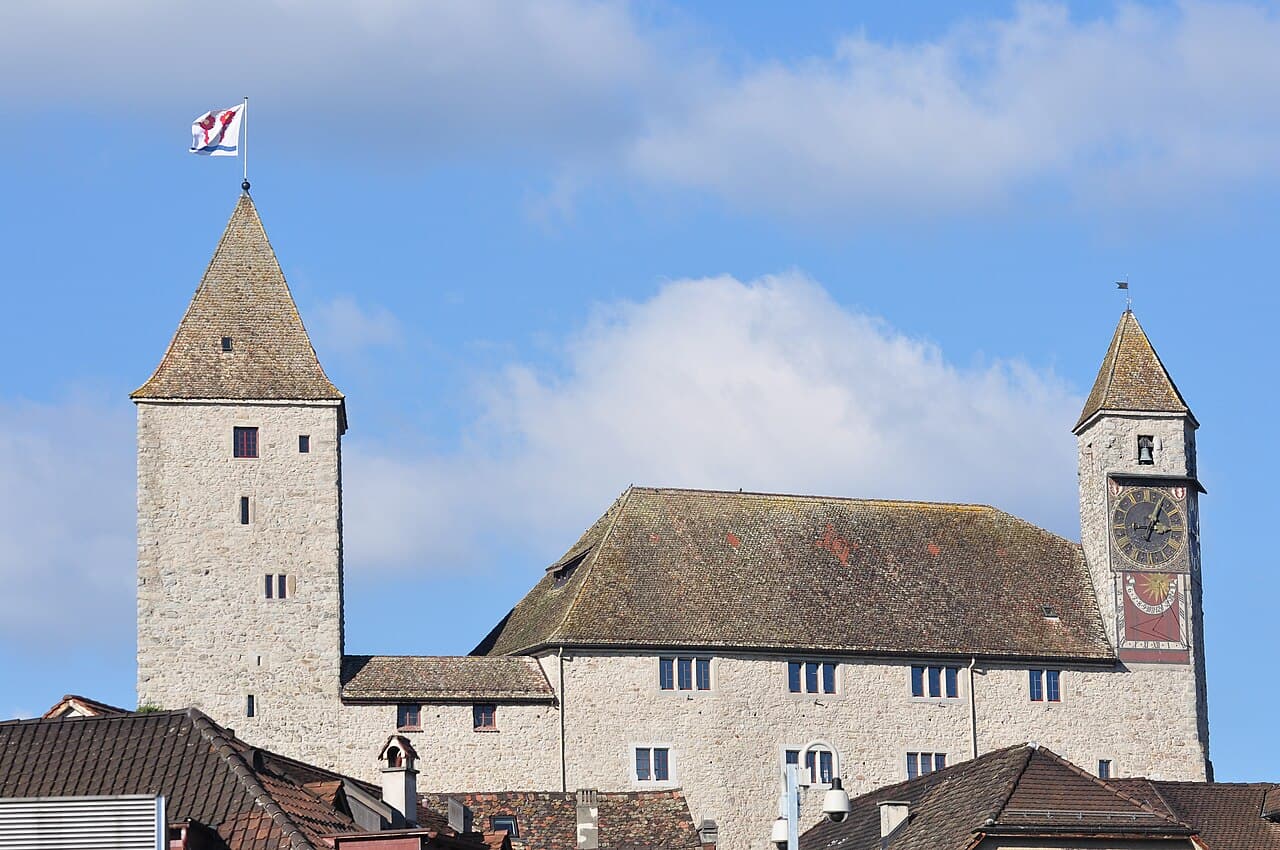
Rapperswil Castle
Rapperswil Castle is a prominent hill castle located in the town of Rapperswil within the canton of St Gallen, Switzerland. Perched on a rocky outcrop projecting into Lake Zurich, the castle is surrounded on three sides by water, providing natural defense and commanding views over the historic old town and the strategic waterway connecting Walensee and Lake Zurich. This location also controlled the medieval trade and pilgrimage routes, including the important Gotthard Pass route between Lombardy and Zurich and the Jakobsweg to Einsiedeln Abbey.
The castle was constructed in the early 13th century, approximately between 1200 and 1220, by the noble House of Rapperswil, specifically by Count Rudolf II and his son Rudolf III von Rapperswil. It marked the relocation of the Rapperswil nobility from Altendorf (Alt-Rapperswil) to this more defensible peninsula near the Seedamm causeway. The castle and the surrounding town walls were built using sandstone quarried from the nearby Lützelau island. The initial structure included a chapel outside the castle walls, separated by a trench, which served as an ossuary and later developed into the Liebfrauenkapelle, dating from around 1220 to 1253.
Historical significance and ownership
The Counts of Rapperswil became extinct in 1283 with the death of Count Rudolf V. Subsequently, their fiefs passed to Emperor Rudolf I and later to the houses of Homberg and Habsburg-Laufenburg through marital ties. The castle and its lordship played a crucial role in regional politics, especially during the turbulent times of the 14th century. In 1350, an attempted coup against the city of Zurich by aristocratic opposition centered around Count Johann II of Habsburg-Laufenburg failed. In retaliation, the mayor of Zurich, Rudolf Brun, destroyed the town walls and castle of Rapperswil.
The castle was rebuilt by Albrecht II, Duke of Austria, between 1352 and 1354, who transformed the castle into an almost equilateral triangular fortress with three corner towers. The southwest tower, known as the Gügeliturm, served as the donjon and watchtower, while the eastern Zeitturm (clock tower) features three bells, a sundial, and two large clock faces. The northwest corner is fortified by the Pulverturm (powder tower). The castle also had a drawbridge from 1698 to 1837 at the lower gate near the former castle chapel.
After the extinction of the Habsburg-Laufenburg line in 1442, the castle became the property of the town of Rapperswil. From 1458 until 1798, during the Old Zurich War and its aftermath, the castle served as an administrative and military base under the control of the Swiss Confederation, specifically as a Gemeine Herrschaft jointly governed by two cantons. It functioned as a prison and a Vogt's seat during this period.
Architectural features and layout
Rapperswil Castle's layout is characterized by its nearly equilateral triangular shape, with each corner reinforced by a robust tower. The Gügeliturm in the southwest is the tallest tower and historically housed the guard who warned residents of approaching dangers or fires. The eastern Zeitturm contains the castle's clock and bells, while the northwest Pulverturm served as the powder magazine.
The central structure between the towers is a six-story palais that housed the castle's main residential and administrative functions. The castle walls include battlements and ramparts, which connect the towers and provide defensive walkways. The castle's original chapel was located outside the walls, separated by a defensive trench, reflecting medieval ecclesiastical and defensive planning.
Interior and current use
Inside the castle, the Polish National Museum has been housed since 1870, established by Polish émigrés led by Count Wladyslaw Broel-Plater, who restored the castle after it had fallen into disrepair. The museum preserves and showcases Polish cultural heritage and history, serving as a symbol of Swiss-Polish friendship. The castle also contains the Schloss Restaurant and offers guided tours by appointment, including access to the impressive Rittersaal (knight's hall) and historical wooden architecture.
Herbal garden and public access
Since 2011, the castle's tower, battlements, and a newly established herbal garden have been opened to the public as part of a local initiative to enhance the castle's role as a cultural and tourist attraction. The castle's elevated position provides panoramic views of the old town, Lake Zurich, the Seedamm causeway, the Frauenwinkel protected area, and the distant Glarus Alps.
Surrounding area and cultural traditions
The castle stands atop the Lindenhof hill, historically known as Schlossberg, which hosts the oldest vineyard on Lake Zurich's shore, first mentioned in 981 AD. The hill also features the Polish freedom pillar, a symbol of solidarity with those who struggle for freedom, and a rose garden. Nearby is the Deer Park, home to a small herd of fallow deer, linked to local legends about the castle's founding.
Rapperswil is known for its vibrant cultural traditions, including the Eis-zwei-Geissebei carnival festival held on Shrove Tuesday, which may have origins linked to the siege and destruction of the town during the 14th century conflicts.
Archaeological and heritage significance
While some hypotheses suggest a Roman watchtower may have preceded the castle, no archaeological evidence has yet confirmed this. Due to the castle's continuous use and structural conditions, extensive archaeological excavations have not been conducted. The castle and the Polish Museum are recognized as Class A objects of national importance in the Swiss inventory of cultural property, highlighting their cultural and historical value.
Rapperswil Castle remains a significant monument reflecting the region's medieval history, architectural evolution, and cultural connections, particularly between Switzerland and Poland. Its restoration and continued use as a museum and cultural site ensure its preservation for future generations.
Frequently asked questions (FAQ)
- How do I get to Rapperswil Castle?
- Rapperswil Castle is conveniently located in Rapperswil, Switzerland, and is accessible by public transportation, including trains and buses. If you are driving, there are parking facilities nearby. The castle is also within walking distance from the Rapperswil train station, making it easy for visitors to reach.
- What is the historical significance of Rapperswil Castle?
- Rapperswil Castle, built in the 13th century, has played a vital role in the region's history as a strategic fortification. It served as a residence for various noble families and has witnessed many historical events over the centuries. Today, it stands as a symbol of Rapperswil's rich heritage and is a popular tourist attraction.
- When was Rapperswil Castle built?
- Rapperswil Castle was constructed in 1220 by the Counts of Rapperswil. Its strategic position on the upper Lake Zurich made it an important military stronghold during the Middle Ages. Over the years, it has undergone several renovations, preserving its historical architecture.
- Can I visit Rapperswil Castle year-round?
- Yes, Rapperswil Castle is open to visitors throughout the year. However, certain areas may have limited access during winter months due to weather conditions. It's advisable to check the castle's official website for any seasonal updates or specific closure dates.
- Why is the architecture of Rapperswil Castle unique?
- The architecture of Rapperswil Castle reflects a mix of medieval and modern influences, showcasing its evolution over the centuries. The castle features impressive towers, fortified walls, and beautiful views of Lake Zurich. This blend of styles makes it a fascinating site for architecture enthusiasts and history buffs alike.
- Is it possible to host events at Rapperswil Castle?
- Yes, Rapperswil Castle offers facilities for hosting various events, including weddings, conferences, and private gatherings. The stunning backdrop and historical ambiance create a unique atmosphere for any occasion. Interested parties should contact the castle's management for more information on booking and arrangements.
- What are the opening hours of Rapperswil Castle?
- Rapperswil Castle typically opens to visitors daily, with hours varying by season. In the summer, the castle is generally open from 9 AM to 7 PM, while winter hours may be shorter. Always check the official website for the most current opening times before your visit.
- What are the ticket prices for visiting Rapperswil Castle?
- Ticket prices for Rapperswil Castle are quite reasonable, with discounts available for children, students, and seniors. General admission typically grants access to the castle grounds and its exhibitions. It's best to verify the latest ticket prices on the official website or at the entrance before your visit.
- What are some nearby attractions to Rapperswil Castle?
- Nearby attractions include the beautiful Rose Gardens of Rapperswil, the picturesque old town, and the scenic promenade along Lake Zurich. Visitors can also explore the local museums and enjoy outdoor activities like hiking and biking in the surrounding areas. This makes Rapperswil Castle an excellent starting point for further exploration.
Photo gallery

Information
Loading map...
Visitor reviews
No reviews yet. Been here? Write the first review and help other travelers!
Write the first reviewVisited this castle? Share your experience
Your review helps other travelers and adds first-hand knowledge to our encyclopedia.



