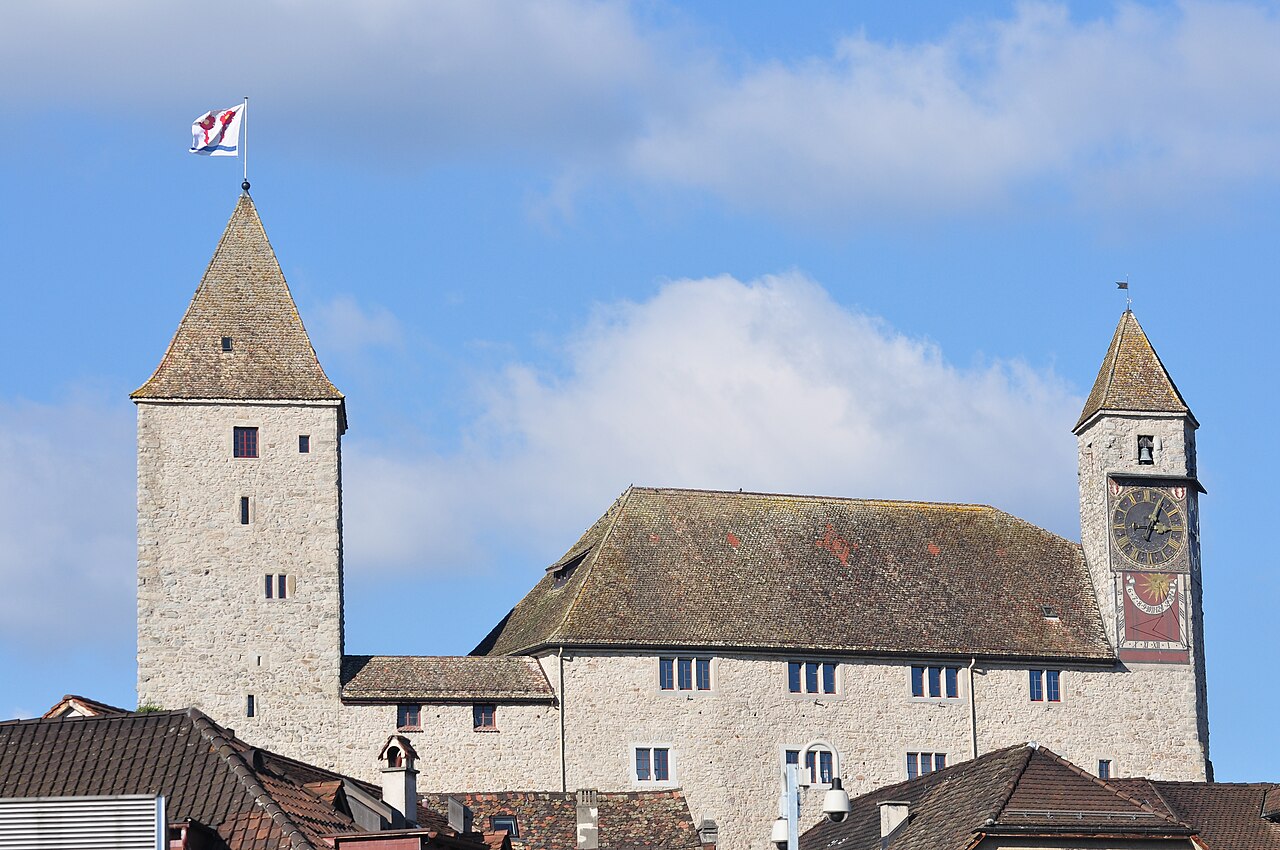
Freienbach Castle
Freienbach Castle stands as a remarkable example of a medieval hill castle with a rich history deeply intertwined with the ecclesiastical and administrative functions of Einsiedeln Abbey in Switzerland. This site, located in the municipality of Freienbach, evolved from a simple granary into a fortified complex that served both defensive and residential purposes over several centuries.
Early origins and abbey connections
The origins of Freienbach Castle date back to the early medieval period, specifically between 965 and 972, when Emperor Otto I granted various farms in the Pfäffikon and Wollerau regions, including lands near Lake Zurich, to the Einsiedeln Abbey. To manage and secure the natural tributes collected from the surrounding population, the Abbey established a large granary on this strategic site. This granary formed the foundation of what would later become a fortified administrative center.
Between 1233 and 1266, under the direction of Abbot Anshelm von Schwanden, the original wooden granary was replaced by a robust stone tower. This tower was multifunctional, serving as a watchtower, granary, and residence. Its construction with massive stone blocks and thick walls reflected the growing need to protect valuable goods and the Abbey’s representatives in the region.
Fortification and military significance
During the late 13th century, tensions between the Einsiedeln Abbey and the neighboring canton of Schwyz culminated in the Marchenstreit dispute over grazing rights. In response, Prince-Abbot Johann von Schwanden fortified the tower further around 1299 by adding defensive walls, ramparts, and a moat. These enhancements transformed the site into a fortified stronghold capable of withstanding regional conflicts.
The tower's defensive role was notably tested in 1314 when a mob from Schwyz attacked with the intent to destroy the Abbey's land and tax records. The Abbot had prudently secured important documents inside the tower and took refuge there, underscoring the tower’s critical protective function during periods of unrest.
Throughout the 14th and 15th centuries, the castle witnessed multiple regional conflicts, including plundering by the Count of Rapperswil in the mid-14th century and involvement in the Old Zürich War. These events further emphasized the castle's strategic importance in the region.
Residential expansion and architectural evolution
By 1359, the site had begun to serve a residential function as the Abbot’s summer home. In the 15th century, under Abbot Burkard von Weissenburg, the castle complex expanded with additional residential wings and the construction of a chapel. The castle was renamed Weissenburg during this period, reflecting the influence of its patron.
The 16th century brought further architectural developments. Between 1544 and 1569, Abbot Joachim Eichhorn commissioned the construction of a Gothic chapel on the property. This chapel featured a rectangular nave and a polygonal choir, with a Gothic-style portal marking its entrance. The interior later received Baroque decorative elements during renovations between 1780 and 1785, including murals from the late 19th century and neoclassical stucco work. Mahogany altars crafted by Father Rudolf Blättler in 1892 enhanced the chapel’s furnishings.
In the 18th century, the castle underwent significant modernization with Baroque-style renovations, updating the residential wings and chapel to reflect contemporary tastes. Around 1760, an older granary expansion was demolished to make way for new residential construction, illustrating the site's continuous adaptation.
Structural features and preservation
The castle’s centerpiece is the mid-13th century stone tower, a sturdy square structure approximately 12.3 meters per side and 13 meters tall. Its walls taper from 2.3 meters thick at the base to 1.4 meters at the top, ensuring formidable defense and structural stability. The principal entrance on the west side of the first floor was originally accessed via a retractable wooden staircase, allowing defenders to control access during attacks.
The second and third floors served as living quarters, with the second floor featuring large windows with built-in seating that overlook Lake Zurich, blending comfort with strategic oversight. The original wooden overhanging structure atop the tower was removed in 1839 and replaced with the current roof during restoration efforts.
Surrounding the tower, a two-story fortification with multiple moats was constructed in the 15th century but later removed in the 16th century to accommodate the chapel. While most moats were filled in, the main moat remains and was carefully restored during conservation work in the 1980s.
The curtain walls that once enclosed the tower and residential areas were dismantled in 1820, but the core elements—the tower, chapel, and residential wings—have been preserved and restored, maintaining the site's historical integrity.
Historical events and continued significance
Freienbach Castle played a vital role in the region's ecclesiastical governance and local defense. It served as a refuge during emergencies, including the election of a new Abbot in 1480 and sheltering monks and villagers after a devastating fire at Einsiedeln Abbey and its village in 1577.
The castle endured damage during the French invasion of 1798 and the subsequent Helvetic Republic period, leading to a temporary transfer of ownership to the Canton of Linth. Control was restored to Einsiedeln Abbey after the 1803 Act of Mediation.
In the 19th and 20th centuries, the castle underwent various restoration projects, including roof replacement in 1839 and chapel renovations in 1928. The late 20th century saw further conservation efforts focusing on the tower, chapel, and moat.
Today, Freienbach Castle remains a significant cultural and historical monument, reflecting its layered history as an abbey governor’s fortified administrative center. It continues to serve administrative and ceremonial functions connected to the local community and religious traditions.
Frequently asked questions (FAQ)
- How do I get to Freienbach Castle?
- Freienbach Castle is easily accessible by public transport. You can take a train to the nearby town of Freienbach, followed by a short walk to the castle.
- What is the historical significance of Freienbach Castle?
- Freienbach Castle dates back to the 13th century and is known for its medieval architecture and rich history. It served as a defensive stronghold and residence for local nobility, reflecting the region's feudal past.
- When was Freienbach Castle built?
- Freienbach Castle was constructed in the early 13th century, with significant renovations occurring in the following centuries. Its long history showcases the evolution of Swiss architecture and defensive design.
- Can I visit Freienbach Castle year-round?
- Yes, Freienbach Castle is open to visitors throughout the year, but it is advisable to check for any specific seasonal hours or maintenance closures. Guided tours may be available to enhance your experience.
- Why is the architecture of Freienbach Castle unique?
- The architecture of Freienbach Castle features a blend of Romanesque and Gothic styles, which is quite distinctive in Swiss castles. Its imposing towers and well-preserved fortifications provide insight into medieval construction techniques.
- Is it possible to host events at Freienbach Castle?
- Yes, Freienbach Castle offers spaces for private events, including weddings and corporate gatherings. It’s recommended to contact the castle management for details on availability and services.
- What are the opening hours for Freienbach Castle?
- Freienbach Castle typically opens at 10 AM and closes at 5 PM, but these hours may vary seasonally. Always check the official website for the most current information before your visit.
- What are the ticket prices for visiting Freienbach Castle?
- Ticket prices for Freienbach Castle are generally affordable, with discounts available for students and seniors. Children under a certain age may enter free of charge, making it a great family-friendly destination.
- What are some nearby attractions to Freienbach Castle?
- Nearby attractions include the beautiful Lake Zurich and the charming town of Rapperswil, known for its historic old town and rose gardens. These sites complement your visit to Freienbach Castle and offer additional cultural experiences.
Information
Website
Visit websiteSources & official resources
Verify the information above using these authoritative references.
Loading map...
Visitor reviews
No reviews yet. Been here? Write the first review and help other travelers!
Write the first reviewVisited this castle? Share your experience
Your review helps other travelers and adds first-hand knowledge to our encyclopedia.