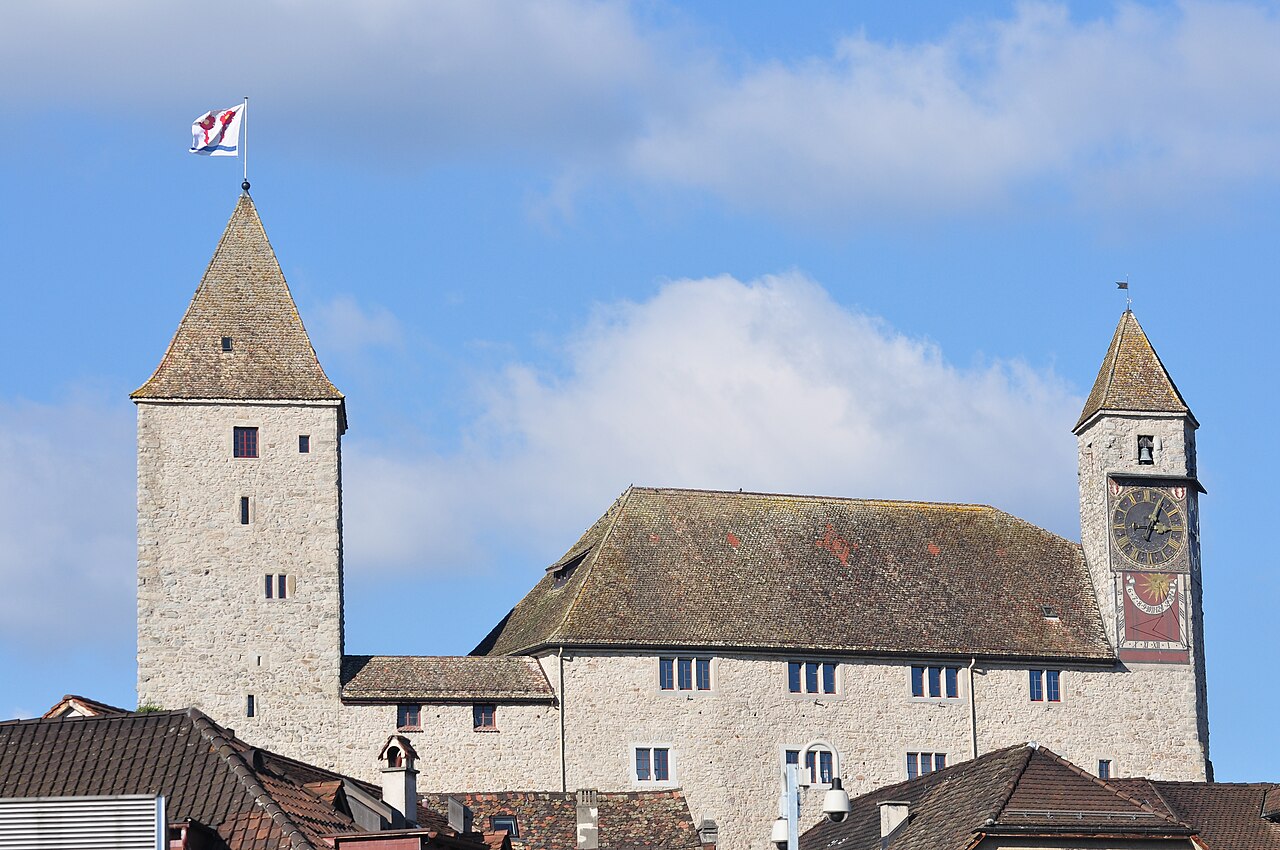
Bubikon Castle
Bubikon Castle, also known as Ritterhaus Bubikon, is a significant medieval complex located in Bubikon, Switzerland. Originally established as a commandery of the Knights Hospitaller, it played a crucial role in the religious and feudal landscape of the region during the High Middle Ages. The castle's origins date back to the 1190s, a period marked by territorial disputes and political negotiations between noble families such as the Counts of Toggenburg and the Counts of Rapperswil. These disputes were resolved through a transfer of lands and rights, culminating in the foundation of the commandery by Diethelm V von Toggenburg and Vogt Rudolf von Rapperswil between 1191 and 1198 AD.
The commandery was established not only as a religious institution but also as a strategic feudal estate, expanding its influence through donations from local noble families throughout the 13th and 14th centuries. At its zenith, the commandery's holdings extended across much of the present-day canton of Zürich, illustrating its considerable power and wealth. The inhabitants of the commandery were granted Burgrecht—a form of municipal citizenship—first by the neighboring town of Rapperswil and later by the city of Zürich, reflecting the commandery's integration into the regional political framework.
Historical significance and secularization
The commandery's history is closely linked to the religious transformations of the Reformation period in Zürich. During the social unrest and riots in the Herrschaft Grüningen region, Johannes Stumpf, the commander at the time, supported the secularization of the commandery and the neighboring Rüti Abbey in the spring of 1525. This marked a turning point as the religious functions ceased, and the lands began to transition to secular ownership. By 1528, the convent was officially secularized, and the commandery's lands were gradually absorbed by the city of Zürich, with final secularization occurring in 1798.
Architectural features and building complex
The Ritterhaus Bubikon complex comprises several notable structures that illustrate its evolution over centuries. The oldest parts include the Bruderhaus (brothers' house) and the chapel of St. John the Baptist, both dating from the early 1190s. The chapel, built in the Romanesque style, incorporates elements that may predate the commandery, possibly constructed by the Toggenburg family. It originally featured a Romanesque nave from the 14th century, later expanded with a Gothic chancel, which was unfortunately destroyed in 1819.
Inside the chapel, remnants of Romanesque mural paintings from the first half of the 13th century survive. These murals depict the foundation of the commandery by the Toggenburg and Rapperswil families and scenes from the life of Saint John the Baptist. The chapel was desecrated during the Reformation, ending its religious use.
The main building, known as the Haupthaus, served as the commander's residence and administrative center. Constructed between the 13th and 15th centuries, it was expanded with the adjacent Ritterhausflügel wing. After the Reformation, this complex became the seat of the local governor appointed by the city of Zürich. The representative rooms were richly decorated in the Renaissance style around 1570, and the façade facing the courtyard was adorned with the coat of arms of the Knights of Malta, symbolizing the commandery's heritage.
Additional buildings include the servants' house, originally built circa 1480 and rebuilt in 1570 to support cheese production, reflecting the economic activities of the estate. The complex also contains the rectory, the Schütte, and Sennhaus buildings, as well as farm and economic structures that supported the commandery's self-sufficiency.
The commandery's role in regional politics and economy
Throughout its history, Bubikon Castle was more than a religious site; it was a center of power and economic influence in the region. The commandery managed extensive agricultural lands and forests, which contributed to its wealth and enabled it to maintain a significant presence in Zürich's political affairs. The granting of Burgrecht to its inhabitants allowed the commandery to participate in local governance and fostered strong ties with urban centers.
The secularization process during the Reformation reflected broader shifts in power from ecclesiastical to secular authorities. The commandery's lands becoming property of the city of Zürich exemplifies this transition, marking the end of the medieval monastic order's dominance in the area.
Preservation and current status
Today, Bubikon Castle stands as a well-preserved historical monument showcasing Romanesque and Gothic architecture alongside Renaissance additions. The complex offers valuable insights into the religious, architectural, and political history of medieval Switzerland. Its buildings, including the chapel and the commander's house, remain significant examples of monastic and feudal architecture from the 12th to 16th centuries.
The site is managed to maintain its historical integrity, allowing visitors to explore the architectural evolution and cultural heritage of the Knights Hospitaller commandery. The preservation of original mural paintings and structural elements provides a rare glimpse into medieval art and construction techniques.
Architectural styles and influences
The castle exhibits a blend of Romanesque and Gothic architectural styles, with later Renaissance modifications. The Romanesque chapel with its thick walls and rounded arches contrasts with the Gothic chancel's pointed arches and larger windows, though the latter was lost in the early 19th century. Renaissance interior decorations in the commander's house reflect the changing tastes and functions of the complex after it ceased to be a monastic institution.
Cultural and heritage importance
Bubikon Castle is an important cultural landmark in the canton of Zürich. It represents the historical presence of the Knights Hospitaller in Switzerland and their role in medieval society. The castle's association with notable noble families and its transformation during the Reformation provide a rich narrative of religious, political, and social change in the region.
Its preservation allows ongoing study and appreciation of medieval monastic life, feudal relations, and architectural development. The site attracts historians, architects, and tourists interested in medieval history and Swiss heritage.
Frequently asked questions (FAQ)
- How do I get to Bubikon Castle?
- Bubikon Castle is easily accessible by public transport. You can take a train to Bubikon Station, which is just a short walk from the castle. If you're driving, there is parking available nearby.
- What is the historical significance of Bubikon Castle?
- Bubikon Castle, dating back to the 13th century, played a crucial role in the region's history as a noble residence and defensive structure. It showcases the medieval architecture and serves as a reminder of the local feudal system. The castle has been preserved and is an important cultural monument in Switzerland.
- When was Bubikon Castle built?
- Bubikon Castle was constructed in the early 13th century, making it a significant historical site in the region. Its architecture reflects the styles of the time and provides insight into medieval construction techniques. Over the centuries, it has undergone various renovations to preserve its integrity.
- Can I take guided tours of Bubikon Castle?
- Yes, guided tours of Bubikon Castle are available and provide an enriching experience for visitors. The tours often include insights into the castle's history, architecture, and the surrounding landscape. It's recommended to check the schedule in advance and book your spot.
- Why is Bubikon Castle a popular tourist attraction?
- Bubikon Castle attracts visitors for its stunning architecture, rich history, and picturesque location. The surrounding landscape offers beautiful views, making it a perfect spot for photography and exploration. Additionally, its proximity to Zurich makes it a convenient day trip for tourists.
- Is it possible to host events at Bubikon Castle?
- Yes, Bubikon Castle can be rented for various events, including weddings, corporate functions, and private gatherings. The unique setting and historical ambiance provide a memorable backdrop for any occasion. It's best to contact the castle administration for availability and booking details.
- What are the opening hours for Bubikon Castle?
- Bubikon Castle typically opens to the public from April to October, with specific hours varying by day. It's advisable to check the castle's official website for the most current opening hours before your visit. Special events may also affect regular hours.
- What are the ticket prices for visiting Bubikon Castle?
- Ticket prices for Bubikon Castle are generally affordable, with discounts available for students and seniors. Family tickets may also be offered, providing a cost-effective option for visitors with children. Always check the official website for the latest pricing information.
- What is the best time to visit Bubikon Castle?
- The best time to visit Bubikon Castle is during the spring and summer months when the weather is pleasant and conducive for outdoor exploration. Additionally, the surrounding gardens and landscape are in full bloom during this time. Visiting during special events or festivals can also enhance your experience.
- Are there any nearby attractions to Bubikon Castle?
- Yes, there are several nearby attractions, including the beautiful Zurich Lake and charming villages in the region. Visitors can also explore hiking trails and enjoy local cuisine in nearby restaurants. The proximity to Zurich makes it easy to combine your castle visit with other cultural experiences.
Information
Website
Visit websiteSources & official resources
Verify the information above using these authoritative references.
Loading map...
Visitor reviews
No reviews yet. Been here? Write the first review and help other travelers!
Write the first reviewVisited this castle? Share your experience
Your review helps other travelers and adds first-hand knowledge to our encyclopedia.