Ramstein Castle
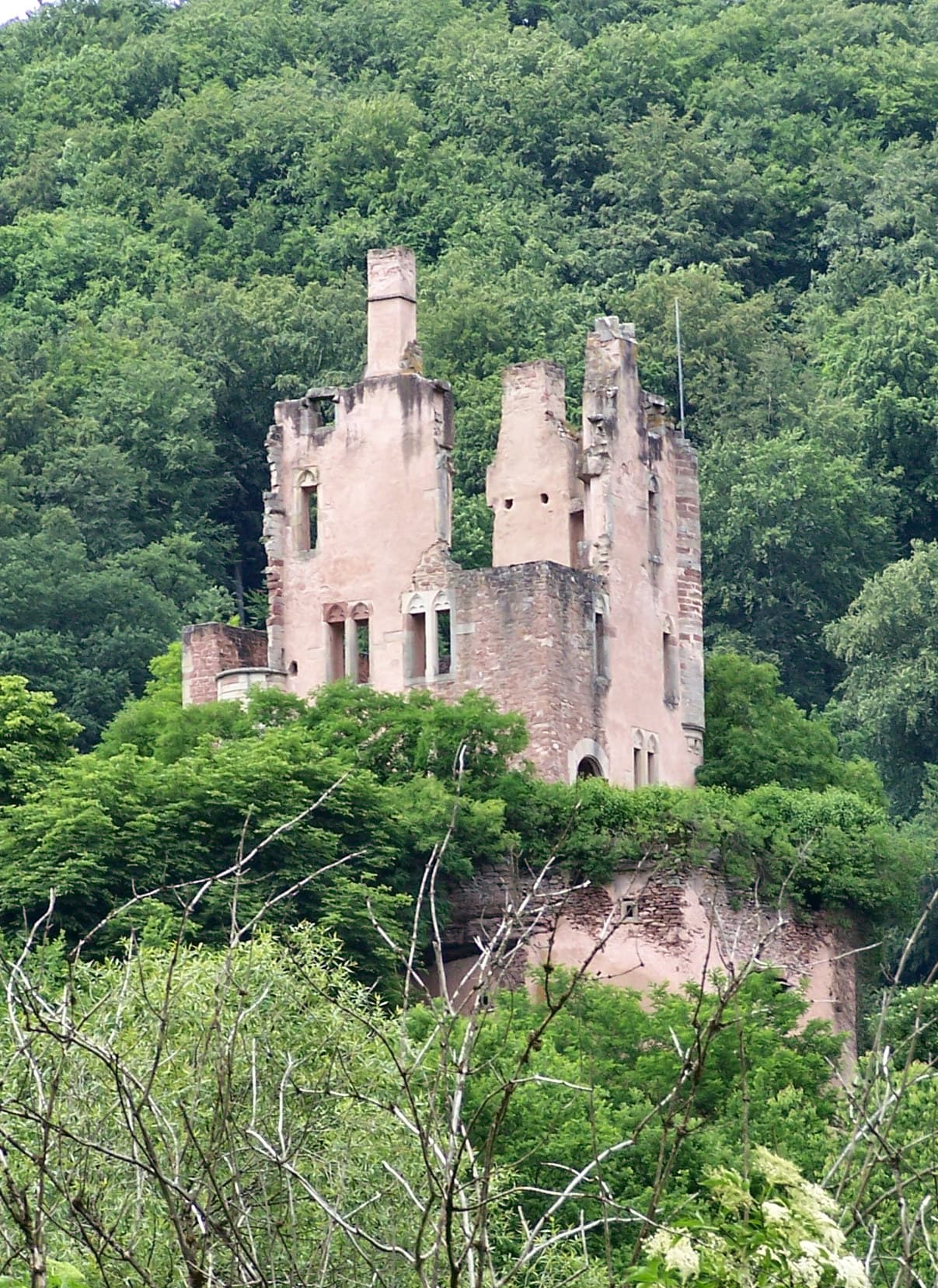
Ramstein Castle, locally known as Burg Ramstein, is a striking medieval hill castle ruin situated south of the town of Kordel in the Rhineland-Palatinate region of Germany. Perched on a prominent 182-meter-high Bunter sandstone rock overlooking the valley near the confluence of the Butzerbach stream and the Kyll river, this castle commands a strategic vantage point that has shaped its historical significance and architectural development.
The site’s origins extend back to the early medieval period, with the first fortification established in the 10th century as a fortified manor farm under the authority of the Archbishopric of Trier. This early structure, known as Runnesstein or Castrum Ruynstein, functioned primarily as an agricultural estate and was pledged to a vassal named Vollmar around 926. The transformation from manor farm to a formidable castle began in the early 14th century, initiated by Archbishop Diether of Nassau, who ruled from 1300 to 1307, and completed under his successor Baldwin of Luxembourg by 1317. This marked the construction of the castle’s core: a fortified Gothic tower house and surrounding defensive walls, replacing the earlier manor and establishing Ramstein as a significant fief of the Electorate of Trier.
Architectural features and layout
The castle occupies an oval-shaped plateau approximately 37 by 57 meters in size, which includes the inner bailey and remains of domestic buildings. The centerpiece is the Gothic tower house, a trapezoidal structure measuring roughly 13 by 10.8 meters with walls 1.35 meters thick, constructed from rubble stone. Originally rising to an estimated 25 meters over four floors, the tower now retains two to three stories, reaching about 18 meters in height. Its stone staircases and spiral stair towers are notable features, with one round staircase tower at the northeast corner and another projecting from the southern wall near the entrance.
The tower’s design reflects both defensive and residential functions. The ground floor, equipped with the largest fireplace, likely served as the kitchen. The first floor contained three fireplaces within a space divided by wooden partitions, probably used as private living quarters. The second floor was a large hall intended for gatherings, ceremonies, and receptions. The top floor, lacking fireplaces, was probably servant quarters. Windows feature characteristic Gothic trefoil designs crafted from locally quarried grey and red sandstone, exemplifying the castle’s architectural style.
Access to the tower was originally protected by a throat ditch nearly 4.7 meters wide, which probably held a drawbridge, enhancing its defensibility. The western entrance portal remains well preserved, measuring 1.55 meters wide by 2.45 meters high. The castle’s curtain walls and corner towers survive in fragments, offering insight into its original fortifications.
Historical context and ownership
Ramstein Castle’s history is deeply intertwined with the Electorate of Trier and the ecclesiastical authorities who controlled the region. After its completion in the early 14th century, the castle was granted as a fief to various subjects of the Electorate, including cathedral deans and nobles. A notable legal dispute during construction involved Arnold of Pittingen, a Luxembourg noble, who contested the archbishop’s right to build on the site. The archbishopric prevailed, allowing completion of the castle by 1317.
Throughout the 14th and 15th centuries, the castle changed hands among several prominent figures such as Johann von der Fels, Jutta von Reuland, William von Manderscheid, and Chorbishop Rupprecht von Hoheneck. After Bernhard von Orley seized the castle in 1417, it was besieged by Archbishop Jakob I von Sierck, resulting in damage and a period of neglect due to scarce financial resources. The castle was repaired in 1488 by Chorbishop Dietrich von Stein, marking a revival in its fortunes.
In the 16th century, it is believed that Archbishop Richard von Greiffenklau zu Vollrads resided at Ramstein. Enhancements during this period included the installation of a clay pipe water supply from a nearby spring, commemorated by an inscribed "Brunnenstein" or well stone still present on site. The castle remained under the control of the cathedral deanery from 1578 until secularization in the early 19th century, though the deans themselves did not reside there, appointing stewards instead.
Military conflicts and decline
Ramstein Castle experienced military action during the Franco-Dutch War (1674–1675), when French troops occupied it for about a year before imperial forces regained control. Following this, the castle was reinforced. However, its most devastating blow came during the War of the Palatine Succession in 1689. On 18 September, French forces set fire to the castle and detonated explosives at two corners, causing extensive destruction and leaving it in ruins. The damage was never fully repaired, and the castle fell into permanent decline.
The associated farmhouse underwent reconstruction after fires in 1675 and 1786. Though plans for a larger building were abandoned due to cost, the farmhouse was rebuilt on the original foundations and adapted for later use as a hotel-restaurant, a role it continues to serve today.
Modern history and preservation
Following the upheavals of the French Revolutionary Wars, the castle and its outbuildings were confiscated and sold at auction in 1803. The property changed hands and was acquired in 1826 by the Bretz family, who remain the owners. From the 1870s, they established a restaurant on the site, integrating hospitality with the castle’s historic atmosphere.
Preservation efforts began in the 20th century, including stabilization of the eastern wall in 1928 and safety enhancements to the battlements in 1930. Although the castle suffered artillery damage during World War II, repairs completed by 1987 helped secure the ruins. Despite these efforts, the castle remains a ruin and is currently closed to public access due to safety concerns and limited financial resources. Visitors can still experience the site’s ambiance by staying at the hotel-restaurant located in the rebuilt farmhouse on the castle grounds.
Cultural significance and visitor experience
Ramstein Castle stands as a testament to the region’s medieval history, ecclesiastical power, and the turbulent military conflicts that shaped the Rhineland-Palatinate. Its Gothic architectural features, including the tower house, staircases, fireplaces, and decorative windows, offer valuable insights into medieval castle design and living conditions.
The castle’s location on a sandstone promontory overlooking the Kyll valley provides spectacular views of the surrounding landscape, including the Meulenwald forest and the river valley below. The juxtaposition of the ruins with the modern hotel-restaurant creates a unique blend of history and hospitality, inviting visitors to immerse themselves in centuries of heritage.
While the ruins themselves are currently not open for direct exploration due to safety issues, the site remains a popular destination for history enthusiasts and tourists who appreciate medieval architecture and scenic natural settings. The hope remains that future restoration efforts will allow safer access and a fuller experience of this remarkable historic castle.
Frequently asked questions (FAQ)
- How do I get to Ramstein Castle?
- Ramstein Castle is located in Burg Ramstein, Germany, and can be accessed by car or public transport. If you are driving, there are parking facilities nearby. For public transport, check local bus or train schedules for the best routes to reach the castle.
- What is the historical significance of Ramstein Castle?
- Ramstein Castle dates back to the 13th century and is an important example of medieval architecture in the region. It served as a defensive stronghold and residence for local nobility, reflecting the turbulent history of the area. Today, it stands as a testament to the heritage and history of the region.
- When was Ramstein Castle built?
- Ramstein Castle was constructed in the early 13th century, with its foundations laid around 1200 AD. Over the centuries, it underwent various renovations and expansions that reflect the architectural styles of the time. Its long history makes it a fascinating site for visitors interested in medieval history.
- Can I visit Ramstein Castle year-round?
- Yes, Ramstein Castle is open to visitors year-round, although specific access may vary by season. It is advisable to check the official website or contact local tourism offices for any seasonal events or maintenance closures. Always plan ahead to ensure the best experience.
- Why is Ramstein Castle a popular tourist destination?
- Ramstein Castle attracts visitors due to its rich history, stunning architecture, and picturesque location. The castle offers breathtaking views of the surrounding countryside and serves as a venue for various cultural events throughout the year. Its historical significance and beauty make it a must-see for anyone visiting the area.
- Is it possible to take guided tours of Ramstein Castle?
- Yes, guided tours of Ramstein Castle are available to enhance your visit and provide in-depth knowledge of its history and architecture. These tours are typically led by knowledgeable guides who share fascinating stories and insights. Be sure to check the schedule and book in advance, especially during peak tourist seasons.
- What are the opening hours for Ramstein Castle?
- Ramstein Castle is generally open from 9 AM to 5 PM, but hours may vary depending on the season and special events. It's recommended to verify the current opening hours on the official website before your visit. This ensures you have the most enjoyable experience without any unexpected closures.
- What are the ticket prices for visiting Ramstein Castle?
- Ticket prices for Ramstein Castle are quite affordable, usually ranging from €5 to €10 for adults, with discounts available for children, students, and seniors. Special rates may apply for guided tours or group bookings. Check the official site for the most accurate and up-to-date pricing information before your visit.
- What is the best time to visit Ramstein Castle?
- The best time to visit Ramstein Castle is during the spring and early autumn months when the weather is mild and pleasant. This allows for comfortable exploration of the castle and its surroundings. Additionally, visiting during these seasons often coincides with various events and festivals, enhancing the overall experience.
- Are there nearby attractions to visit after Ramstein Castle?
- Yes, there are several nearby attractions to explore after your visit to Ramstein Castle. The charming village of Ramstein-Miesenbach offers local shops and eateries, while the surrounding countryside features beautiful hiking trails. Additionally, the nearby town of Kaiserslautern has museums and parks that are worth checking out.
Photo gallery

Information
Website
Visit websiteSources & official resources
Verify the information above using these authoritative references.
Loading map...
Visitor reviews
No reviews yet. Been here? Write the first review and help other travelers!
Write the first reviewVisited this castle? Share your experience
Your review helps other travelers and adds first-hand knowledge to our encyclopedia.