Porta Nigra
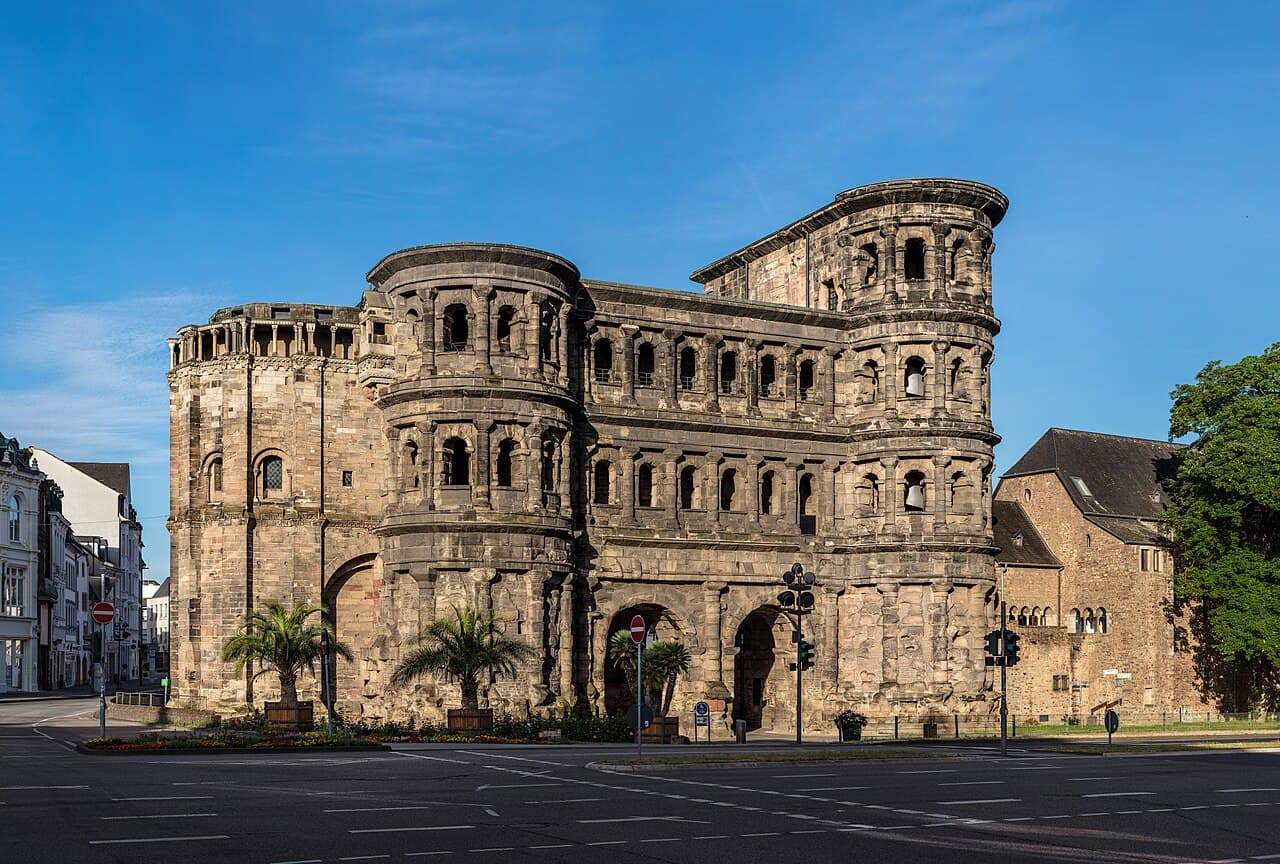
The Porta Nigra (Latin for black gate) is a monumental Roman city gate located in Trier, Germany. Constructed in the 2nd century AD, it stands as one of the best-preserved examples of Roman fortification architecture north of the Alps. The gate was originally part of the city's extensive defensive walls, serving as a grand entrance to the Roman settlement known as Augusta Treverorum.
Roman origins and architectural design
The Porta Nigra was built around 170 AD during the Roman Empire's period of urban expansion and military consolidation. It was designed as a massive stone gateway, constructed using large blocks of grey sandstone that have darkened over centuries, giving the gate its distinctive blackened appearance and its modern name. The original Roman name of the gate has not survived in historical records.
The structure is a prime example of Roman military architecture, featuring two large towers flanking a central archway. The gate's walls are up to 6 meters thick, and the entire building rises to approximately 30 meters in height. The use of large, precisely cut stone blocks assembled without mortar is characteristic of Roman engineering expertise.
The Porta Nigra's design includes multiple floors connected by staircases within the towers, which would have housed guards and served as defensive positions. The gate also featured openings for archers and other defensive mechanisms, emphasizing its role not only as a ceremonial entrance but also as a military fortification.
Medieval transformations and preservation
During the Middle Ages, the Porta Nigra underwent significant changes. It was converted into a church by the Greek monk Simeon of Trier in the 11th century, who lived as a hermit in the gate. After his death, he was canonized, and the gate was transformed into a double church, with the upper and lower levels serving different religious functions. This adaptation contributed to the building's preservation through the centuries.
The name "Porta Nigra" first appeared in medieval documents, inspired by the darkened color of the sandstone caused by weathering and pollution. Despite its age, the gate remained structurally sound, avoiding demolition or extensive alteration that many Roman structures suffered.
Modern restoration and cultural significance
In the 19th century, the Porta Nigra was restored under the direction of the famous architect Friedrich Wilhelm IV of Prussia, who ordered the removal of the medieval church additions to return the gate closer to its original Roman appearance. This restoration helped establish the Porta Nigra as a symbol of Trier's Roman heritage.
Today, the Porta Nigra is a UNESCO World Heritage Site, recognized for its outstanding preservation and historical importance. It attracts visitors worldwide who come to admire its massive stone construction, Roman engineering, and the layers of history visible in its structure.
Architectural features and visitor experience
The Porta Nigra's imposing facade includes twin towers with multiple levels, large arched entrances, and defensive openings. Visitors can explore the interior staircases and upper floors, gaining insight into Roman military architecture and medieval adaptations.
The gate stands at the northern edge of Trier's historic center, offering panoramic views of the city and the Moselle River valley. Its location and monumental scale make it a focal point for understanding the city's Roman past and its continuous occupation through the Middle Ages to the present.
Construction techniques
The sandstone blocks used in the Porta Nigra were carefully quarried and shaped to fit tightly without mortar, a technique known as dry stone masonry. Iron clamps were used to hold the stones together, many of which remain visible today, illustrating the durability of Roman construction methods.
Defensive elements
The gate's thick walls and narrow windows served defensive purposes. Arrow slits and machicolations allowed defenders to repel attackers while remaining protected. The gate's height and robust construction made it a formidable obstacle against any assault.
Historical context of Trier and the Porta Nigra
Trier was one of the most important cities in the Roman Empire, serving as an administrative and military center. The Porta Nigra was part of the city's extensive fortifications, which enclosed an area of approximately 653 hectares. The city's strategic location on the Moselle River contributed to its prominence and the need for strong defensive structures.
Throughout its history, the Porta Nigra witnessed the transformation of Trier from a Roman provincial capital to a medieval religious center and finally to a modern city that treasures its ancient heritage.
Visiting information
The Porta Nigra is open to visitors year-round, with guided tours available in multiple languages. The site includes informational displays detailing its Roman origins, medieval modifications, and restoration efforts. Visitors can climb the towers and walk through the gate to experience the architecture firsthand.
The surrounding area features other Roman monuments, such as the Imperial Baths and the Roman Bridge, making Trier a rich destination for those interested in ancient history and architecture.
Frequently asked questions (FAQ)
- How do I get to Porta Nigra?
- Porta Nigra is located in the heart of Trier, Germany. You can reach it easily by public transport, with several bus lines stopping nearby, or you can take a leisurely walk from the city center, which is just a short distance away.
- What is the historical significance of Porta Nigra?
- Porta Nigra is a UNESCO World Heritage Site and one of the best-preserved Roman city gates in the world. Built in the 2nd century AD, it served as a gateway to the Roman city of Augusta Treverorum and showcases the architectural prowess of ancient Rome.
- When was Porta Nigra built?
- Construction of Porta Nigra began around 186 AD and was completed during the reign of Emperor Marcus Aurelius. Its robust structure has stood the test of time, making it a lasting symbol of Trier's Roman heritage.
- Can I enter Porta Nigra?
- Yes, visitors can enter Porta Nigra and explore its impressive architecture from the inside. There is an exhibition that provides insights into the history of the gate and the city of Trier.
- Why is Porta Nigra a popular tourist attraction?
- Porta Nigra attracts visitors due to its historical significance, stunning architecture, and its status as a symbol of Trier's Roman past. It offers a glimpse into ancient Roman engineering and serves as a backdrop for various cultural events throughout the year.
- Is it possible to visit Porta Nigra at night?
- Yes, Porta Nigra is beautifully illuminated at night and can be enjoyed even after the gates close to visitors. However, the interior is only accessible during regular opening hours, so plan your visit accordingly to experience both day and night views.
- What are the opening hours for Porta Nigra?
- Porta Nigra is typically open from 10 AM to 5 PM, with extended hours during the summer months. It is advisable to check the official website for any seasonal changes or special events that may affect visiting times.
- What are the ticket prices for Porta Nigra?
- As of the latest information, adult tickets to Porta Nigra cost around €4, while reduced tickets for students and seniors are available for €2. Children under 18 can enter for free, making it an affordable destination for families.
- What is the best time to visit Porta Nigra?
- The best time to visit Porta Nigra is during the spring and early autumn when the weather is mild, making it ideal for walking around the area. Additionally, visiting during weekdays can help you avoid larger crowds.
- Are there any nearby attractions to visit?
- Yes, there are several attractions near Porta Nigra, including the Trier Cathedral and the Roman amphitheater. Visitors can also enjoy the charming streets of Trier, filled with shops, cafes, and other historical sites.
Photo gallery

Information
Loading map...
Visitor reviews
No reviews yet. Been here? Write the first review and help other travelers!
Write the first reviewVisited this castle? Share your experience
Your review helps other travelers and adds first-hand knowledge to our encyclopedia.