Rakvere Castle
Rakvere Castle stands prominently on Castle Hill in Rakvere, Estonia, embodying a rich history that spans from the Viking Age through the High Medieval period and beyond. This hill castle has evolved from an ancient wooden stronghold into a complex stone fortress, reflecting the shifting tides of military technology, political power, and architectural style over centuries.
The earliest archaeological evidence of human settlement at the site, known as Vallimäe, dates back to the 9th century with artifacts such as arrowheads and pottery from the Viking Age. More substantial records reveal a wooden stronghold called Tarvanpea existing by the 5th and 6th centuries, surrounded by a pine palisade. This early fortification marked the strategic importance of the site long before stone construction began.
By the early 13th century, written records mention Tarvanpea, and the Danish name Wesenberg appears in 1252. The name Wesenberg, meaning "bull's head," is linked to the town seal and symbolizes the fortress's enduring identity. The castle's significance in regional power struggles is highlighted by its mention in the Russian Novgorod chronicles as Rakovor in 1268.
Early fortifications and danish rule
In 1226, the stronghold was captured by Johannes Dolenist, a vassal of the Bishop of Tartu, with papal support, marking a key moment in the castle's history. However, the Stensby Treaty of 1238 returned the castle to Danish control, where it became one of three royal castles in the Duchy of Estonia, alongside Tallinn and Narva. These castles formed a defensive network essential for Danish territorial control.
Throughout the 13th century, the castle faced repeated military challenges, especially from Novgorod forces who unsuccessfully besieged it in 1268. Following these conflicts, the Danes initiated the transition from wooden fortifications to stone, constructing the first stone buildings in a modest convent house style. These early stone structures included half-cellars and curtain walls, marking the beginning of Rakvere's medieval stone fortress phase.
Livonian order expansion and architectural development
After the Livonian Order acquired Rakvere and the surrounding region in 1347, the castle underwent significant expansion and modernization. It became the administrative center for the Rakvere vogtei, with the vogt exercising military, judicial, and administrative authority. The castle's layout was expanded northward, incorporating new defensive walls, vaulted cellars, and a complex gate system.
The Livonian Order's architectural influence is evident in the castle's rectangular main tower, convent house features with vaulted arcades, and multiple defensive towers. The castle's walls were thickened and raised several times to adapt to evolving military needs, including the use of artillery. The southwestern rondel, a round artillery tower, exemplifies these adaptations, providing a strategic platform for cannon fire.
The eastern gate complex was a formidable defensive structure featuring a drawbridge, pitfall, inner portcullis, and a "wolf hole"—a defensive pit designed to trap attackers. Adjacent to the gatehouse stood a large semicircular tower with heated guardrooms, including hypocaust stoves for warmth, showcasing advanced medieval engineering.
Livonian war and subsequent conflicts
The Livonian War (1558–1583) brought intense conflict to Rakvere Castle. Captured by Russian forces in 1558, the castle's defenses were reinforced with wooden outer walls, palisades, and bastions to meet the demands of contemporary warfare. The Russians used Rakvere as a district center governed by appointed voyevodas, underscoring its strategic importance.
Swedish attempts to retake the castle in 1573 and 1574 failed, but in 1581, under the command of Pontus de la Gardie, the Swedes successfully captured Rakvere, establishing it as the administrative center of the Swedish Rakvere county. The castle was further fortified with bastions and thickened walls, adapting to the era's military architecture.
During the early 17th century, the castle changed hands amid the Polish-Swedish wars. The Polish-Lithuanian Commonwealth controlled Rakvere from 1602 to 1605 before retreating and deliberately destroying the fortress to prevent its use by Swedish forces. From 1635, the castle was officially removed from military service and integrated into the Rakvere manor estate.
Architectural features and castle remains
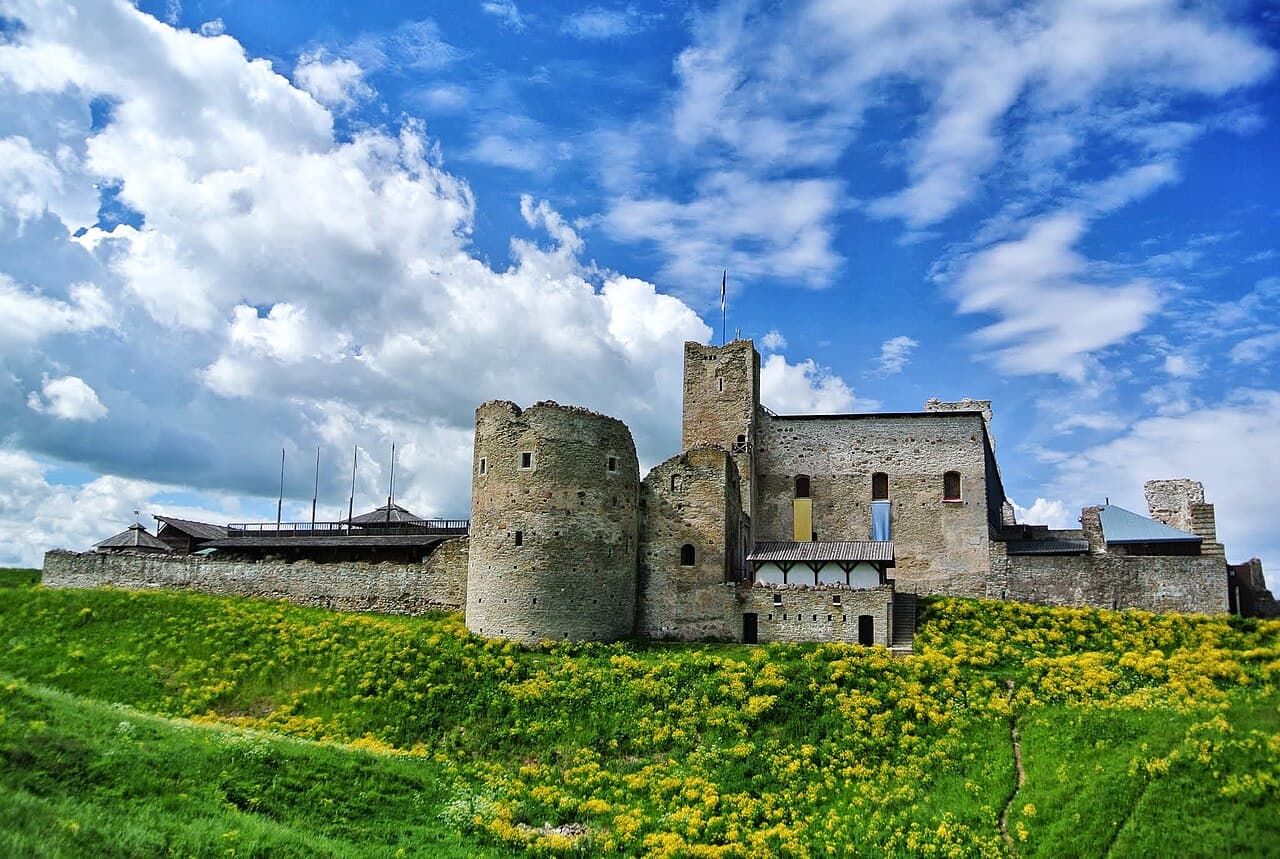
Rakvere Castle occupies a commanding hilltop position approximately 105 meters above sea level, rising 25 meters above the surrounding terrain. The castle's layout evolved from a wooden stronghold into a complex stone fortress with an irregular quadrangular curtain wall up to two meters thick. The western wall, reaching seven meters high, supports a battlement walkway and stone buttresses.
The castle includes a rectangular western tower divided by an east-west wall, corner towers, and a large eastern gate complex with multiple defensive elements. The southern wing housed heated wooden buildings with stoves, while vaulted arcades enclosed the courtyard. The southwestern rondel is a distinctive artillery tower designed to accommodate cannon fire, reflecting the castle's adaptation to gunpowder weaponry.
Under Russian rule, extensive wooden outer defenses were added, including palisades, blockhouses filled with stones, tall towers, and bastions. These outer works enclosed a large wooden settlement capable of housing several thousand men, highlighting Rakvere's role as a major military center.
Among the castle's preserved artifacts are six historical cannons from various periods, including a 15th-century Burgundian cannon known as "Tont" and a Swedish field cannon called "Ööbik" from the late 17th to early 18th century. Black powder demonstrations of cannon firing continue to attract visitors.
Modern preservation and cultural significance
Today, Rakvere Castle is partially restored and open to the public as a museum and cultural site. The southern wing and corner towers are among the best-preserved sections, with the Estonian flag proudly flying from one of the towers. The site serves as a vivid testament to Estonia's layered history, showcasing architectural evolution from early medieval wooden fortifications to high medieval stone military architecture.
The castle museum offers interactive exhibits, including tastings of Malvasia wine brewed according to medieval recipes, enriching visitors' understanding of the castle's historical lifestyle. Rakvere Castle remains a significant heritage landmark, illustrating the complex interplay of military, political, and cultural forces in Estonia's history.
Frequently asked questions (FAQ)
- How do I get to Rakvere Castle?
- Rakvere Castle is located in the town of Rakvere, Lääne-Viru County, Estonia. It is accessible by car and public transport, with clear signage from the town center guiding visitors to the hilltop site.
- What are the opening hours of Rakvere Castle museum?
- The Rakvere Castle museum is generally open daily from 10:00 to 18:00 during the tourist season, with reduced hours in the off-season. It is advisable to check the official website for current visiting times before planning your visit.
- Can I participate in interactive activities at Rakvere Castle?
- Yes, Rakvere Castle offers interactive exhibits and activities, including medieval-themed events, guided tours, and demonstrations such as cannon firing using black powder, providing an immersive historical experience.
- What is the historical significance of Rakvere Castle?
- Rakvere Castle has played a crucial role in regional defense and administration since the 13th century. It witnessed conflicts involving Danish, Livonian, Russian, Swedish, and Polish-Lithuanian forces, reflecting Estonia's complex medieval and early modern history.
- Is Rakvere Castle suitable for families and children?
- Rakvere Castle is family-friendly, offering engaging exhibits and interactive activities that appeal to children and adults alike. The spacious courtyards and educational programs make it an enjoyable visit for all ages.
Photo gallery

Information
Website
Visit websiteSources & official resources
Verify the information above using these authoritative references.
Loading map...
Visitor reviews
No reviews yet. Been here? Write the first review and help other travelers!
Write the first reviewVisited this castle? Share your experience
Your review helps other travelers and adds first-hand knowledge to our encyclopedia.