Rabenstein Castle Ruins
Rabenstein Castle ruins stand as a striking testament to medieval fortification and noble residence perched above the municipality of Sankt Paul im Lavanttal in Austria. Established around 1100, this hill castle evolved from a simple watchtower into a significant defensive stronghold designed to protect the nearby St. Paul Abbey, founded in 1091 by Engelbert I, Margrave of Istria. Its strategic position atop a steep rocky hill with natural cliffs on three sides made it a formidable fortress commanding the surrounding valley.
Medieval origins and early history
The initial construction of Rabenstein Castle was likely a response to the need for safeguarding the religious and economic interests of the newly established abbey and the adjacent settlement. Originally a watchtower, the structure was expanded into a fully-fledged castle under the auspices of the noble family von Ramenstain, later known as von Rabenstein, who took their name from the castle itself. This family held the castle until around 1200, after which the lineage became extinct.
Following the extinction of the von Rabenstein family, ownership passed through marriage to the Counts of Pfannberg and subsequently came under the control of the Archbishopric of Salzburg around 1300. The archbishops appointed caretakers to manage the castle, which led to frequent disputes with the monks of St. Paul Abbey over land rights and income, reflecting the complex power dynamics of the region during the High Medieval period.
Sieges, reconstructions, and changing ownership
In 1307, the castle was besieged and partially destroyed by order of Duke Albert I, who sought to prevent its control from falling to Duke Henry VI of Carinthia amid regional political tensions. The castle was subsequently rebuilt and enlarged by Bishop Konrad IV of Fohnsdorf of Salzburg, who granted it as a fief to Burkhard II of Vanstorf. This reconstruction included the addition of a prominent bergfried or keep, a square tower that remains a dominant feature of the ruins today.
In 1461, the castle came into the possession of Emperor Frederick III, under whose reign it withstood the 1476 Ottoman assault on the nearby market town, highlighting its strategic military importance. Later, Maximilian I inherited the castle but sold it in 1514 to Franz von Dietrichstein. His son, Seyfried von Dietrichstein, transformed the fortress into a Renaissance-style palace in 1567, reflecting the changing tastes and residential functions of the castle during the Renaissance period.
Baroque chapel and destruction by fire
Throughout the 16th and early 17th centuries, the castle changed hands multiple times, including ownership by notable figures such as Hans Ulrich von Eggenberg. Ultimately, the castle reverted to the control of St. Paul Abbey in 1629. Under Abbot Hieronymus Marchstaller, the castle chapel underwent a significant Baroque restoration and was consecrated in 1633. This chapel represented the spiritual heart of the castle complex, though only traces remain today.
In 1636, a devastating fire severely damaged the castle. The blaze was suspected to be deliberate, with some historical accounts controversially implicating the abbot himself. After this event, the castle was abandoned and left to decay, never rebuilt or restored to its former grandeur.
Archaeological significance and conservation efforts
Archaeological studies reveal that the site of Rabenstein Castle has been occupied continuously from the Neolithic era through the Bronze and Iron Ages into the early modern period. This long history underscores the strategic importance of the location beyond its medieval use.
Following the 1787 secularization reforms by Emperor Joseph II, which dissolved St. Paul Abbey, the castle ruins came under state religious fund control before passing into private ownership in the 19th century. From 1997 to 2002, the ruins underwent careful stabilization and conservation supported by local and national Austrian authorities. These efforts focused on preserving the remaining structures without reconstruction, ensuring the site remains a visible and educational monument to its layered past.
Architectural features and surviving structures
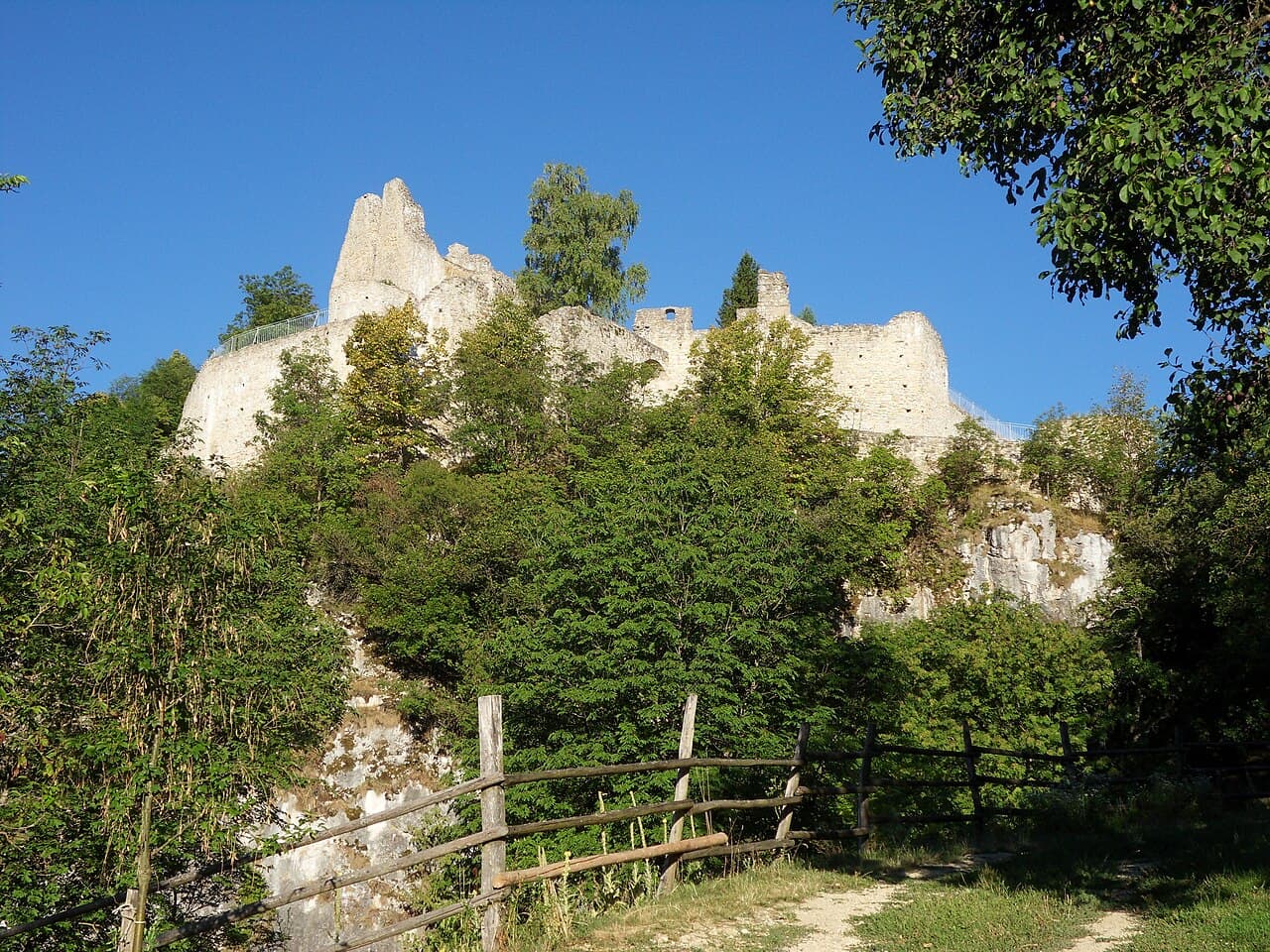
Rabenstein Castle was designed as a rock fortress, utilizing the natural topography of the hill with steep cliffs on three sides to enhance its defensibility. The central feature is the bergfried, a square keep built in 1307 at the highest point of the site. Today, three of its walls still stand, providing a sense of the tower’s original imposing mass and function as a last refuge during sieges.
Adjacent to the bergfried on the southern side was the palas, the main residential building of the castle. Remnants of this structure, along with other ancillary buildings dating from the 13th and 14th centuries, survive amid the rocky outcrop. These ruins reflect the castle’s medieval phase prior to Renaissance modifications.
The castle’s northern approach was protected by a semicircular barbican, a fortified outer gate area designed to delay attackers. The castle’s defensive walls, originally constructed in two layers during the 12th and 13th centuries, formed a formidable perimeter. Much of the outer masonry has since weathered away or was dismantled for local building materials.
Some sections of the castle rose to heights of up to three stories, illustrating its evolution from a simple watchtower to a complex fortress and noble residence. Surviving masonry shows architectural elements from both its High Medieval origins and later Renaissance updates.
The early 17th-century baroque chapel within the castle complex, consecrated in 1633, has left only minimal traces visible today, yet it represents the spiritual and cultural importance of the site during its final active phase.
Modern conservation has prioritized the stabilization of these ruins, halting further decay while maintaining the authenticity of the site. Visitors today can explore the remains, gaining insight into the castle’s historical significance and architectural evolution over several centuries.
Frequently asked questions (FAQ)
- How do I visit Rabenstein Castle ruins?
- Rabenstein Castle ruins are accessible to the public year-round. Visitors should prepare for a steep hike up the hill, as the site is perched on rocky terrain. There are no entrance fees, but facilities are limited, so wear appropriate footwear and bring water.
- What is the historical significance of Rabenstein Castle?
- Rabenstein Castle played a crucial role in protecting St. Paul Abbey and the surrounding region from the 12th to the 17th centuries. Its layered history reflects the shifting political and religious powers in medieval Austria, including ties to noble families and the Archbishopric of Salzburg.
- When was Rabenstein Castle destroyed?
- The castle was severely damaged by a fire in 1636, suspected to be deliberately set. After this event, it was abandoned and left in ruins, never rebuilt.
- Can I see the architectural features of different periods at Rabenstein Castle?
- Yes, visitors can observe architectural elements from the High Medieval period, including the bergfried and defensive walls, as well as Renaissance modifications made in the 16th century. The ruins also include traces of a Baroque chapel.
- Is the site suitable for families with children?
- While the ruins are fascinating, the steep and rocky terrain may be challenging for young children or those with mobility issues. Supervision is advised, and proper footwear is recommended for safety.
Photo gallery

Information
Current owner
Private owner
Loading map...
Visitor reviews
No reviews yet. Been here? Write the first review and help other travelers!
Write the first reviewVisited this castle? Share your experience
Your review helps other travelers and adds first-hand knowledge to our encyclopedia.