Burgruine Hartneidstein
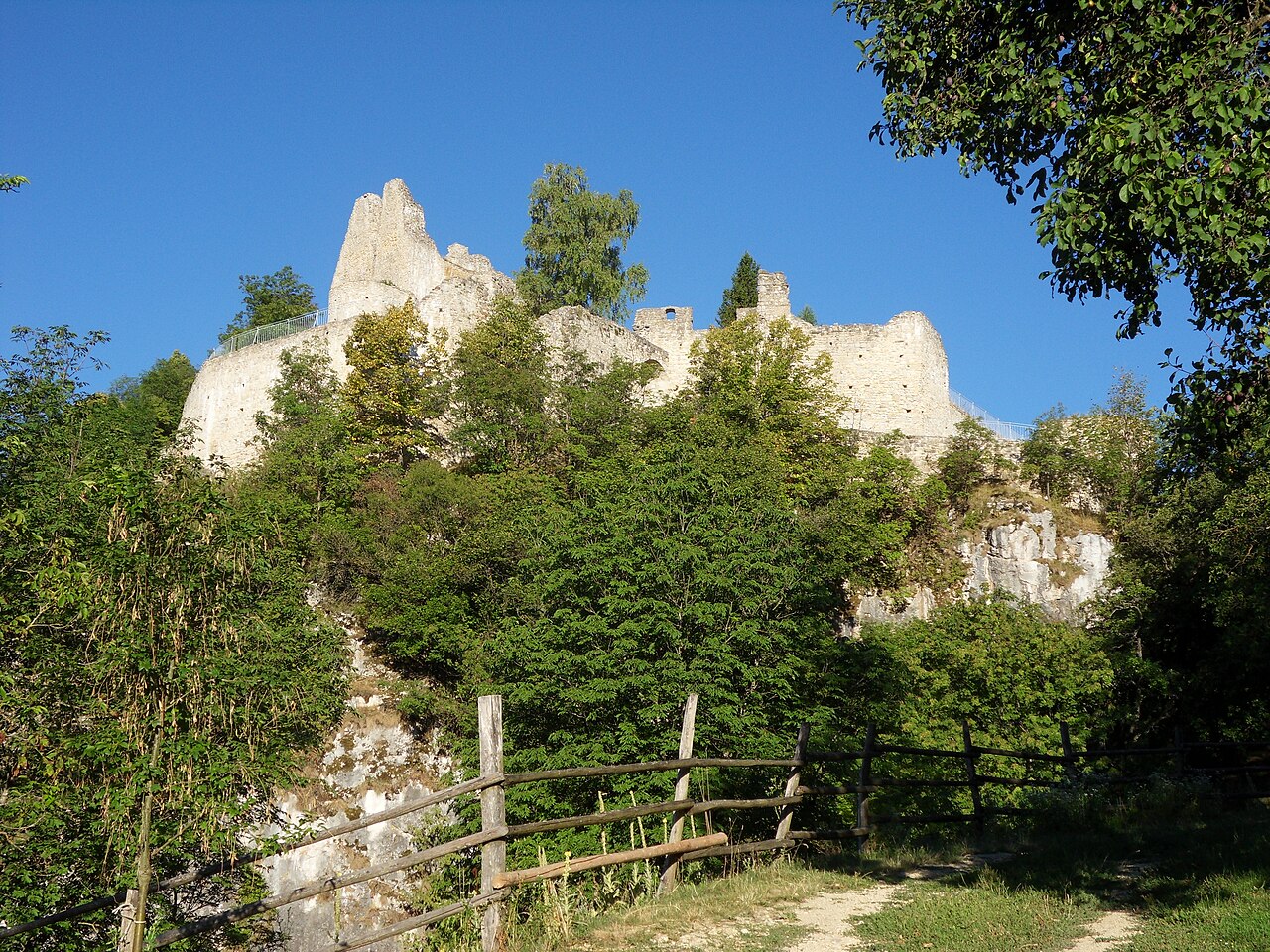
Burgruine Hartneidstein is a medieval hill castle ruin situated near the village of Eitweg in Austria, prominently positioned on a steep ridge within the Koralpe mountain range. Constructed around the early 14th century by the noble Hartneid von Weißenegg, the castle was strategically designed to oversee and control the surrounding Lavant valley. Its location atop a hill provided natural defensive advantages, which were further enhanced by its robust stone construction and fortifications.
Historical background and ownership transitions
The castle's foundation around 1300 marked the establishment of a significant feudal seat by the Weißenegg family, who were ministeriales—unfree knights serving higher nobility—linked to the Counts of Vovbrk. Early on, the castle functioned as a fief under these counts before the Weißenegg brothers transferred control to the Duke of Carinthia in 1317. This transfer reflected the complex feudal and ecclesiastical relationships of the time, as the Weißenegg family also had ties to the Bishopric of Bamberg, leading to disputes over jurisdiction.
Throughout the 14th century, Burgruine Hartneidstein played a key role as the seat of a regional court, an important judicial institution inherited from the Counts of Vovbrk. Ownership and control shifted among various noble families, including Konrad von Auffenstein and the influential Counts of Cilli. In 1425, the Counts of Cilli exchanged Hartneidstein and the nearby Weißenegg castle for Muta castle and customs rights along the Drava River with the Bishopric of Bamberg. This transaction solidified the castle's association with the bishopric, under whose authority it served as the base for the Bamberg regional judge.
Military events and decline
In 1469, Burgruine Hartneidstein experienced a violent episode during a Turkish military incursion, which resulted in the destruction of some adjacent buildings by fire. The castle was promptly rebuilt, maintaining its administrative and defensive functions. It continued to serve as the center of regional judicial affairs until the late 17th century, when administrative responsibilities gradually shifted to the nearby town of Wolfsberg, which was more accessible.
The castle's decline accelerated as it was increasingly neglected. The last documented maintenance was the replacement of its roof in 1724. After this, the fortress was abandoned and fell into ruin. Ownership remained with the Bishopric of Bamberg until 1759, when the property was acquired by Empress Maria Theresa. By the early 19th century, Burgruine Hartneidstein was officially recognized as a ruin. Since 1846, the castle site and surrounding forests have been owned by the family of Count Hugo Henckel von Donnersmarck, proprietors of the Wolfsberg estate.
Architectural features and layout
The castle was originally constructed as a stone fortress, typical of medieval hill castles designed for defense and control of strategic routes. Its layout centers on a large, square bergfried (main tower), which originally rose approximately 25 meters in height. Today, the northern walls of this tower remain standing, offering insight into the castle's formidable vertical defenses.
The main entrance was marked by a gate featuring Gothic architectural elements, notably pointed arches that framed the doorway. Adjacent to the gate on the northern side stood the gatekeeper's house, which controlled access to the castle. On the southern side of the site, remnants of the palas—the principal residential building—are preserved. This structure underwent expansions during the 14th and 15th centuries, reflecting ongoing adaptation to the castle's residential and administrative needs.
The castle's construction primarily utilized local stone masonry, employing typical medieval techniques without extensive decorative embellishments. Although the ruins have been subject to partial restoration, much of the structure has succumbed to decay since abandonment in the 18th century. The site remains a significant example of a fortified seat of regional power and justice from the medieval period.
Burgruine hartneidstein in the context of austrian medieval castles
Burgruine Hartneidstein exemplifies the characteristics of a hill castle built for both defense and administrative purposes during the high to late medieval period in Austria. Its history of ownership reflects the complex interplay between secular and ecclesiastical powers, a common theme in the region's medieval political landscape. The castle's role as a regional court seat underlines its importance beyond military functions, serving judicial and administrative roles for several centuries.
The castle's architectural elements, such as the bergfried, gatehouse with Gothic details, and palas, align with typical medieval fortress design while illustrating adaptations over time. Its decline and eventual ruination mirror the fate of many similar castles that lost strategic relevance with changing political and administrative structures in the early modern period.
Preservation and current status
Today, Burgruine Hartneidstein stands as a partially preserved ruin, with significant portions of its walls and towers still visible. The site offers valuable insights into medieval castle construction and feudal administration in Austria. It remains under the ownership of the Henckel von Donnersmarck family, who have maintained the surrounding lands since the mid-19th century. Visitors to the site can explore the remnants of the bergfried, gatehouse, and palas, gaining a tangible connection to the castle's historical significance.
Information
Current owner
Henckel von Donnersmarck family
Loading map...
Visitor reviews
No reviews yet. Been here? Write the first review and help other travelers!
Write the first reviewVisited this castle? Share your experience
Your review helps other travelers and adds first-hand knowledge to our encyclopedia.