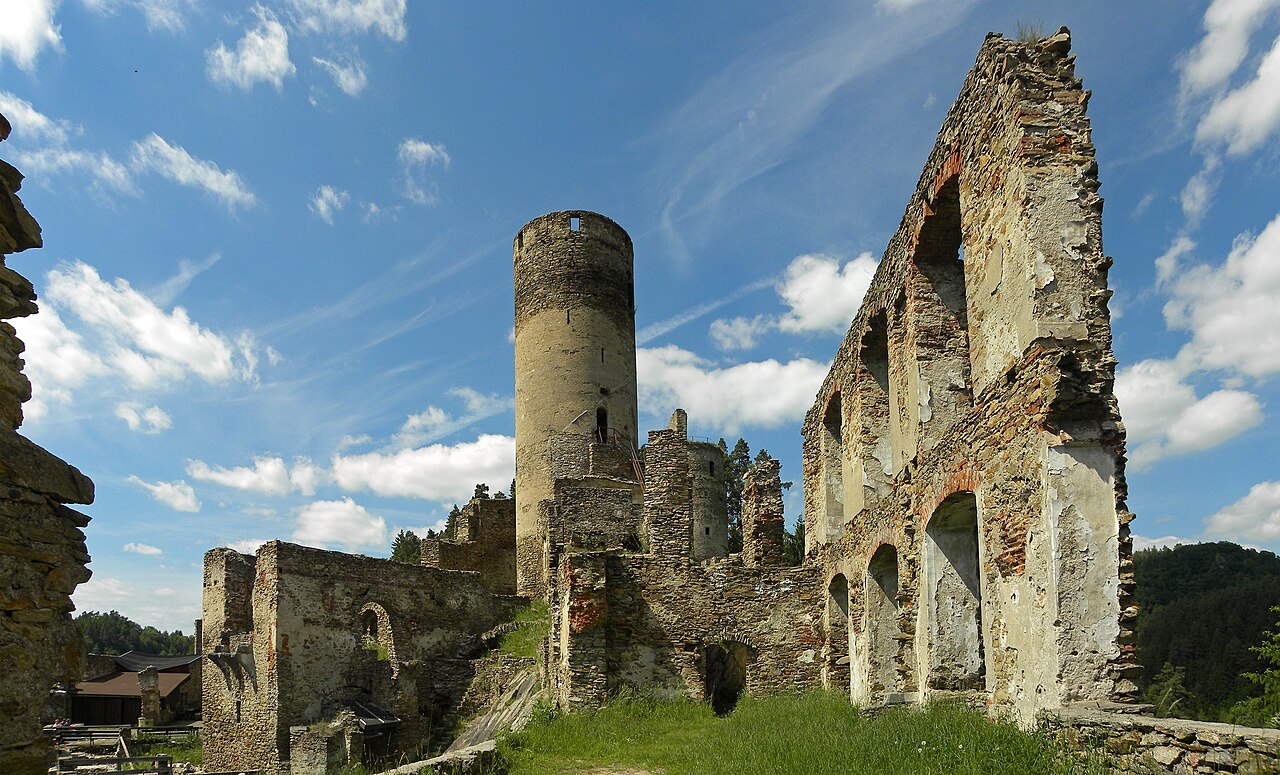
Raabs Castle

Raabs Castle: medieval fortress on the Thaya river in Lower Austria
Raabs an der Thaya, Austria
High Medieval (11th–13th c.)
Partially Restored

Raabs Castle, known locally as Burg Raabs, is a prominent medieval fortress located in the town of Raabs an der Thaya in the province of Lower Austria. This hill castle occupies a commanding position on a steep rocky ridge overlooking the confluence of the Thaya rivers, offering strategic views over the surrounding landscape. Its elongated ground plan follows the natural contours of the ridge, a typical defensive adaptation in medieval castle architecture.

The castle's origins date back to the mid-11th century, with the first documented mention in 1074. It was likely constructed between 1050 and 1074 by the Lords of Raabs, an influential noble family of the region. Raabs Castle played a significant role in the turbulent political landscape of the High Medieval period, particularly due to its proximity to the borderlands of Moravia and Bohemia.

Early history and medieval conflicts

In the early 12th century, the castle came under the control of Gottfried II, Lord of Raabs and Burgrave of Nuremberg. During this period, the castle served as a base for Luitpold of Znojmo, a Moravian duke from the House of Přemyslid, who was hosted by Gottfried II. Luitpold used Raabs Castle as a staging ground for raids into Moravian territory, provoking military responses from neighboring powers.

One notable episode involved a siege led by Boleslav IV, Duke of Bohemia, who marched against Raabs Castle to capture Luitpold after he refused to surrender. The siege lasted six weeks, ending with Luitpold's surrender and the restoration of the castle to Gottfried II. This event highlights the castle's strategic importance and its role in regional power struggles during the 12th century.

Ownership transitions and political significance

Following the extinction of the male line of the Lords of Raabs around 1192, the castle passed to the Counts of Hirschberg-Tallenstein through marriage. The castle's ownership changed hands several times during the 13th century, reflecting the shifting political alliances and feudal arrangements of the time.

By the mid-13th century, the castle became part of the holdings of Vok I of Rožmberk, a member of the Czech noble clan Vítkovci, after the acquisition of the county by King Přemysl Otakar II of Bohemia in 1252. Subsequently, following the Battle of Marchfeld in 1278, the castle and surrounding lands were confiscated by King Rudolf I of Habsburg and incorporated into Habsburg domains by 1282. These transitions underscore Raabs Castle's role at the crossroads of Bohemian and Austrian territorial ambitions.

Ownership continued to evolve, with the castle held by the House of Maissau from 1297 until 1385, when it passed to the House of Puchheim. The Puchheim family maintained possession until 1702, when Franz Anton von Puchheim sold the castle following his appointment as bishop of Wiener Neustadt. Subsequent ownership included various noble families until the early 20th century, when Baron Hugo Klinger von Klingerstorff acquired it in 1912.

Architectural features and layout

Raabs Castle's architecture reflects its High Medieval origins and adaptation to the rugged terrain. The castle's elongated layout follows the rocky ridge, maximizing natural defensive advantages. Key features include fortified curtain walls, towers positioned for optimal surveillance, and a gatehouse controlling access.

The castle overlooks the Thaya river, providing a natural moat on one side and enhancing its defensive position. The steep slopes surrounding the site reduce vulnerability to siege engines and direct assault. Inside, the castle would have contained residential quarters, a great hall, and service buildings arranged along the ridge.

Modern history and preservation

In the 20th century, Raabs Castle experienced economic challenges, particularly following the First World War, which led to its auction in 1932. Restoration efforts in recent decades have aimed to preserve the castle's structural integrity and historical character. Today, the castle is owned by the publisher Richard Pils and his family, who operate a cultural venue known as the “province library.”

The site hosts various exhibitions and an annual poets’ festival in August, integrating literary culture with the castle's historical ambiance. Guided tours are available upon request, allowing visitors to explore the castle's architectural features and learn about its layered history.

Visiting raabs castle

Raabs Castle is accessible to the public through guided tours, which provide detailed insights into its medieval architecture and historical significance. The castle's location on a rocky promontory offers panoramic views of the Thaya valley and the surrounding countryside.

Visitors should inquire in advance to arrange tours, as opening times may vary. The castle's cultural events and exhibitions add to the visitor experience, making it a notable destination for those interested in medieval fortifications and Austrian heritage.

Frequently asked questions (FAQ)

How do I arrange a visit to Raabs Castle?
Visits to Raabs Castle are by guided tour, which can be arranged upon request. It is recommended to contact the castle's management in advance to confirm availability and opening times.
What is the historical significance of Raabs Castle?
Raabs Castle played a key role in regional conflicts during the High Medieval period, serving as a strategic fortress on the border between Austria and Moravia. It witnessed sieges and ownership changes reflecting broader political shifts.
What architectural features does Raabs Castle have?
The castle features an elongated layout following a rocky ridge, with fortified walls, towers, and a gatehouse. Its position above the Thaya river provides natural defenses and commanding views.
Is Raabs Castle accessible for visitors with limited mobility?
Due to its hilltop location on a rocky promontory, access to Raabs Castle involves uneven terrain and stairs, which may limit accessibility for visitors with mobility impairments.
When is the best time to visit Raabs Castle?
The castle is best visited during the warmer months when guided tours and cultural events such as the annual poets’ festival are held. Visitors should check for event schedules and tour availability.

Information

Hill Castle

Current owner

Private owner

Address

Oberndorf bei Raabs 1, Austria

Loading map...

Visitor reviews

No reviews yet. Been here? Write the first review and help other travelers!

Write the first review

Visited this castle? Share your experience

Your review helps other travelers and adds first-hand knowledge to our encyclopedia.
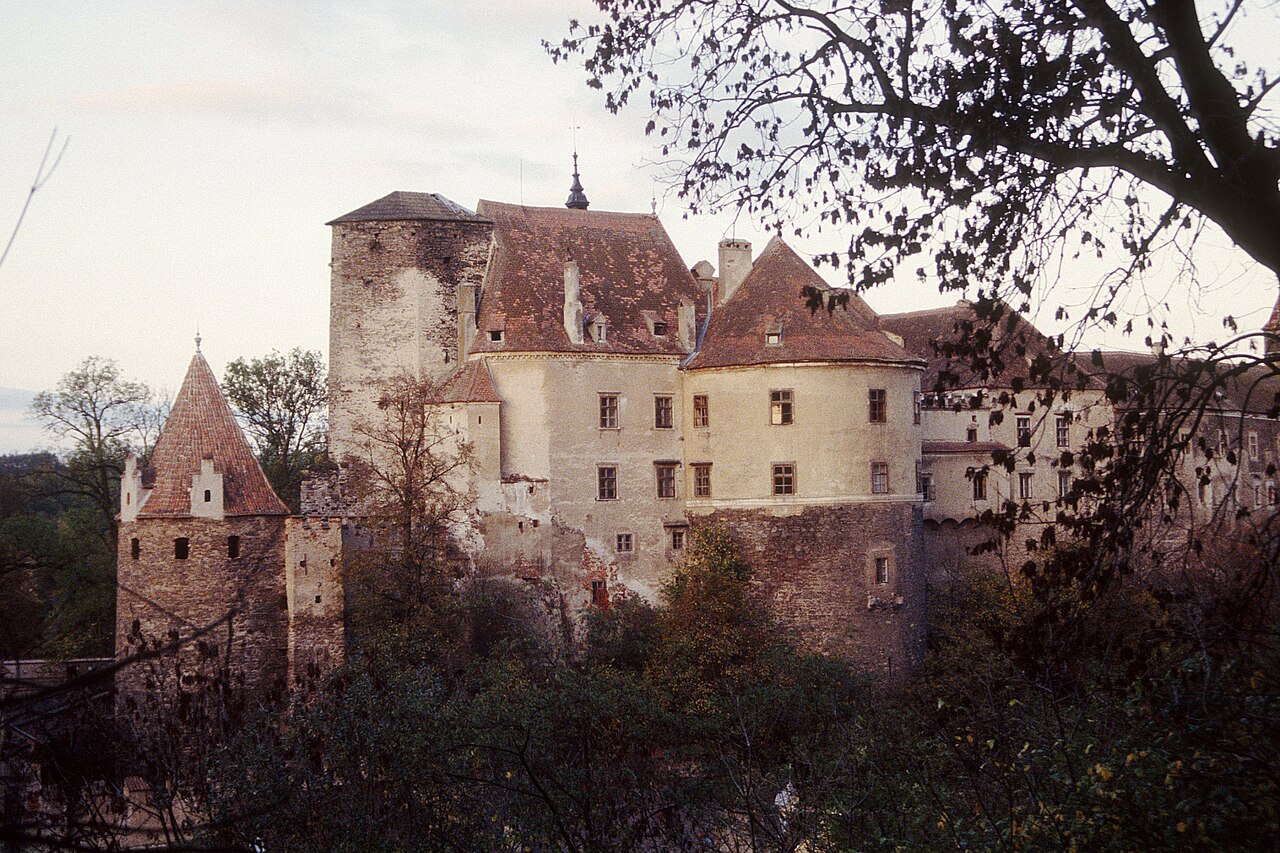
Write a review

(5/5)

0/2000 characters

Your review will be visible after admin approval

Nearby castles

0.2 km
Burg Raabs an der Thaya — Austria castle

Burg Raabs an der Thaya

Raabs an der Thaya, Austria

Burg Raabs an der Thaya is a remarkable hilltop castle located in the town of Raabs an der Thaya, Austria, commanding a strategic position on a rocky spur overlooking the confluence of the German and Moravian Thaya rivers. This high medieval fortress embodies a rich architectural and historical legacy spanning from the 11th century through the Renaissance and Baroque periods. Today, the castle remains inhabited and protected as a significant cultural monument, offering a tangible connection to the region's complex medieval past. Early origins and historical context The origins of Burg Raabs an der Thaya trace back to a fortified settlement known as "Burganlage Sand", situated approximately two kilometers west of the current castle site. This early stronghold was established between 926 and 929 AD during a period marked by Hungarian dominance in the region. The settlement was inhabited by Slavic peoples but was destroyed by fire, likely resulting from a Hungarian raid, as evidenced by the discovery of Hungarian arrowheads during archaeological excavations. Following this destruction, the site was abandoned. The castle itself is first documented in the year 1100 AD in the chronicles of Cosmas of Prague, who mentions a lord named Gotfridi residing in "castrum Racouz". Earlier records from 1074 and 1076 reference the surrounding forest "silva Rogacz", granted to the Babenberg margraves of Austria. Throughout the 11th and 12th centuries, the castle and its lands were pivotal in the power struggles among Bohemia, Moravia, and Austria. A notable event includes the six-week siege in 1100 by Duke Bretislav of Bohemia, aimed at dislodging a hostile Moravian Přemyslid ruler occupying the castle. Medieval ownership and political significance From the early 12th century, the Raabs family held the castle and the prestigious title of Burggraf of Nuremberg. Their male lineage ended around 1191, after which the county was divided through marriage between the Zollern family, ancestors of the later Hohenzollerns, and the counts of Dollnstein-Hirschberg. The castle's ownership changed hands frequently in subsequent centuries, reflecting the shifting political landscape. The Counts of Plain-Hardegg assumed control in 1252, followed by the Rosenbergs in 1260. After 1278, the Habsburgs acquired the castle, with complex arrangements involving the Maissau family and Kuenring ministeriales until the late 13th century. In 1385, the Puchheim family became owners and transformed the castle from a feudal fief into a free estate by the early 1500s. They expanded the complex significantly and were notable supporters of Protestantism during the Reformation. A violent incident in 1591 involved the murder of Niklas von Puchheim in the castle courtyard amid conflicts with local nobility. Early modern and modern history The 18th and 19th centuries saw the castle pass through several noble families, including the Quarient and Raall, Bartenstein, Kaiserstein, Villa-Secca, Lindheim, and Boos von Waldeck und Montfort. The castle attracted notable visitors such as Archduke Rainer in 1898 and Archduke Franz Ferdinand in 1910. The First World War brought economic hardship, and in 1924, Austrian President Michael Hainisch visited the site. A tragic event in 1926 involved a duel and the subsequent suicide of the baron’s wife, Sybille, contributing to the castle’s decline. In 1932, the castle was auctioned and largely emptied of its furnishings. During the 1930s, it housed a local museum until World War II. Under Nazi rule, the castle served various purposes including a base for Sudeten German paramilitary groups, a resettlement camp for ethnic Germans, and a training site for the Hitler Youth. Post-war, the castle changed hands multiple times and underwent renovations in the 1970s. Since 1996, publisher Richard Pils has owned the property and, together with a local association, has been actively restoring the complex. Architectural features and layout Burg Raabs an der Thaya is a long, narrow fortress extending about 200 meters in length and up to 40 meters wide, perched on a rocky hilltop. The castle's layout follows the natural contours of the hill, resulting in a complex structure built in multiple phases from the 11th through the 17th centuries. The main castle core occupies the eastern end of the site. Access is exclusively from the west, where outer defensive wards and a narrow enclosed passage called a zwinger protect the approach. The castle’s defensive design includes a rock-cut neck ditch and multiple layers of fortifications. Roman and early medieval elements The oldest surviving elements include the "Feste Haus", a fortified residential building, and a Romanesque chapel dedicated to Saint Clemens. The chapel likely had two floors; its lower level, once used as a wine cellar, features a heavily altered round-arched window. A distinctive Romanesque funnel-shaped window in the chapel’s south wall dates it to the 12th century. The southern curtain wall and a cellar near the main tower show finely worked stonework with a herringbone pattern, typical of early 12th-century construction. The bergfried and main tower The castle’s main tower, or bergfried, has a unique multi-faceted shape. Its base is pentagonal and dates to the mid-12th century, constructed from roughly hewn rubble stone with traces of joint finishing. Above approximately ten meters, the tower’s plan changes to a seven-sided form from the late 13th century, reflecting later additions and architectural evolution. Excavations beneath the Großer Rittersaal (Great Knight’s Hall) uncovered a thick stone wall dating to around 1050, indicating an 11th-century stone building phase predating much of the visible structure. Later medieval and renaissance modifications During the late medieval and Renaissance periods, the castle was remodeled into a multi-winged palace complex arranged around two courtyards. A notable late Gothic feature is the "Ochsenturm", a semicircular artillery bastion projecting from the southern wall, measuring 17 meters across. On the northern side, a Renaissance well house contains a shaft reaching down to the valley floor, demonstrating the castle's adaptation to evolving defensive and domestic needs. Outer defenses and foreworks The western foreworks include the "Hungerturm", a dungeon tower, and another round tower, both heavily altered in the 16th and 17th centuries. The "Hungerturm" was part of a gate complex that once included an 18th-century round tower now demolished. The first outer courtyard, called the "Umkehr", lies below the "Turniergarten" and features open Renaissance arcades facing the valley. A modern stone bridge crosses the neck ditch separating the outer ward from the main castle. The 16th-century zwinger walls, with semicircular bartizans (small overhanging turrets), flank the neck ditch and parts of the main castle. A rock-cut neck ditch and an arcade resembling an aqueduct connect the main castle to a platform known as the "Bastei". This platform likely marks the site of a 13th-century burgrave’s castle, later rebuilt as a 16th-century forework visible in a 1672 engraving by Georg Matthäus Vischer. Cultural significance and preservation Burg Raabs an der Thaya stands as a testament to the layered history of medieval fortifications and noble residences in Lower Austria. Its fabric reveals a complex layering of construction phases, showcasing Romanesque, Gothic, Renaissance, and Baroque architectural styles. The castle's continuous habitation and recent restoration efforts have preserved its historical character, making it an important site for cultural heritage and tourism. The castle's location atop a rocky hill with commanding views and its extensive defensive works exemplify the strategic military architecture of the high medieval period. Its evolution into a Renaissance palace complex reflects broader shifts in castle functions from purely military to residential and administrative roles. Today, the castle is privately owned and maintained by publisher Richard Pils in collaboration with local heritage associations. Its preservation ensures that Burg Raabs an der Thaya remains a vital link to Austria's medieval past and an engaging destination for visitors interested in history and architecture.

High Medieval (11th–13th c.)
Details
4.2 km
Kollmitz Castle — Austria castle

Kollmitz Castle

Kollmitzgraben, Austria

Kollmitz Castle, known locally as Burg Kollmitz, is a significant medieval ruin located near the village of Kollmitzgraben in the province of Lower Austria. Positioned strategically on a ridge within a bend of the Thaya river valley, it ranks among the largest castle ruins in Austria. The site offers a fascinating glimpse into medieval fortification and noble residence architecture, featuring a semicircular gate tower, a round corner tower, a massive keep, and the remains of a two-level residential building. Historical background and ownership The castle was first documented in the 12th century under the name "Chalmunze," marking its origins in the high medieval period. Throughout its history, Kollmitz Castle changed hands multiple times, initially belonging to various noble families before passing to the Gera Abbey and later the Lords of Raabs. Its most prosperous era occurred during the renaissance under the ownership of the Lords of Hofkirchen, a family that controlled the castle from 1411 until the early 17th century. The Hofkirchen family's tenure ended in 1611 when Wolfgang von Hofkirchen died in exile in Prague amid the Habsburg Counter-Reformation, during which he was viewed as a leader of Protestant nobility. Subsequently, the castle passed through several owners and eventually fell into disuse. Architectural features and fortifications The keep and towers The keep of Kollmitz Castle is a dominant feature, standing approximately 25 meters tall with walls nearly 2.90 meters thick. This robust structure served as the stronghold and last line of defense. Adjacent to the keep is a gothic corner tower, likely constructed in the 15th century, notable for its exceptionally thick walls measuring 3.7 meters. Both towers are accessible to visitors and provide panoramic views of the surrounding landscape. Residential buildings and renovations The castle's residential quarters included a two-level building that underwent renovation around 1700. However, the imposition of a roof tax during the Napoleonic Wars led to the removal of roofs around 1800, rendering the castle uninhabitable and accelerating its decline into ruin. The bohemian or devil's wall Approximately 400 meters north of the main castle ruins stands a remarkable freestanding defensive structure known as the Bohemian wall or Devil's wall. Built around 1448, this curtain wall stretches about 160 meters in length and rises 5 meters high, spanning the narrowest part of the ridge to protect the road leading to the castle. This wall is unique in Austria for being a separated defensive barrier and played a crucial role in defending the castle during a siege by the troops of the Bohemian King Podiebrad in 1450. Decline and preservation Following its abandonment as a residence and administrative center, Kollmitz Castle fell into disrepair. In 1708, it was acquired by Franz Anton von Quarient und Raal, under whose ownership the castle no longer served a practical purpose and continued to deteriorate. The removal of roofs in the early 19th century further hastened its ruinous state. Today, the ruins are owned by the city of Raabs and maintained by the Society for the Preservation of the Kollmitz Ruins. The site is freely accessible to the public, offering visitors the opportunity to explore its extensive passageways, large cellars, and climb both the keep and the round tower. Visitor experience and surroundings The approach to Kollmitz Castle involves a scenic walk through wooded terrain, enhancing the sense of entering a medieval stronghold. The ruins themselves provide a tangible connection to Austria's medieval past, with well-preserved structural elements that illustrate the defensive and residential functions of the castle. Its location on a ridge overlooking the Thaya river valley adds strategic and aesthetic value to the site. While detailed historical records are limited, the castle's architectural remains and its distinctive Bohemian wall offer valuable insights into medieval fortification techniques and the region's turbulent history during the late Middle Ages and Renaissance periods.

High Medieval (11th–13th c.)
Details
6.7 km

Eibenstein Castle

L1258, Austria

Eibenstein Castle, known locally as Burg Eibenstein, is a striking medieval hilltop ruin located near the hamlet of Eibenstein, southeast of the village of Drosendorf an der Thaya in the province of Lower Austria. This castle stands on a steep rocky outcrop overlooking the Thaya River, a strategic position that provided natural defenses and control over a crucial river crossing in the region. Constructed in the 12th century, Eibenstein Castle exemplifies the typical high medieval hill castle (Höhenburg) architecture of its era. Its elevated position on a rocky cliff allowed it to serve both as a defensive stronghold and a symbol of feudal power. The castle's robust stone walls were adapted to the uneven terrain, incorporating natural rock formations into its fortifications. Historical background and ownership The first recorded mention of Eibenstein Castle dates back to 1194, indicating its establishment by the medieval European nobility during a period of territorial consolidation and frequent regional conflicts. Initially, the castle was held by the Eibenstein family, who maintained ownership until 1543. On April 24 of that year, ownership transferred to Christoph and Erasmus von Schneckenreith, brothers from a noble family whose lineage ended by 1569. Following the extinction of the Schneckenreith family, the castle became part of the larger lordship of Drosendorf. Subsequently, it passed into the hands of the Hoyos family, a noble lineage originally from Spain, who retained possession for an extended period. This succession of noble owners reflects the castle's importance within the regional feudal hierarchy. Architectural features and strategic location Eibenstein Castle's design capitalized on its hilltop location, typical of high medieval fortifications. The castle's northern walls were constructed atop a precipitous rocky cliff that directly overlooked the Thaya River, providing a formidable natural defense. This positioning allowed defenders to monitor and control river traffic and protect the surrounding lands from incursions. The castle complex included defensive walls that conformed to the topography, with battlements and towers likely integrated to enhance surveillance and defense capabilities. Although detailed architectural plans and measurements are not available, the ruins suggest a compact fortification adapted to the terrain's constraints. Structural decline and partial collapse By the 17th century, Eibenstein Castle had fallen into significant disrepair. The decline was documented by the cleric and cartographer Georg Matthäus Vischer, who depicted the castle as a ruin. Historian Franz Xaver Kießling later described the site as desolate, confirming its prolonged abandonment. During the Thirty Years’ War (1618–1648), the ruins saw temporary occupation, likely for shelter or strategic purposes amidst the conflict. However, the castle never recovered its former prominence. A major structural loss occurred in 1867 when a severe storm caused the collapse of a large section of the castle's southern facade, which fell down the steep cliff into the Thaya River below. This event significantly altered the castle's silhouette and contributed to its current ruinous state. Cultural significance and local legends Local folklore enriches the castle's history with tales linking its last proprietors to the Knights Templar, a medieval religious and military order known for their secretive and martial legacy. These legends also narrate how rebellious peasants allegedly ravaged the fortress, contributing to its decline and abandonment. While these stories add a layer of mystique, they remain part of the oral tradition rather than documented history. The castle's narrative is thus a blend of verifiable facts and evocative local myths, enhancing its allure as a cultural landmark. Current state and visitor experience Today, the ruins of Eibenstein Castle are freely accessible to the public. The site is reached by a short walk from the nearby road, making it a quiet destination off the main tourist routes. Visitors can explore the remains of the stone walls, foundations, and the dramatic cliffside setting that once made the castle a formidable fortress. The ruins, though lacking decorative elements or archaeological artifacts such as inscriptions or pottery, offer a tangible connection to the region's medieval past. The castle's elevated position provides scenic views of the Thaya River valley and the village of Eibenstein, noted for its parish church dedicated to Saint Giles. Eibenstein Castle stands as a testament to the architectural ingenuity and feudal history of medieval Austria. Its enduring presence, despite centuries of neglect and natural decay, continues to captivate historians, architects, and visitors alike.

High Medieval (11th–13th c.)
Details