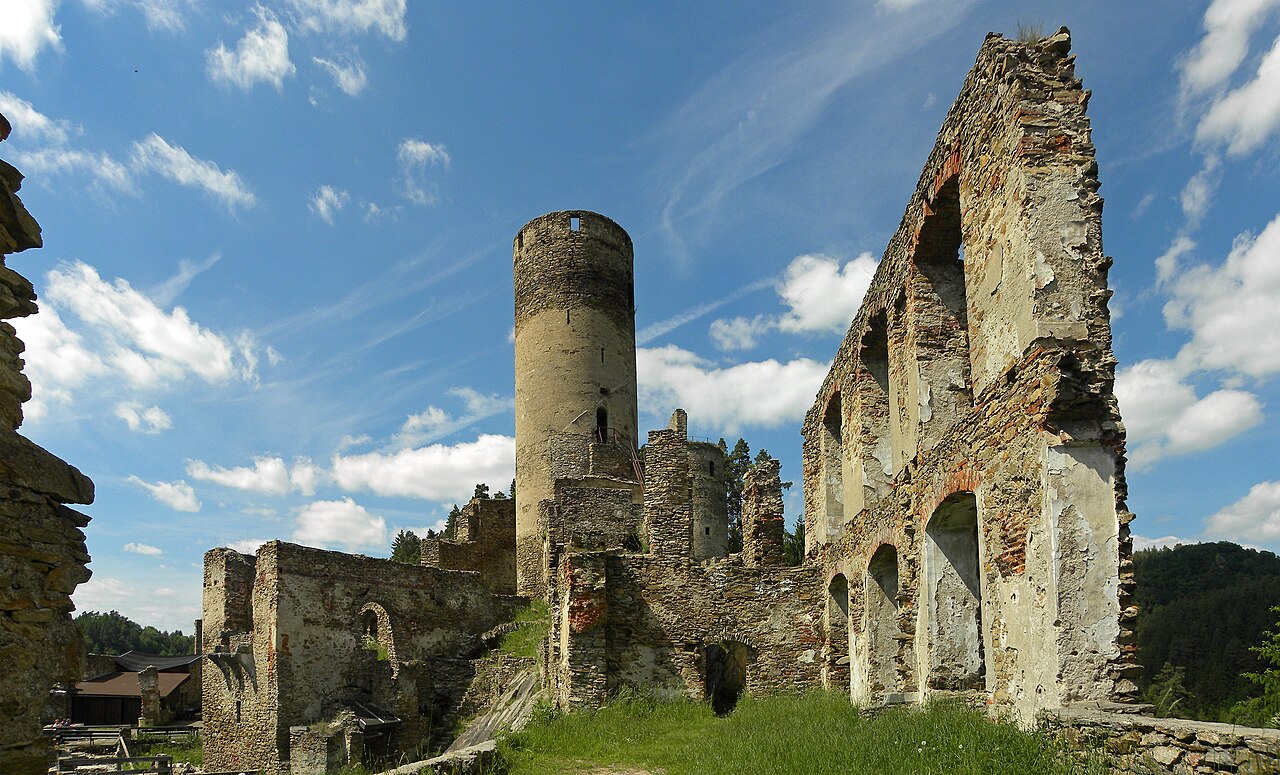
Eibenstein Castle
Eibenstein Castle, known locally as Burg Eibenstein, is a striking medieval hilltop ruin located near the hamlet of Eibenstein, southeast of the village of Drosendorf an der Thaya in the province of Lower Austria. This castle stands on a steep rocky outcrop overlooking the Thaya River, a strategic position that provided natural defenses and control over a crucial river crossing in the region.
Constructed in the 12th century, Eibenstein Castle exemplifies the typical high medieval hill castle (Höhenburg) architecture of its era. Its elevated position on a rocky cliff allowed it to serve both as a defensive stronghold and a symbol of feudal power. The castle's robust stone walls were adapted to the uneven terrain, incorporating natural rock formations into its fortifications.
Historical background and ownership
The first recorded mention of Eibenstein Castle dates back to 1194, indicating its establishment by the medieval European nobility during a period of territorial consolidation and frequent regional conflicts. Initially, the castle was held by the Eibenstein family, who maintained ownership until 1543. On April 24 of that year, ownership transferred to Christoph and Erasmus von Schneckenreith, brothers from a noble family whose lineage ended by 1569.
Following the extinction of the Schneckenreith family, the castle became part of the larger lordship of Drosendorf. Subsequently, it passed into the hands of the Hoyos family, a noble lineage originally from Spain, who retained possession for an extended period. This succession of noble owners reflects the castle's importance within the regional feudal hierarchy.
Architectural features and strategic location
Eibenstein Castle's design capitalized on its hilltop location, typical of high medieval fortifications. The castle's northern walls were constructed atop a precipitous rocky cliff that directly overlooked the Thaya River, providing a formidable natural defense. This positioning allowed defenders to monitor and control river traffic and protect the surrounding lands from incursions.
The castle complex included defensive walls that conformed to the topography, with battlements and towers likely integrated to enhance surveillance and defense capabilities. Although detailed architectural plans and measurements are not available, the ruins suggest a compact fortification adapted to the terrain's constraints.
Structural decline and partial collapse
By the 17th century, Eibenstein Castle had fallen into significant disrepair. The decline was documented by the cleric and cartographer Georg Matthäus Vischer, who depicted the castle as a ruin. Historian Franz Xaver Kießling later described the site as desolate, confirming its prolonged abandonment.
During the Thirty Years’ War (1618–1648), the ruins saw temporary occupation, likely for shelter or strategic purposes amidst the conflict. However, the castle never recovered its former prominence.
A major structural loss occurred in 1867 when a severe storm caused the collapse of a large section of the castle's southern facade, which fell down the steep cliff into the Thaya River below. This event significantly altered the castle's silhouette and contributed to its current ruinous state.
Cultural significance and local legends
Local folklore enriches the castle's history with tales linking its last proprietors to the Knights Templar, a medieval religious and military order known for their secretive and martial legacy. These legends also narrate how rebellious peasants allegedly ravaged the fortress, contributing to its decline and abandonment.
While these stories add a layer of mystique, they remain part of the oral tradition rather than documented history. The castle's narrative is thus a blend of verifiable facts and evocative local myths, enhancing its allure as a cultural landmark.
Current state and visitor experience
Today, the ruins of Eibenstein Castle are freely accessible to the public. The site is reached by a short walk from the nearby road, making it a quiet destination off the main tourist routes. Visitors can explore the remains of the stone walls, foundations, and the dramatic cliffside setting that once made the castle a formidable fortress.
The ruins, though lacking decorative elements or archaeological artifacts such as inscriptions or pottery, offer a tangible connection to the region's medieval past. The castle's elevated position provides scenic views of the Thaya River valley and the village of Eibenstein, noted for its parish church dedicated to Saint Giles.
Eibenstein Castle stands as a testament to the architectural ingenuity and feudal history of medieval Austria. Its enduring presence, despite centuries of neglect and natural decay, continues to captivate historians, architects, and visitors alike.
Frequently asked questions (FAQ)
- How do I get to Eibenstein Castle?
- Eibenstein Castle is accessible by a short walk from the nearby road L1258 in Lower Austria. The site is off the main tourist routes, so a car or local transport to the vicinity is recommended.
- What is the historical significance of Eibenstein Castle?
- Eibenstein Castle dates back to the 12th century and was a strategic hilltop fortress guarding a crossing of the Thaya River. It reflects the feudal history and medieval architecture of Lower Austria.
- Is Eibenstein Castle open to visitors?
- Yes, the ruins of Eibenstein Castle are freely accessible to the public. Visitors can explore the remains and enjoy scenic views of the Thaya River valley.
- When was Eibenstein Castle built?
- Eibenstein Castle was built in the 12th century, with the first recorded mention in 1194.
- Why did Eibenstein Castle fall into ruin?
- The castle fell into disrepair by the 17th century due to neglect and damage during conflicts such as the Thirty Years’ War. A major collapse occurred in 1867 during a storm.
Information
Address
L1258, Austria
Loading map...
Visitor reviews
No reviews yet. Been here? Write the first review and help other travelers!
Write the first reviewVisited this castle? Share your experience
Your review helps other travelers and adds first-hand knowledge to our encyclopedia.