Querforadat Castle
Querforadat Castle stands as a significant medieval fortress located in the municipality of Cava, within the historic region of Catalonia, Spain. This hill castle occupies a commanding rocky outcrop overlooking the Torrent del Coll del Quer, a strategic position typical of medieval border fortifications known as "castells termenats." Constructed during the early medieval period, its primary purpose was to control and defend the surrounding territory along vital access routes.
Early history and noble stewardship
The castle's origins are documented as early as 1004, with explicit references to the fortress appearing by 1109. In the 11th century, Querforadat was under the ownership of the Counts of Cerdanya, a prominent noble family governing parts of the region. Around the year 1100, Galceran, son of Sicardis, pledged fealty to the Counts for several castles including Querforadat, then known as "Cher Foradat." This highlights the castle's role within the feudal network of the time.
Following the first half of the 12th century, control of the castle and the surrounding territories passed to the Count of Barcelona, marking a significant shift in regional power. Subsequently, Galceran, son of Adalaidis from the Pinós family, reaffirmed his feudal allegiance for the castle, now referred to as "Cher Foradad," indicating continuity of noble stewardship despite changing overlords.
Throughout the 13th and early 14th centuries, ownership remained with the Galceran de Pinós family. In 1313, the procurator of Saura de Mallorca, widow of Pere Galceran de Pinós, formally paid homage to King James of Aragon for Querforadat and its lands. Despite this royal connection, the family maintained the castle as their allodial property, a hereditary possession free from feudal duties to the crown.
Later noble alliances and titles
In 1428, the viscountcy of Évol came under the control of the Castre-Pinós family through marriage alliances, linking influential noble lineages. Around 1620, Gaspar Galceran de Castre-Pinós de So i Aragó, the first Count of Guimerà, adopted the additional title of Viscount of Querforadat. This noble title persisted within his descendants, preserving the family's historic connection to the fortress.
Architectural features and current remains
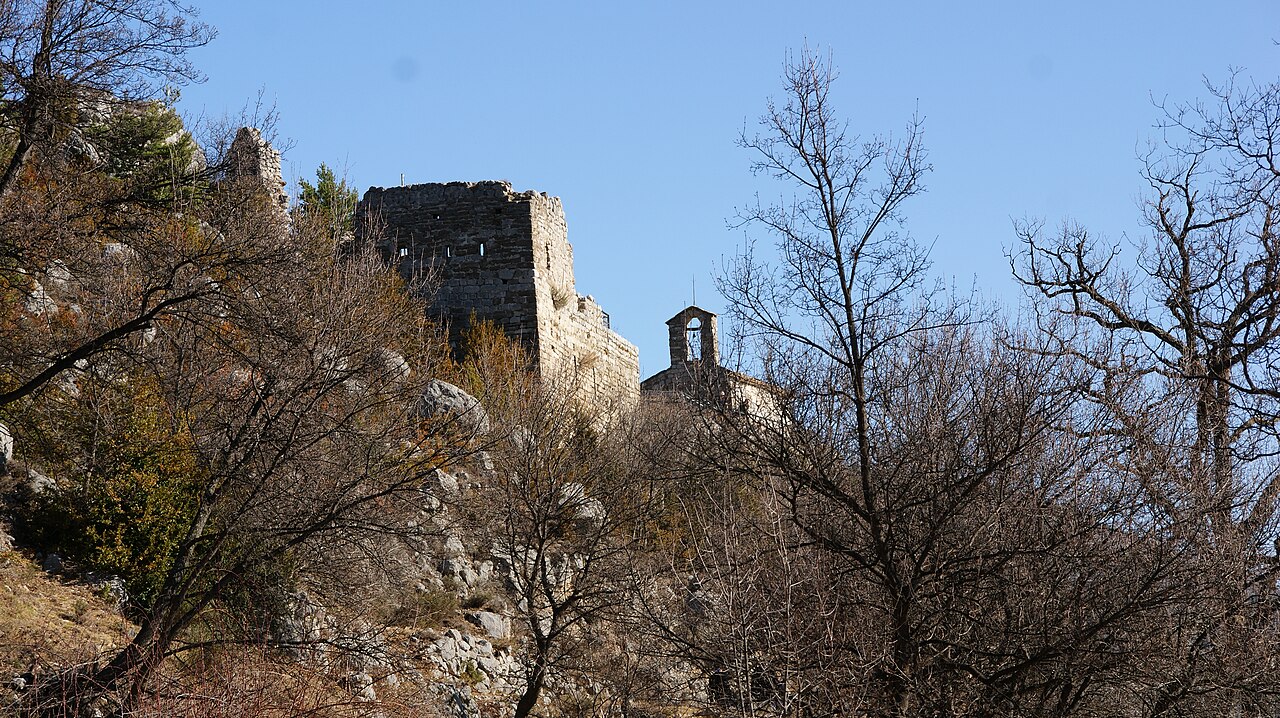
Querforadat Castle's strategic location on a rocky promontory provided natural defenses complemented by constructed fortifications. The surviving remains are limited but significant. The most prominent feature visible today is a circular tower that formed part of the castle's defensive system. This tower, built with robust stone masonry typical of the medieval period, has been partially incorporated into a later residential structure. The reuse of the tower's vaulted ceiling within the house exemplifies adaptive architectural practices over the centuries.
Fragments of the enclosing curtain walls also survive, though they are incomplete and in a ruinous state. These walls once enclosed the castle's courtyard, providing protection and controlling passage along the borderland it guarded. Constructed from locally sourced stone, the walls reflect the practical defensive architecture of the time.
The overall preservation state of Querforadat Castle is poor due to centuries of neglect and modifications. The integration of original medieval elements into newer buildings illustrates a common pattern of reuse rather than isolated preservation. While no decorative stonework, inscriptions, or detailed architectural ornamentation remain visible, the ruins retain the fortress's footprint and defensive character.
Historical and cultural significance
Querforadat Castle serves as a tangible reminder of medieval territorial organization and noble power in the Alt Urgell region of Catalonia. Its role as a border castle reflects the complex feudal allegiances and shifting political landscape of the early to late medieval period.
Though no specific legends or inscriptions have been recorded at the site, archaeological and archival research have contributed to understanding its history and layout. The castle's designation as a cultural asset of national interest within Catalonia and its registration under Spanish heritage protection underscore its importance for historical preservation and study.
Visiting querforadat castle
Today, Querforadat Castle is accessible to visitors interested in medieval history and castle architecture. Although the remains are modest, the site offers insight into the defensive strategies and noble residences of the region's past. Visitors can explore the ruins and appreciate the castle's commanding views over the surrounding landscape.
Due to its ruinous condition and partial incorporation into private property, access may be limited, and visitors are advised to respect the site and any local regulations. The castle's location within Catalonia makes it part of a broader network of medieval fortifications that illustrate the region's rich historical tapestry.
Frequently asked questions (FAQ)
- When was Querforadat Castle built?
- Querforadat Castle was constructed during the early medieval period, with historical records dating back to the year 1004.
- Where is Querforadat Castle located?
- The castle is located in the municipality of Cava, in the Catalonia region of Spain, positioned on a rocky hill overlooking the Torrent del Coll del Quer.
- What remains can be seen at Querforadat Castle today?
- Today, visitors can see the ruins of a circular tower and fragments of the surrounding walls, with parts of the tower incorporated into a later residential building.
- Is Querforadat Castle protected as a heritage site?
- Yes, Querforadat Castle is recognized as a cultural asset of national interest within Catalonia and is registered under Spanish heritage protection.
- Can visitors access Querforadat Castle freely?
- Access to the castle may be limited due to its ruinous condition and partial incorporation into private property, so visitors should respect local regulations and property boundaries.
Information
Loading map...
Visitor reviews
No reviews yet. Been here? Write the first review and help other travelers!
Write the first reviewVisited this castle? Share your experience
Your review helps other travelers and adds first-hand knowledge to our encyclopedia.