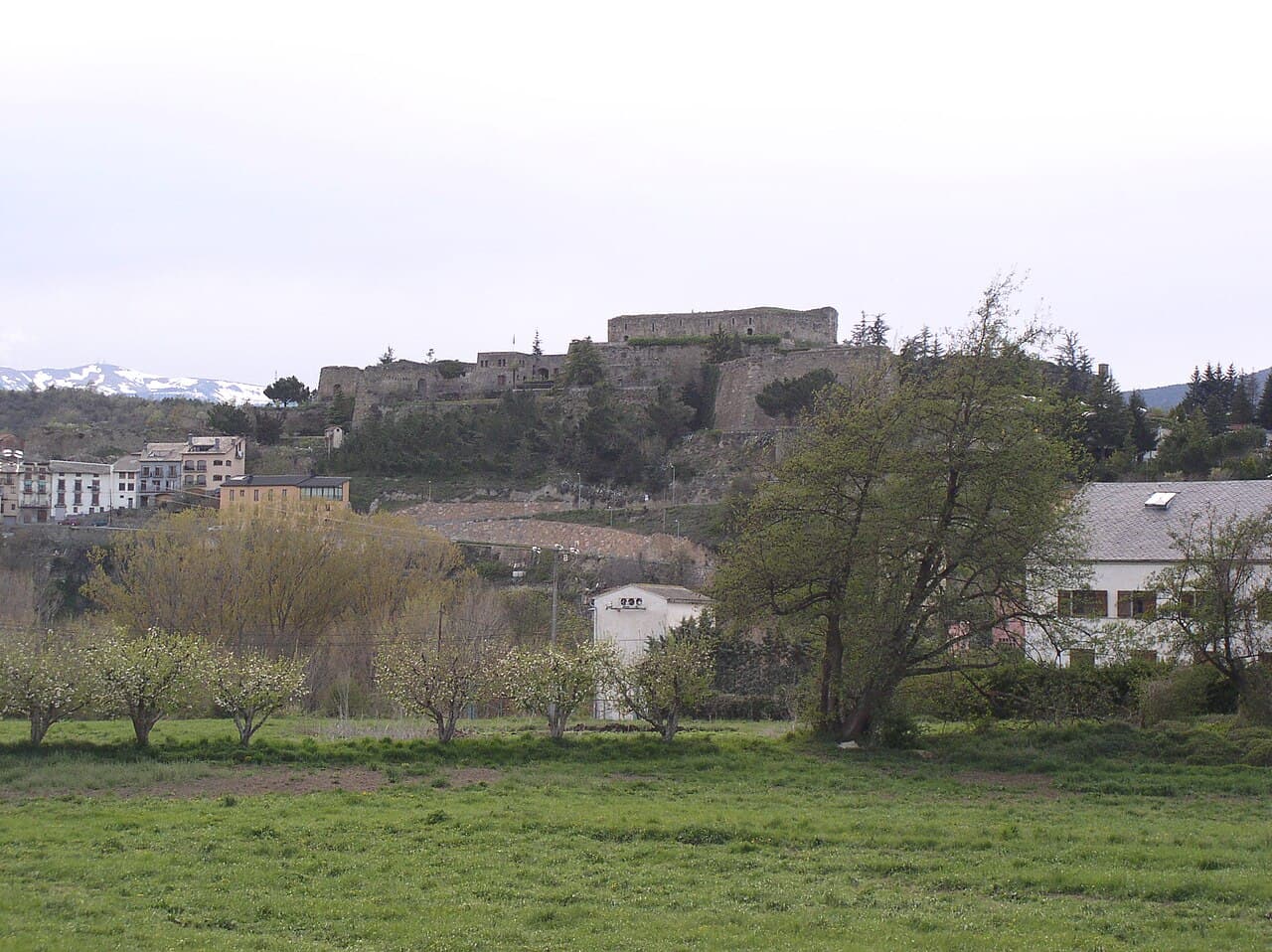
Castell de Ciutat
Castell de Ciutat stands as a significant hill castle located in the municipality of La Seu d'Urgell within the scenic Urgellet valley of Spain. This fortress, perched prominently on a strategic elevation, has served as a defensive bastion and administrative center since medieval times. Its layered history reflects the complex political and military struggles of the region, as well as the evolution of castle architecture from medieval fortifications to modern bastioned designs.
Medieval origins and early history
The site of Castell de Ciutat is believed to correspond to the “pujo Urgelli” mentioned in 11th-century documents, indicating its early importance. The first explicit written references to the castle appear in the 12th century, but the location had already been a focal point for power in the region. The Counts of Urgell established their main residence here, known as the “palacio Civitatis,” documented in 1099. This palace served as the noble seat before the counts relocated closer to border territories.
During the 12th century, the castle became the center of jurisdictional disputes. In 1135, a conflict arose between Viscount Pere Ramón of Castellbò, who fortified the old comital palace, and Bishop Pere Berenguer, who claimed rights dating back to the 10th century. Count Ermengol VI arbitrated, favoring the viscount but imposing conditions to balance control. Despite this, the count’s will in 1154 assigned the castle to the church, leading to a concord in which the viscount recognized the bishop’s secular claims and agreed to refrain from hostile actions involving the fortress.
Further cementing ecclesiastical authority, Count Ermengol VII formally ceded the castle to the church in 1167 during the tenure of Bishop Arnau de Preixens. Later, in 1190, an agreement between Count Ermengol VIII and Viscount Arnau de Castellbò involved the viscount relinquishing control over Castellbò and other fortifications in exchange for royal approval and funds to rebuild Castell de Ciutat. Despite ongoing conflicts, peace treaties in 1194 and 1206 reaffirmed the count’s ultimate sovereignty.
Strategic significance and ownership transitions
In 1226, the viscounty of Castellbò became part of the County of Foix. By 1256, the Count of Urgell transferred ownership of Castell de Ciutat as a freehold to Roger IV of Foix, elevating the castle as a strategic stronghold for the Counts of Foix in the region. This transition marked the castle’s growing military and political importance.
Architectural evolution and military adaptations
The castle underwent significant reconstruction in the 17th century. Contemporary descriptions, including those from the medieval document known as the “Spill,” depict a four-sided structure without towers, surrounded by a substantial moat. The courtyard contained a stone well that provided fresh water, a critical feature for sustaining inhabitants during sieges. A chapel dedicated to Saint George was also present, although it lacked its own endowment.
During the early 18th century, the castle played a notable role in the War of Spanish Succession. It was commanded by General Josep Moragues i Mas, a key figure in the Catalan resistance. The fortress fell to Bourbon forces in 1713, and despite Moragues’ later attempts to recapture it in 1714, the castle remained under Bourbon control.
In 1751, the castle was rebuilt again to reflect contemporary military design principles. This reconstruction adapted the fortress to the Vauban style, a star-shaped fortification system developed to counter artillery advances. The castle features five named bastions: Trobada, Cup, Sant Esteve, Sant Ermengol, and Sant Isidre. These bastions project outward from the main walls, providing overlapping fields of fire and enhancing defensive capabilities.
Further restorations occurred during the Carlist Wars of the 19th century, reflecting the ongoing military relevance of the site. After a period of abandonment in the 20th century, the castle’s historic core was restored, and the complex was adapted for new uses, preserving its heritage.
Architectural features and surviving elements
Today, Castell de Ciutat presents a complex architectural palimpsest combining medieval fragments with later fortifications. The fortress’s Vauban-style star-shaped layout is a prominent feature, with its five bastions strategically positioned for defense. An advanced guard position, the Solsona tower, stands before the main stronghold, providing an additional layer of protection.
Within the courtyard remains the medieval stone well, a tangible link to the castle’s early layout. This circular well, constructed from cut stone, was essential for sustaining the fortress’s inhabitants during sieges.
Only one fragment of the original medieval construction is tentatively identified on the northwest section of the upper structure. This wall portion, built from unshaped granite cobbles bound with sturdy mortar, suggests an earlier construction phase predating the 17th and 18th-century reconstructions. The base of a former tower may be discerned within this fragment, hinting at the castle’s original defensive arrangements.
Historical significance and cultural heritage
Castell de Ciutat embodies the turbulent history of the region, reflecting shifting political powers, ecclesiastical influence, and military innovation. Its role in the Catalan resistance during the War of Spanish Succession highlights its strategic importance. The castle’s architectural evolution from medieval fortress to Vauban-style bastioned fortification illustrates broader trends in military architecture adapting to changing warfare technologies.
Today, the castle stands as a monument to the region’s rich cultural heritage, attracting visitors interested in medieval history, military architecture, and Catalan identity. Its preservation and restoration efforts ensure that this historic fortress continues to educate and inspire future generations.
Frequently asked questions (FAQ)
- What are the visiting hours for Castell de Ciutat?
- Castell de Ciutat is typically open to visitors during daylight hours, but it is recommended to check with the Municipality of La Seu d'Urgell for current opening times and any guided tour availability.
- Is Castell de Ciutat accessible for people with limited mobility?
- The castle is located on a hill with uneven terrain, which may pose challenges for visitors with limited mobility. Some areas of the fortress may not be fully accessible.
- What is the historical significance of Castell de Ciutat?
- Castell de Ciutat played a crucial role as a defensive and administrative center in medieval Catalonia. It was involved in regional conflicts, including the War of Spanish Succession, and reflects the evolution of military architecture from medieval to Vauban-style fortifications.
- Can I visit the medieval stone well inside the castle?
- Yes, visitors can see the medieval stone well located in the castle's courtyard, which provided fresh water to its inhabitants during sieges.
- Are there guided tours available at Castell de Ciutat?
- Guided tours may be offered by the Municipality of La Seu d'Urgell or local heritage organizations. It is advisable to contact them in advance to confirm availability and schedule.
Photo gallery

Information
Sources & official resources
Verify the information above using these authoritative references.
Loading map...
Visitor reviews
No reviews yet. Been here? Write the first review and help other travelers!
Write the first reviewVisited this castle? Share your experience
Your review helps other travelers and adds first-hand knowledge to our encyclopedia.


