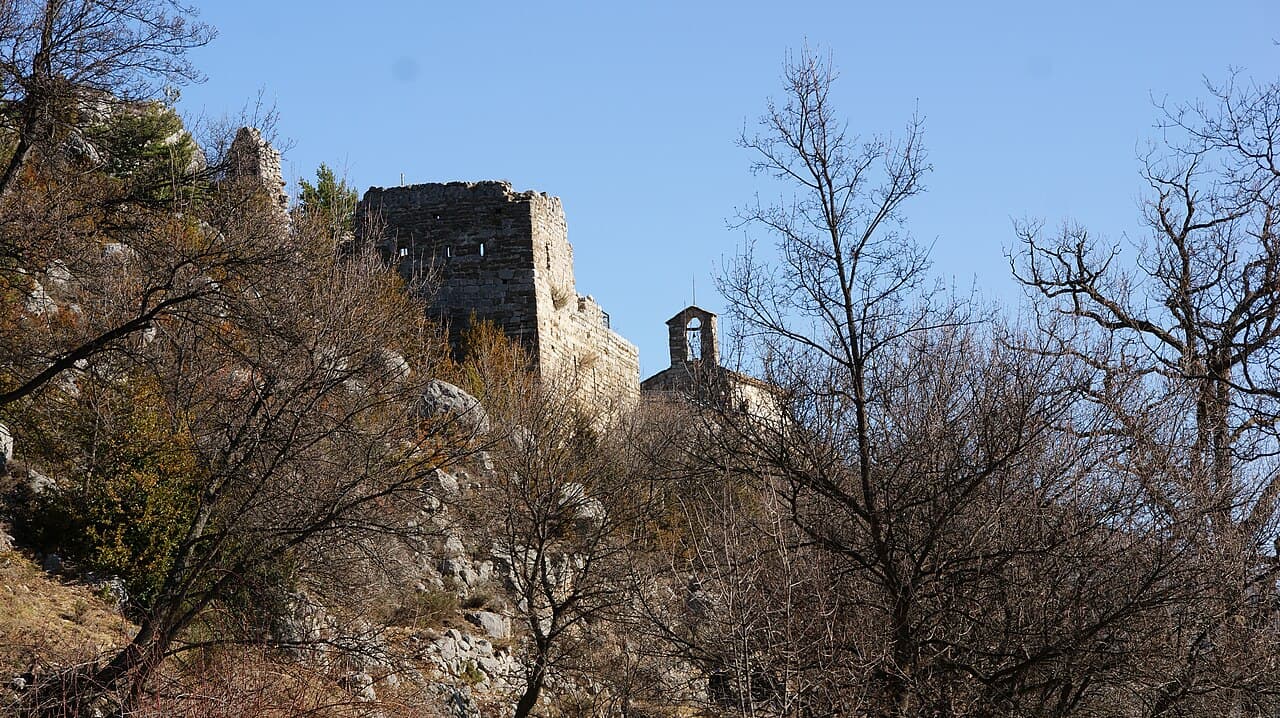
Castell de Saldes
Castell de Saldes stands as a significant medieval hill castle located near the village of Saldes in the mountainous Berguedà region of Spain. Its strategic position on a rocky hill just below the summit provided commanding views over the surrounding landscape, making it an important frontier stronghold during the Middle Ages. The castle's origins date back to the 11th century, with its first documented mention occurring between 1068 and 1095, when Galceran, son of Sicardis, pledged loyalty to Guillem Ramon, Count of Cerdanya.
This early period established the castle as a noble residence linked to the powerful Counts of Cerdanya, integrating it into the feudal network that shaped the region. Over the subsequent decades, the castle's lords swore allegiance to notable figures such as Bernat Guillem and Ramon Berenguer III, Count of Barcelona, reflecting its role within the expanding influence of the County of Barcelona and the Crown of Aragon.
Historical significance and feudal ties
By the mid-12th century, the lordship of Castell de Saldes was held by Galceran and Berenguera de Pinós, with the Saldes family likely serving as castle keepers. The Pinós family emerged as the principal residents around the 13th century, marking a period of architectural growth and enhanced fortification. Galceran de Pinós' formal pledge of loyalty to King Alfonso II of Aragon between 1162 and 1196 further cemented the castle's feudal ties to the Crown of Aragon, underscoring its political importance.
During the early 14th century, the castle became a focal point in the conflict between King James II of Aragon and Pere I Galceran de Pinós. The king's forces occupied the fortress during this dispute, highlighting its strategic value. Legal rulings later affirmed the Pinós family's allodial ownership of the castle, meaning it was held independently of royal feudal obligations, a rare status that emphasized its unique position within the regional power dynamics.
Architectural development and modifications
The castle underwent significant renovations in 1370, primarily focused on updating the lord's residential quarters. These modifications reflected evolving needs for comfort and defense, adapting the medieval fortress to changing architectural styles and functions. Despite its robust fortifications, the castle faced threats during the remensa rebellion of 1484, a peasant uprising that challenged feudal authority in Catalonia.
Throughout the 15th century, Castell de Saldes gradually lost its military and strategic significance. By the 17th century, it was abandoned, having passed into the possession of the Dukes of Alba. The castle's decline mirrored broader shifts in military technology and political structures that rendered many medieval fortresses obsolete.
Archaeological research and preservation
In the 20th and 21st centuries, archaeological excavations conducted by local authorities and specialists uncovered complex structural details of the castle. These efforts revealed original stone flooring in the main hall and restored parts of the fortress, providing valuable insights into its layered history and architectural evolution. The site today offers a tangible connection to the medieval past of the Berguedà region.
Structural layout and defensive features
Upper precinct and chapel of Santa Maria
The castle is divided into two main sections enclosed by thick defensive walls: the upper precinct (Sobirà) and the lower precinct (Jussà). The upper precinct contains the principal fortified building and the Romanesque chapel of Santa Maria, first documented in 1288. The chapel originally featured a single nave covered by a pointed barrel vault and a semicircular apse with a south-facing entrance. A small bell gable with one opening was positioned on the west side, characteristic of Romanesque ecclesiastical architecture.
Later alterations included the addition of a wooden lintel on the west door, reshaping the apse into an oval form, and the replacement of the original roof with ceramic tiles. These changes illustrate the ongoing use and adaptation of the chapel over centuries.
Main stronghold and courtyard
The main fortified building within the upper precinct is a two-story rectangular structure approximately 14.25 meters long and 5.9 to 6.2 meters wide. Its ground floor contains a vaulted room with a pointed arch ceiling and three narrow arrow slits on the southern wall, designed for defense. Although the roof above the ground floor no longer exists, the upper floor shows traces of several chambers and additional arrow openings.
East of this building lies a spacious courtyard, known as the patio de armas or weapons yard, bordered by the enclosure walls, the chapel, and a large adjoining building. The surrounding walls of the upper precinct, especially along the south and west sides, remain largely intact with considerable height preserved. The entrance gate retains its original threshold and door jambs, along with evidence of a former semicircular arch, highlighting the castle's medieval defensive architecture.
Lower precinct and residential buildings
The lower precinct contains remnants of later residential buildings and wall sections. A notable feature is a square tower at the southwestern corner, partially fallen but with surviving south, east, and west walls. Around the perimeter walls, more recent constructions interpreted as dwellings have been identified, reflecting the castle's extended use beyond its initial military function.
Construction materials and techniques
The castle was built using medium-sized, irregular stones set flat in uneven layers, bonded with lime mortar. Initial wooden floors were replaced by pointed barrel vaults during medieval improvements, enhancing structural strength and fire resistance. Repairs in the later Middle Ages to the southern wall of the main residential building introduced new windows, a paved floor, and a fireplace, indicating efforts to improve domestic comfort within the fortress.
These architectural elements collectively reveal a complex history of construction, defense, and habitation that unfolded over several centuries, reflecting broader trends in medieval castle design and feudal society in Catalonia.
Frequently asked questions (FAQ)
- How do I get to Castell de Saldes?
- Castell de Saldes is located in the picturesque village of Saldes, Spain. You can reach it by car via the C-16 road, which connects to the AP-7 motorway. Public transport options are limited, so driving is recommended for the most convenient access.
- What is the historical significance of Castell de Saldes?
- Castell de Saldes dates back to the 11th century and played a crucial role in the region's defense against invasions. Its strategic location provided a vantage point over the surrounding landscape, making it an important military site during medieval times. Today, it stands as a testament to the rich history of Catalonia.
- When was Castell de Saldes last renovated?
- The last significant renovations of Castell de Saldes took place in the late 20th century. These efforts were aimed at preserving its structure and enhancing its historical features. Visitors can see the careful restoration that has allowed the castle to remain a prominent landmark.
- Can I take guided tours of Castell de Saldes?
- Yes, guided tours of Castell de Saldes are available, allowing visitors to learn about its history and architecture from knowledgeable guides. Tours typically include access to key areas of the castle and insights into its past. It’s advisable to check the schedule and book in advance during peak tourist seasons.
- Why is Castell de Saldes a popular tourist destination?
- Castell de Saldes attracts visitors for its stunning views, rich history, and architectural beauty. The castle's location offers breathtaking panoramas of the surrounding mountains and valleys, making it a favorite spot for photographers and history enthusiasts alike. Its historical significance adds to its allure as a must-visit site in Catalonia.
- Is it possible to visit Castell de Saldes year-round?
- Yes, Castell de Saldes is open to visitors year-round, although opening hours may vary by season. It's best to check the official website or contact local tourism offices for the most up-to-date information on visiting hours and special events. This ensures you plan your visit during the best times for a full experience.
- What are the ticket prices for Castell de Saldes?
- Ticket prices for Castell de Saldes are generally affordable, with discounts available for children, seniors, and groups. It's recommended to check the official website for the latest pricing information and any special promotions. Purchasing tickets in advance can sometimes provide additional savings.
- What is the best time to visit Castell de Saldes?
- The best time to visit Castell de Saldes is during the spring and fall when the weather is mild and the surrounding nature is at its most beautiful. Summer can be quite hot and crowded, while winter may limit accessibility due to snow. Plan your visit during the shoulder seasons for a more pleasant experience.
- Are there any nearby attractions to visit along with Castell de Saldes?
- Yes, there are several nearby attractions worth exploring, including the stunning natural parks and hiking trails in the area. The village of Saldes itself offers charming local culture and dining options. Additionally, the nearby town of La Ametlla de Merola features more historical sites and scenic views, making it an excellent day trip.
Photo gallery

Information
Website
Visit websiteSources & official resources
Verify the information above using these authoritative references.
Loading map...
Visitor reviews
No reviews yet. Been here? Write the first review and help other travelers!
Write the first reviewVisited this castle? Share your experience
Your review helps other travelers and adds first-hand knowledge to our encyclopedia.



