Puerta de Elvira
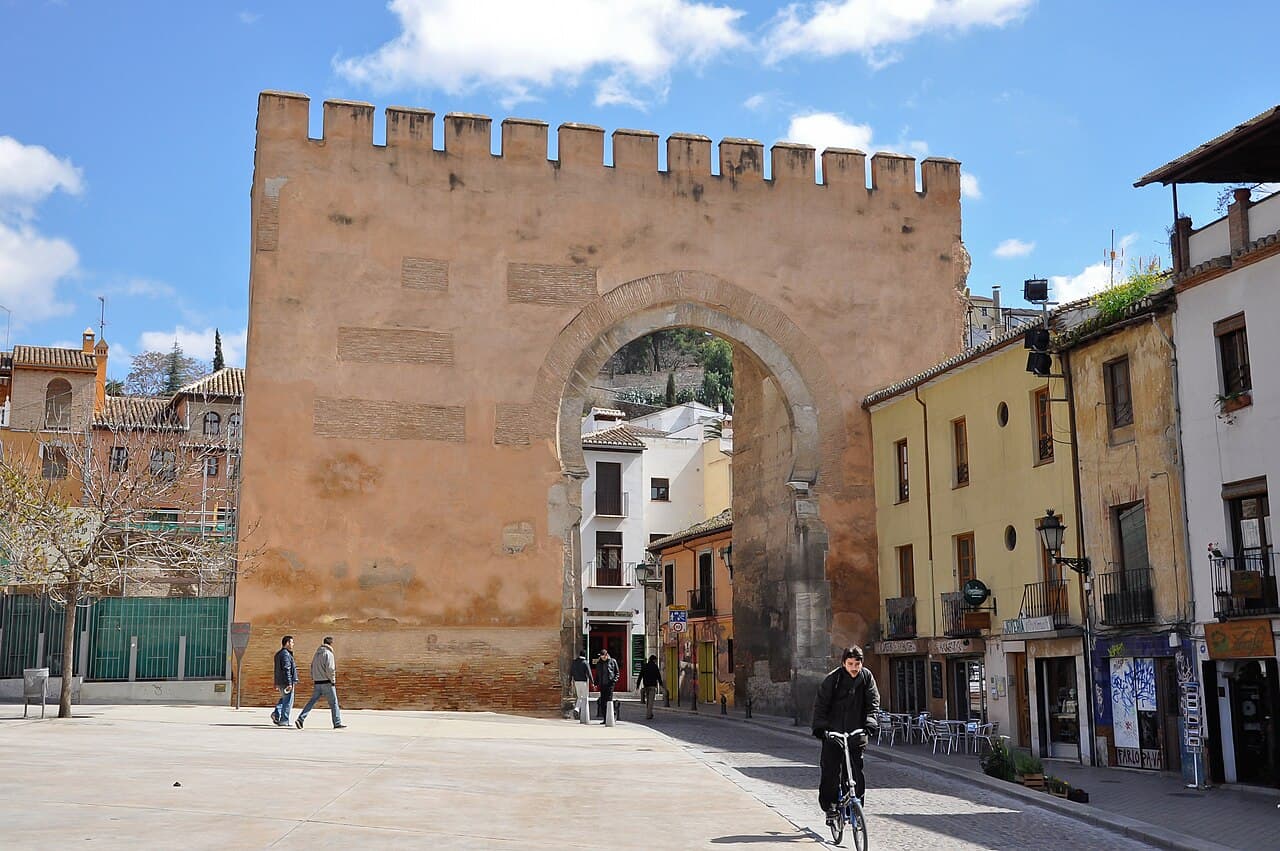
The Puerta de Elvira, also known historically as Bāb Ilbīra in Arabic, is a significant medieval gate located in Granada, Spain. This gate marks the entrance to the Albaicín neighborhood and stands at the beginning of Calle Elvira. It was declared a Bien de Interés Cultural in 1896, recognizing its cultural and historical importance.
Historical background and significance
The Puerta de Elvira was originally constructed as part of the Zirid walls in the 11th century during the High Medieval period. The Zirids were a Berber dynasty that ruled the region, and the gate served as a crucial defensive and access point to the city of Granada. The gate's Arabic name, Bāb Ilbīra, reflects its Islamic heritage and the city's history under Muslim rule.
In the 14th century, the gate underwent significant reconstruction during the Nasrid dynasty, the last Muslim dynasty in Spain. This reconstruction transformed the gate into a heavily fortified bastioned fortress to strengthen the city's defenses as part of the new Nasrid walls extension. The Nasrid period was marked by extensive architectural developments in Granada, including the famous Alhambra palace complex.
Architectural features and structure
The Puerta de Elvira was designed as a fortified gate, combining military functionality with architectural elements typical of medieval Islamic fortifications. The gate originally included defensive towers and bastions, which were added during the Nasrid rebuilding to improve protection against siege warfare.
Although only a portion of the original gate remains today, the surviving structure displays characteristic features such as the horseshoe arch typical of Islamic architecture and robust stone construction. The gate's design facilitated control over access to the city and served as a checkpoint for travelers and goods entering Granada.
Relationship with the surrounding area
Outside the gate once lay the Ibn Malik Cemetery, a large Muslim burial ground that played a significant role in the city's social and religious life during the Islamic period. This cemetery was eventually replaced by the Royal Hospital (Hospital Real), which now occupies part of the former cemetery grounds. The hospital itself is a notable Renaissance building, highlighting the layers of historical development in the area surrounding the gate.
Cultural and heritage importance
The Puerta de Elvira stands as a testament to Granada's complex history, reflecting the city's Islamic past and its evolution through the medieval period. Its designation as a Bien de Interés Cultural underlines its value as a heritage monument and a symbol of Granada's architectural and historical legacy.
Today, the gate is a prominent landmark within the Albaicín, a UNESCO World Heritage Site, attracting visitors interested in the city's medieval fortifications and Islamic architecture. Its preservation allows for the study and appreciation of the defensive strategies and urban planning of medieval Granada.
Visiting the puerta de elvira
The gate is accessible to the public and is situated at a key point for exploring the historic Albaicín district. Visitors can appreciate the gate's architectural details and its strategic location overlooking the city. The surrounding neighborhood offers additional attractions, including narrow streets, historic buildings, and views of the Alhambra.
While the gate itself is a ruin with only partial preservation, it remains an important cultural site for those interested in medieval fortifications and the Islamic heritage of southern Spain.
Frequently asked questions (FAQ)
- What is Puerta de Elvira?
- Puerta de Elvira is a historical gate located in Granada, Spain, renowned for its stunning Moorish architecture. It served as one of the main entrances to the city during the medieval period and is a testament to the Islamic influence on the region's culture and design.
- When was Puerta de Elvira built?
- Puerta de Elvira was constructed in the 11th century, during the period of the Taifa of Granada. This makes it one of the oldest architectural remnants in the city, showcasing the rich history of Granada’s Islamic past.
- What are the opening hours of Puerta de Elvira?
- Puerta de Elvira is accessible to visitors year-round, and there are no specific opening hours as it is an outdoor site. However, it is recommended to visit during daylight hours for the best experience and photography opportunities.
- Can I take photos at Puerta de Elvira?
- Yes, visitors are welcome to take photos at Puerta de Elvira. The gate's intricate designs and scenic surroundings provide a fantastic backdrop for photography, especially during sunrise or sunset.
- Is it possible to access Puerta de Elvira with a wheelchair?
- While Puerta de Elvira is an outdoor site, the surrounding area may have uneven surfaces that can make accessibility challenging. It's advisable for visitors with mobility issues to plan ahead and consider bringing assistance for a more comfortable visit.
- What is the best time to visit Puerta de Elvira?
- The best time to visit Puerta de Elvira is during the spring and fall when the weather is mild and pleasant. Early mornings or late afternoons also offer stunning light for photography and fewer crowds.
- Are there any nearby attractions to visit along with Puerta de Elvira?
- Yes, nearby attractions include the Alhambra, a UNESCO World Heritage site, and the Generalife gardens. The historic Albaicín neighborhood is also just a short walk away, offering additional cultural experiences and beautiful views of the Alhambra.
- What are the ticket prices for visiting Puerta de Elvira?
- There is no ticket fee to visit Puerta de Elvira, as it is an open public space. Visitors can explore the site freely, making it an accessible option for those interested in the history and architecture of Granada.
Photo gallery

Information
Loading map...
Visitor reviews
No reviews yet. Been here? Write the first review and help other travelers!
Write the first reviewVisited this castle? Share your experience
Your review helps other travelers and adds first-hand knowledge to our encyclopedia.