Alhambra
Alhambra stands as one of Spain's most iconic landmarks, a UNESCO World Heritage Site, and a pinnacle of Moorish architecture. Located in Granada, southern Spain, this vast complex combines a palace, fortress, and gardens, showcasing centuries of cultural, political, and artistic history. Its unique blend of military and royal residential architecture makes it a singular example of Islamic art and architecture in Europe.
The origins of the Alhambra trace back to a modest fortress established in the 9th century atop the Sabika hill, built on earlier Roman fortifications. This initial structure was primarily military, intended to defend the territory. However, the complex we recognize today largely emerged under the Nasrid dynasty, the last Muslim rulers of the Iberian Peninsula, who reigned from the 13th to the 15th centuries. Their extensive building campaigns transformed the site into a magnificent royal palace and fortified city.
Historical development and significance
Early beginnings and Nasrid expansion
The site’s earliest fortifications date from the early medieval period, but it was under Muhammad I Ibn al-Ahmar, founder of the Nasrid dynasty in 1238, that the Alhambra began its transformation into a royal residence. The Nasrids expanded the fortress walls and constructed palaces, administrative buildings, and religious structures, turning the Alhambra into a self-contained royal city.
Throughout the 14th century, rulers such as Yusuf I and Muhammad V further enhanced the complex. They added intricate palaces like the Palace of the Lions, renowned for its exquisite muqarnas vaulting, marble fountains, and decorative stucco. The Comares Palace, with its famous Hall of the Ambassadors crowned by a wooden dome symbolizing the seven heavens, served as the sultan’s official residence and government seat.
Christian conquest and Renaissance additions
In 1492, the Reconquista culminated with the surrender of Granada to the Catholic Monarchs, Ferdinand and Isabella. The Alhambra then became their royal court. It was here that Christopher Columbus received royal endorsement for his voyage to the Americas.
The Christian rulers adapted the complex by adding Renaissance elements, most notably the Palace of Charles V, commissioned in 1527 and designed by Pedro Machuca. This imposing Renaissance palace contrasts sharply with the surrounding Moorish architecture, featuring a massive stone square exterior enclosing a circular courtyard. Though construction was halted in the early 17th century, it remains a significant symbol of the cultural transition in Spain.
Architectural features and layout
The Alcazaba fortress
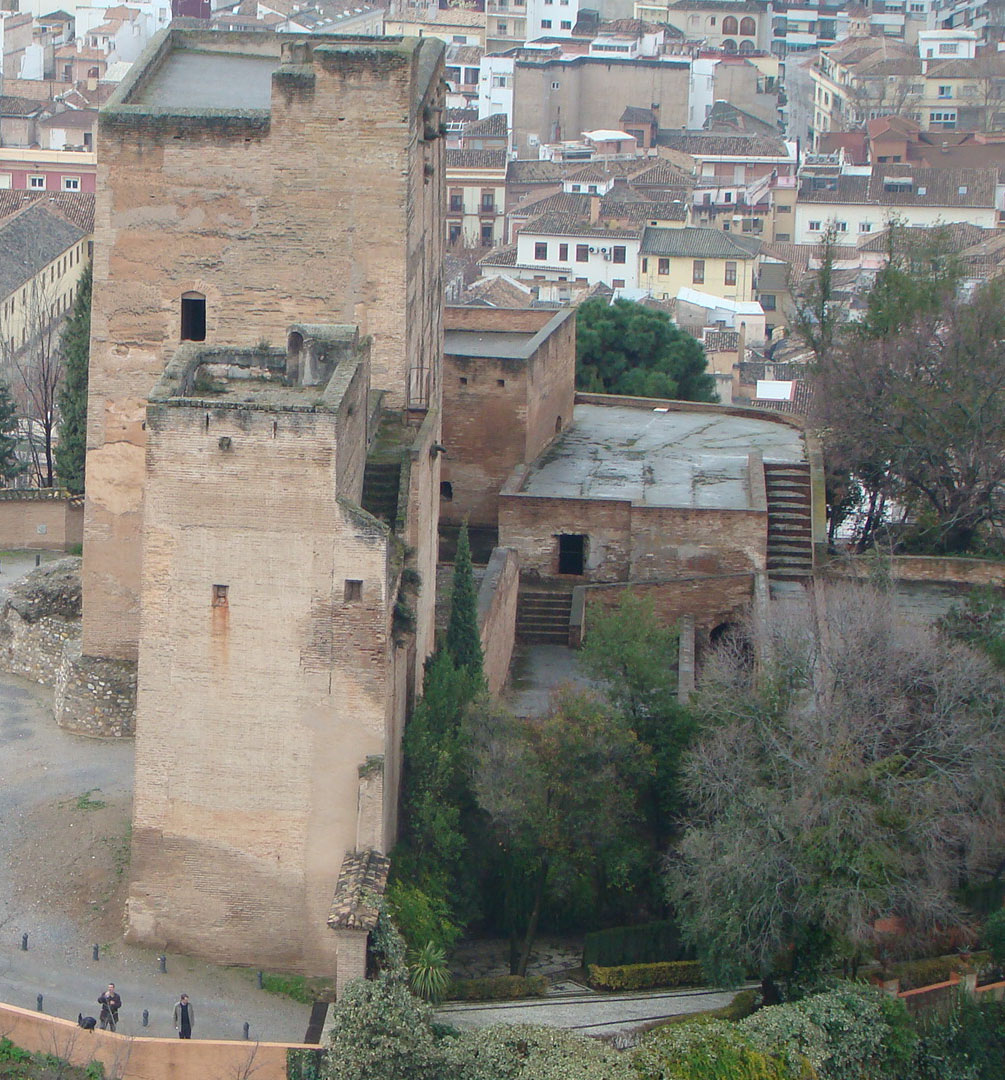
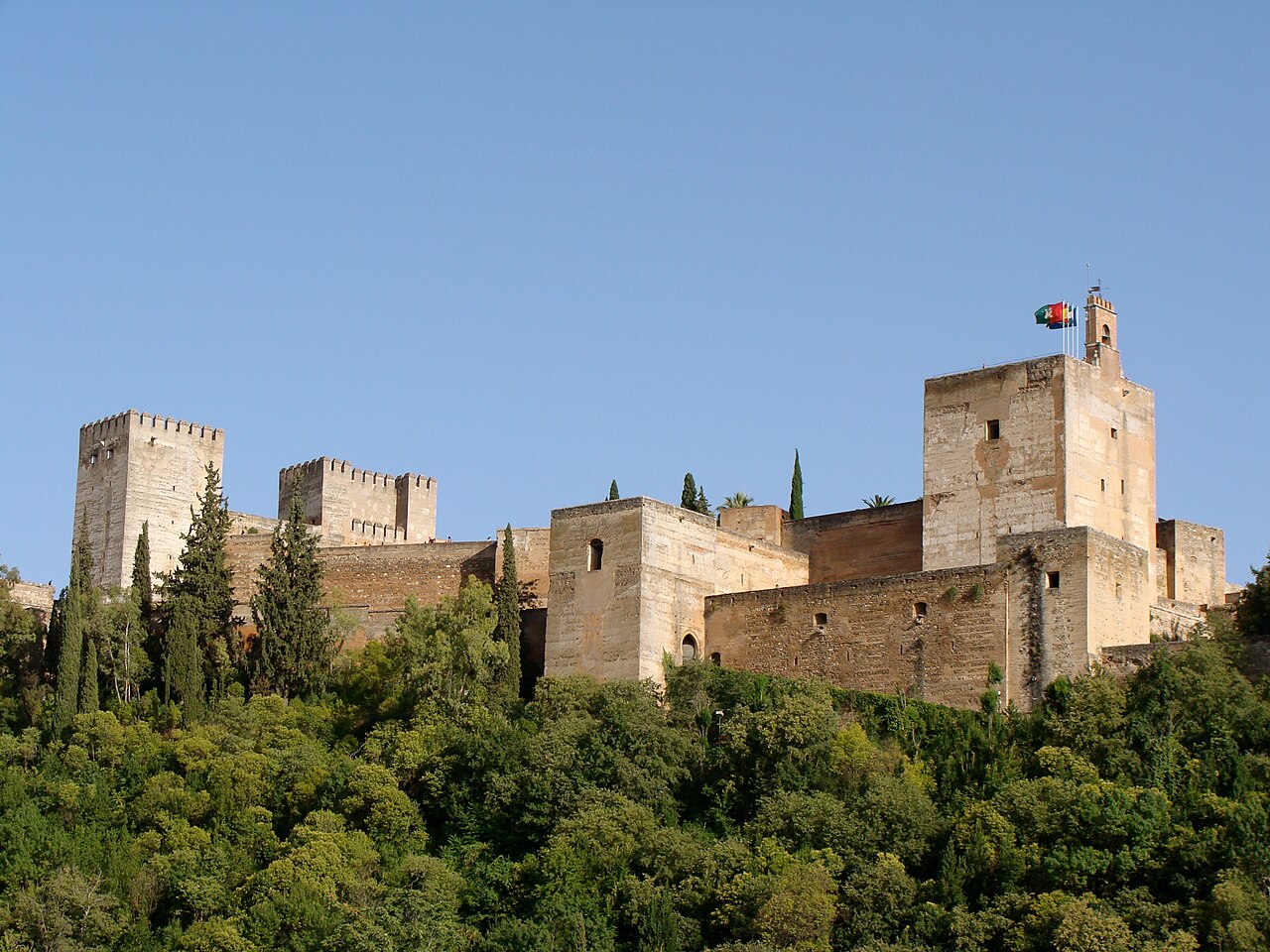
The Alcazaba is the oldest part of the Alhambra, located on the westernmost and highest section of the hill. It served as the military stronghold with thirteen defensive towers, including the prominent Torre del Homenaje and Torre de la Vela. Though partially ruined, the fortress walls, battlements, and cisterns remain visible, illustrating its defensive role.
The Nasrid palaces
The royal residential complex comprises three main palaces: the Mexuar, Comares Palace, and the Palace of the Lions. The Mexuar served administrative and ceremonial functions, featuring courtyards and a throne room. The Comares Palace includes the Patio de los Arrayanes with its reflective pool and the Hall of the Ambassadors, noted for its soaring dome and elaborate decoration.
The Palace of the Lions epitomizes Nasrid architectural sophistication with its central courtyard surrounded by a colonnade of slender columns and the iconic Fountain of the Lions, a marble basin supported by twelve lion sculptures. Each surrounding hall displays intricate muqarnas vaulting and detailed stucco work, illustrating the height of Islamic art in Spain.
Other significant structures
The Partal Palace, the oldest surviving Nasrid palace, features a pavilion overlooking a large reflective pool and a richly decorated oratory. Several towers along the northern walls, such as the Torre de los Picos and Torre de la Cautiva, were converted into palatial residences blending defense with comfort.
The Generalife, the Nasrid summer palace and country estate, is famed for its terraced gardens, fountains, and lush orchard known as the Garden of Paradise. It was connected to the Alhambra by a walled corridor and served as a retreat from the palace’s administrative center.
Water management and gardens
The Alhambra’s sophisticated water supply system, the Acequia del Sultan, channels water from the Darro River to the complex. This system includes aqueducts, reservoirs, and conduits that supply water to the palaces and gardens, creating the characteristic interplay of water features, sound, and light that define the site’s ambiance.
The extensive gardens, including those at the Generalife, are adorned with exotic plants, fountains, and reflective pools, embodying the Islamic ideal of paradise on earth. The gardens’ design enhances the sensory experience and complements the architectural elegance of the palaces.
Later history, decline, and restoration
After the Christian conquest, the Alhambra gradually declined in political importance. It suffered damage during the Napoleonic Wars, particularly between 1810 and 1812, when several towers were destroyed. The site fell into disrepair until rediscovered by European Romantic travelers in the 19th century.
The American writer Washington Irving played a pivotal role in popularizing the Alhambra through his 1832 book, Tales of the Alhambra. Restoration efforts began in the early 19th century under architect José Contreras and continued through the 20th century, with significant conservation work led by Leopoldo Torres Balbás in the 1920s and 1930s.
Today, the Alhambra is a well-preserved monument attracting millions of visitors annually. It embodies a rich cultural heritage that reflects the complex history of medieval Spain, the legacy of Islamic art, and the Renaissance influences introduced after the Reconquista.
Artistic and cultural legacy
The Alhambra’s interiors were once richly furnished with carpets, tapestries, cushions, and large Hispano-Moresque vases decorated with Arabic inscriptions and cobalt blue, white, and gold motifs. Although original furnishings have not survived, these artifacts highlight the luxurious lifestyle of the Nasrid court.
Notable surviving objects include a bronze lamp from 1305 that hung in the Alhambra mosque, decorated with Arabic calligraphy and vegetal motifs. The original is displayed in Madrid’s National Archaeological Museum, while a replica is housed in the Alhambra Museum.
Overall, the Alhambra remains a masterpiece of Islamic architecture and a symbol of the cultural synthesis that shaped Spain’s history. Its intricate decorations, harmonious proportions, and integration with the natural landscape continue to inspire architects, artists, and visitors worldwide.
Frequently asked questions (FAQ)
- How do I get to Alhambra from Granada city center?
- The Alhambra is conveniently located just a short distance from the city center of Granada. You can reach it by bus, taxi, or a scenic 30-minute walk through the picturesque streets of the Albaicín neighborhood. Public transport options include the C32 bus, which runs frequently and stops near the entrance.
- What is the historical significance of Alhambra?
- Alhambra is a UNESCO World Heritage site and a stunning example of Moorish architecture, reflecting the rich Islamic history of Spain. Originally built as a fortress in 889 AD, it was transformed into a majestic palace in the 13th century by the Nasrid dynasty. The castle is renowned for its intricate art, beautiful gardens, and impressive architecture.
- When is the best time to visit Alhambra?
- The best time to visit Alhambra is during the spring (March to May) and fall (September to November) when the weather is mild and the gardens are in full bloom. Summer can be quite hot and crowded, while winter offers a quieter experience but cooler temperatures. Planning your visit during weekdays can also help avoid large crowds.
- Can I buy tickets online for Alhambra?
- Yes, you can purchase tickets online through the official Alhambra website, which is highly recommended to avoid long queues. Online booking allows you to choose your preferred time slot and ensures your entry to this popular attraction. Keep in mind that tickets can sell out quickly, especially during peak season.
- Is Alhambra accessible for visitors with disabilities?
- Alhambra strives to be accessible, offering options for visitors with reduced mobility. There are accessible pathways and facilities, including ramps and elevators in certain areas. It is advisable to check ahead and plan your visit to ensure you can fully experience the site.
- What are the opening hours for Alhambra?
- Alhambra is open to visitors throughout the year, with varying hours depending on the season. Generally, the site opens at 8:30 AM, and closing times range from 8:00 PM in the summer to 6:00 PM in winter. It’s best to check the official website for the most current hours before your visit.
- What nearby attractions can I visit after Alhambra?
- After exploring Alhambra, you can visit the Generalife, the summer palace and gardens of the Nasrid rulers, which is just a short walk away. Additionally, the historic Albaicín neighborhood offers charming streets, viewpoints, and local shops. Other nearby attractions include the Granada Cathedral and the Royal Chapel.
- What are the ticket prices for Alhambra?
- Ticket prices for Alhambra vary depending on the type of access and time of year, with general admission typically costing around €14. Discounts are available for students, seniors, and children. Be sure to check the official website for any special promotions or combined tickets with other attractions.
Information
Website
Visit websiteSources & official resources
Verify the information above using these authoritative references.
Loading map...
Visitor reviews
No reviews yet. Been here? Write the first review and help other travelers!
Write the first reviewVisited this castle? Share your experience
Your review helps other travelers and adds first-hand knowledge to our encyclopedia.