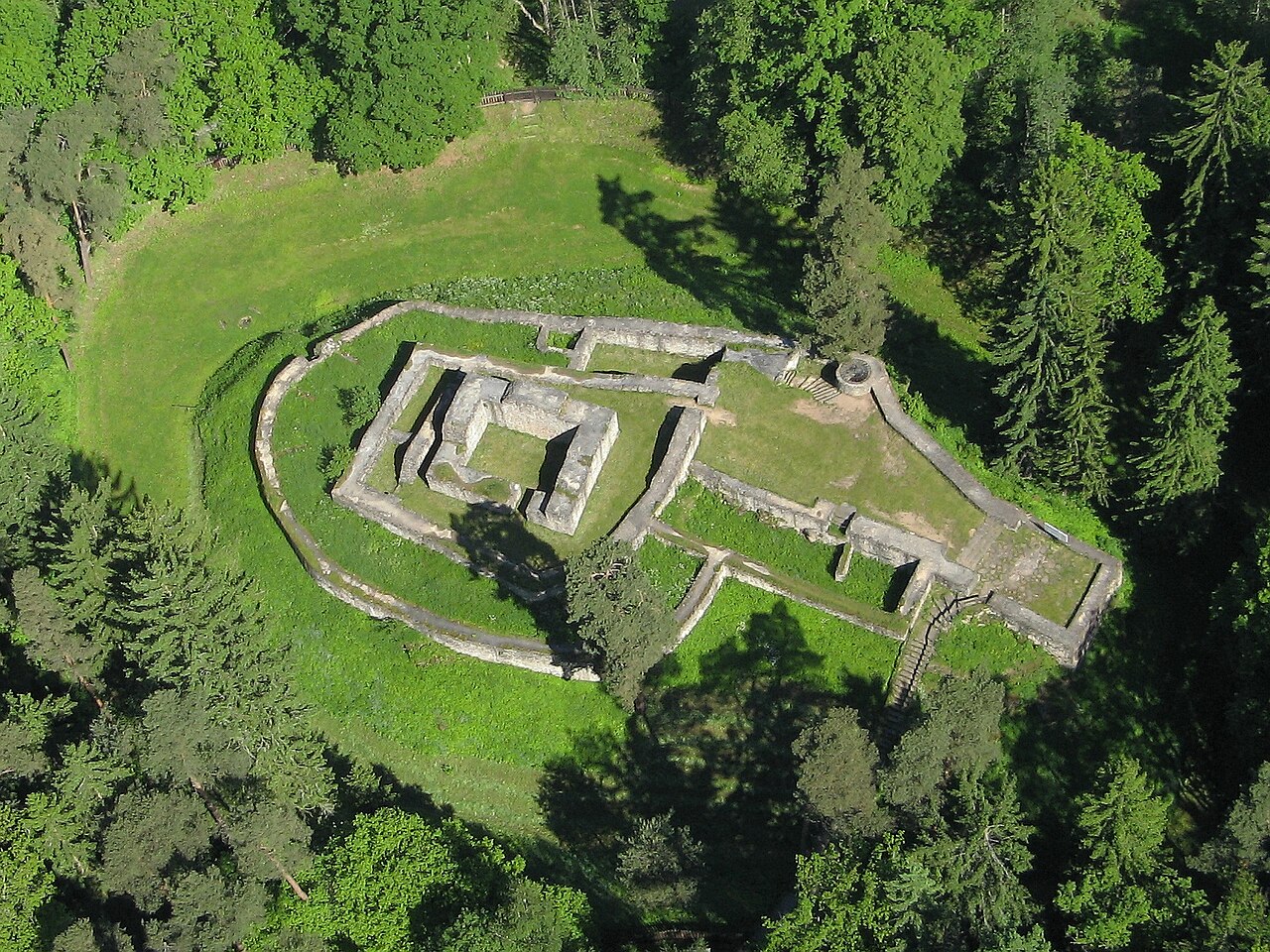
Příběnice Castle
Příběnice castle is a notable Gothic hill castle located in the municipality of Malšice in the Czech Republic. Established in the first half of the 13th century by the noble Vítkovci family, particularly associated with Vítek III and his sons Vítek V and Vok I of Rožmberk, the castle served as the administrative center of the Příběnice lordship. It played a significant role in the territorial and political influence of the Rožmberk family, one of the most powerful noble houses in medieval Bohemia.
Architectural design and layout
Perched on a rocky promontory approximately 410 meters above sea level, Příběnice castle was strategically positioned with natural defenses provided by a loop of the Lužnice River surrounding it on multiple sides. The castle was primarily constructed from stone, skillfully adapted to the uneven rocky terrain, which enhanced its defensive capabilities. Its layout was complex, consisting of a central stronghold divided into four main sections.
Central complex and palace wings
The heart of the castle was a large palace complex enclosing a narrow inner courtyard. Access to this courtyard was through a passage located in the northern palace wing. Archaeological evidence reveals that the palace wings were supported by buttresses which likely carried a gallery overlooking the courtyards, a feature typical of Gothic castle architecture.
Defensive features
Defense was paramount in the castle's design. A wide moat and an imposing embankment fortified the northeast approach. On this side, a parkán—an outer defensive wall—was identified, featuring two rectangular bastions positioned along the steep slope. The castle also boasted an octagonal bergfried on the southwestern side, a tall stone keep used for defense and observation, which partially survives today. Adjacent to it on the northeast was a rectangular tower measuring approximately 12 by 8 meters, reinforcing the castle’s fortified core.
Auxiliary structures and surroundings
The castle’s approach included a fortified latrán, an outer courtyard or suburb area to the southwest, which contained remains of houses, fortifications, and a mill. This latrán functioned as both a protective barrier and a small settlement supporting the castle’s inhabitants. A stone bridge once connected Příběnice to the smaller castle of Příběničky across the river; remnants of this bridge were uncovered during excavations in 2009.
Historical significance and events
From its inception, Příběnice was deeply intertwined with the political and military history of Bohemia. During the early 15th century, the castle gained strategic importance amid the Hussite Wars, a series of religious and social conflicts that reshaped the region. Oldřich II of Rožmberk, a prominent noble, used the castle as a fortress against the radical Hussite faction known as the Taborites. The castle also served as a prison for captured Hussite preachers, highlighting its role in the religious conflicts of the period.
In a notable episode in 1394, King Wenceslaus IV was temporarily detained at Příběnice by Jindřich III of Rožmberk, leader of the opposing Pan’s Union faction, underscoring the castle’s political significance. In November 1420, the Taborites captured Příběnice following an uprising of prisoners led by Václav Koranda. This takeover resulted in the loss of the castle and its valuable treasures, which had been stored by both secular and ecclesiastical authorities.
Under Taborite control, the castle functioned as a stronghold and prison for high-profile captives, including noblemen and clergy, until 1437. The return of Příběnice to Oldřich II came as part of a peace treaty in 1437. Following its recovery, Oldřich II ordered the demolition of the castle along with the nearby fortress of Příběničky and the adjacent village, likely to prevent their future use as military bases.
Decline and archaeological remains
Despite its destruction, the Příběnice estate remained under the ownership of the Rožmberk family and was administratively merged with the Choustník estate. By 1667, historical records described Příběnice as a ruined and overgrown site. Today, the castle exists as ruins covered by forest growth, with surviving fragments of walls, towers, moats, and the overall layout still visible.
Archaeological research has been instrumental in uncovering the castle’s original form and strategic position. Excavations have revealed the foundations of the palace wings, the defensive parkán with bastions, the octagonal bergfried, and the remains of the latrán. The precise location of the castle chapel, built in the first half of the 14th century, remains undetermined, but its existence is confirmed by historical sources.
Cultural and heritage importance
Příběnice castle stands as a significant monument to the Gothic medieval architecture and the turbulent history of Bohemia during the Hussite Wars. Its ruins offer valuable insights into the military, administrative, and residential functions of a noble hill castle in the region. The site attracts historians, archaeologists, and visitors interested in medieval fortifications, noble family histories, and the complex socio-political landscape of 13th to 15th century Bohemia.
Frequently asked questions (FAQ)
- When was Příběnice castle built?
- Příběnice castle was built in the first half of the 13th century by the noble Vítkovci family, notably linked to the Rožmberk lineage.
- What role did Příběnice castle play during the Hussite Wars?
- During the Hussite Wars, Příběnice served as a fortress and prison for captured Hussite preachers and was a strategic stronghold against the Taborite faction.
- Is Příběnice castle accessible to visitors today?
- Today, Příběnice castle is a ruin covered by forest growth. Visitors can explore the visible remains of walls, towers, and moats, though facilities may be limited.
- What are the notable architectural features of Příběnice castle?
- Notable features include the octagonal bergfried, stone palace wings with buttresses, a fortified latrán, a wide moat, embankments, and bastioned outer walls.
- Why was Příběnice castle demolished?
- After its recapture in 1437, Oldřich II of Rožmberk ordered the demolition of Příběnice castle to prevent its future military use, along with the nearby fortress and village.
Information
Loading map...
Visitor reviews
No reviews yet. Been here? Write the first review and help other travelers!
Write the first reviewVisited this castle? Share your experience
Your review helps other travelers and adds first-hand knowledge to our encyclopedia.