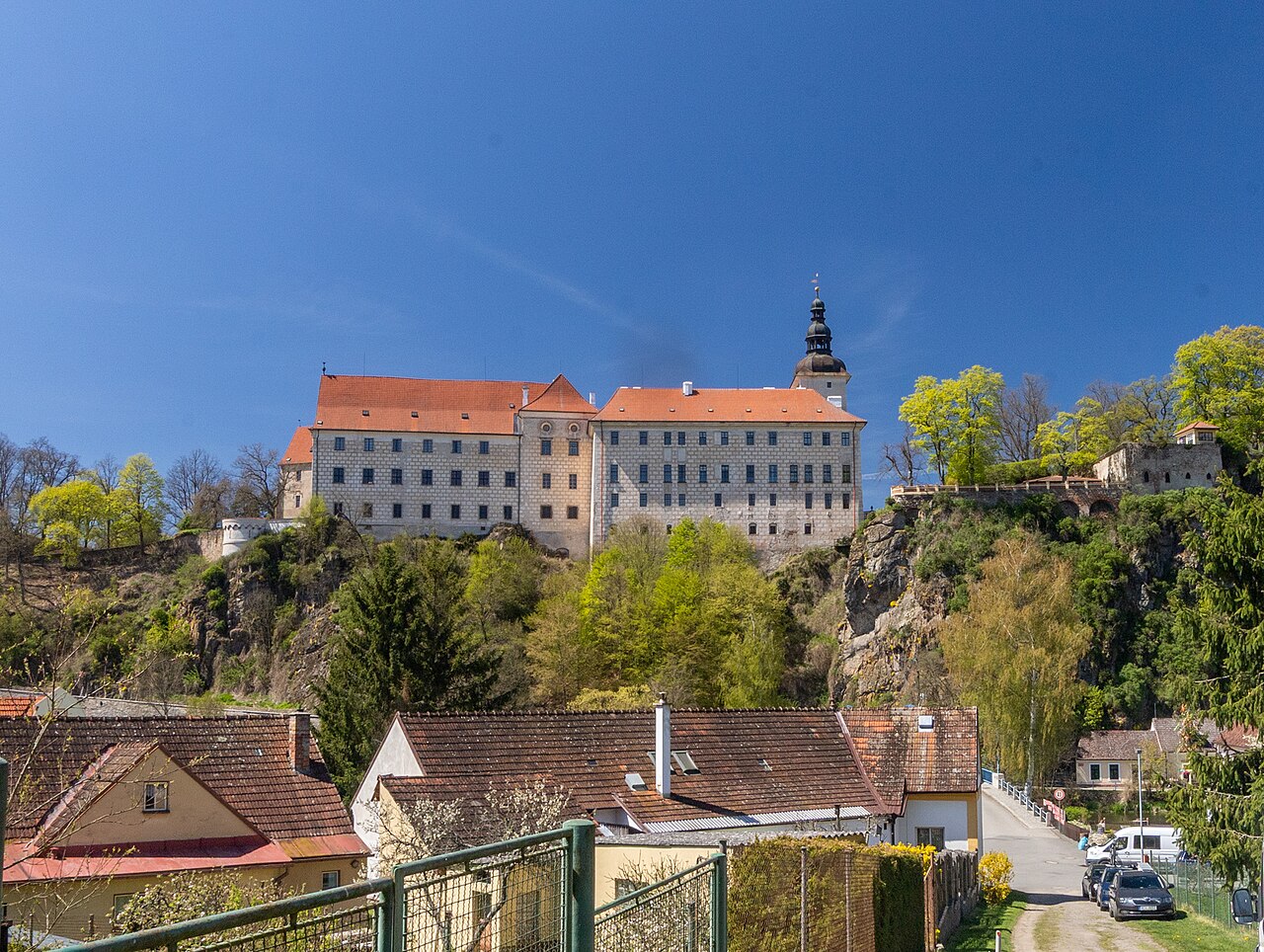
Dobronice Castle
Dobronice castle stands as a significant medieval fortress ruin located near the village of Dobronice u Bechyně in Czechia. Constructed in the early 14th century, this hill castle occupies a strategic promontory overlooking the Lužnice River, a vantage point that provided both defense and control over the surrounding landscape. The castle's origins trace back to a local noble family whose name it bears, marking it as a seat of regional power and influence during the High medieval period.
The castle's architectural evolution reflects the changing needs and fortunes of its successive owners. Initially likely founded as a wooden or mixed wooden-and-stone fortification, Dobronice was transformed into a robust stone stronghold during the early 1300s. Its core defensive feature is a cylindrical bergfried, a tall defensive tower integrated into the curtain walls, dated by dendrochronology to between 1310 and 1322. This bergfried rises through four floors, with the uppermost chamber distinguished by a rare ribless cross-vault, a vaulting technique that uses intersecting arches without ribs, showcasing the advanced masonry skills of the period.
Historical development and ownership
Throughout the 15th century, Dobronice castle witnessed a series of ownership changes among prominent Bohemian noble families. After the original Dobronice lineage, the estate passed to the Kraselovští of Kraselov, Sedlečtí of Dub, and Malovcové of Malovice. Between 1455 and 1459, the influential Rosenberg family acquired the castle but sold it shortly after to their appointed burgraves, the Vítové ze Rzavého family.
In the 16th century, the Hozlauer family took possession, enhancing the estate with economic structures such as a mill and brewery. However, their involvement in a regional uprising led to partial confiscation of their holdings, and by 1636, the royal chamber seized the remaining property due to debts.
Later, Ferdinand Prüger of Greinburg acquired Dobronice, and in 1691, his daughter sold it to Václav Sattenwolf, rector of the Jesuit college of St. Clement in Prague. The Jesuits used the castle as a summer residence and administrative center until their dissolution in 1773, after which the castle was abandoned and fell into rapid decline.
Architectural features and layout
Defensive structures and bergfried
The castle's layout is characterized by two moats that separated the outer bailey from the inner core, enhancing its defensive capabilities. The heart of the castle is the cylindrical bergfried, built into the curtain wall. Its entrance was originally planned at a lower level but was changed to an upper-floor entrance during construction, a common defensive strategy to limit access. The tower's ground floor includes a niche that may have served as a defensive recess or was adapted later as a modern entry point.
Palaces and residential buildings
At the promontory's opposite end, remains of at least one main living building or palace survive, with another palace near the northeast corner. The main gate lay between this palace and the bergfried, controlling access to the castle's inner sanctum.
Late Gothic additions and expansions
Between the late 15th and early 16th centuries, a "new castle" was constructed in the second outer bailey. This late Gothic residence featured vaulted cellar rooms and a timber chamber designated for female occupants, indicating differentiated living spaces by gender. Access was controlled by a slender tower or risalit leading to the gate passage.
Further expansions included the creation of a zwinger—an enclosed outer ward between the castle core and moat to strengthen defenses. The northeast palace was enlarged with barrel-vaulted rooms, while the new palace along the eastern curtain wall included vaulted rooms with cellar vaults and additional timber chambers.
Decline, preservation, and current condition
Following the Jesuit order's dissolution, Dobronice castle was abandoned and deteriorated rapidly. In 1790, roofing materials and valuable stones were removed by the estate administrator, accelerating its ruinous state. Efforts to preserve the ruins began in 1890 to prevent collapse into the valley below, but damage from road construction in 1915 further compromised the structure.
Stabilization work by the Czech Tourist Club in 1920 helped secure the remaining walls. After the estate's confiscation in 1948, maintenance ceased until 1973 when concrete repairs reinforced the surviving bergfried, intended as a lookout tower. Today, the ruins are owned by Panství Bechyně SE, under entrepreneur Josef Šťáva.
Architectural significance and surviving elements
Dobronice castle's most prominent surviving feature is its cylindrical bergfried, a rare example of early 14th-century defensive towers with a distinctive ribless cross-vaulted upper chamber. The ruins also include portions of the 14th-century Gothic palace, residential buildings from the 16th century, and a chapel. Remnants of the castle ditch and earthworks remain visible, outlining the castle's original defensive perimeter.
While much of the castle lies in ruins, the site offers valuable insight into medieval castle construction, defensive strategies, and noble residence layouts in Bohemia. The layered architectural phases reflect the castle's adaptation to evolving military and domestic needs over several centuries.
Frequently asked questions (FAQ)
- How do I get to Dobronice castle?
- Dobronice castle is located near the village of Dobronice u Bechyně in South Bohemia, Czechia. It is accessible by local roads and can be reached by car or regional public transport followed by a short walk to the site.
- What is the best time to visit Dobronice castle?
- The best time to visit Dobronice castle is during the late spring to early autumn months when weather conditions are favorable for exploring the ruins and the surrounding landscape.
- Is Dobronice castle suitable for visitors with limited mobility?
- As Dobronice castle is a ruin situated on a hill with uneven terrain and limited modern infrastructure, it may not be suitable for visitors with limited mobility. Visitors should be prepared for walking on rough paths.
- Are there guided tours available at Dobronice castle?
- Currently, Dobronice castle does not offer regular guided tours. Visitors can explore the ruins independently, and informational signage may be available on-site to provide historical context.
- Can I visit Dobronice castle year-round?
- Dobronice castle is generally accessible year-round; however, visitors should check local conditions during winter months as snow and ice may make access difficult and unsafe.
Information
Current owner
Panství Bechyně SE
Loading map...
Visitor reviews
No reviews yet. Been here? Write the first review and help other travelers!
Write the first reviewVisited this castle? Share your experience
Your review helps other travelers and adds first-hand knowledge to our encyclopedia.