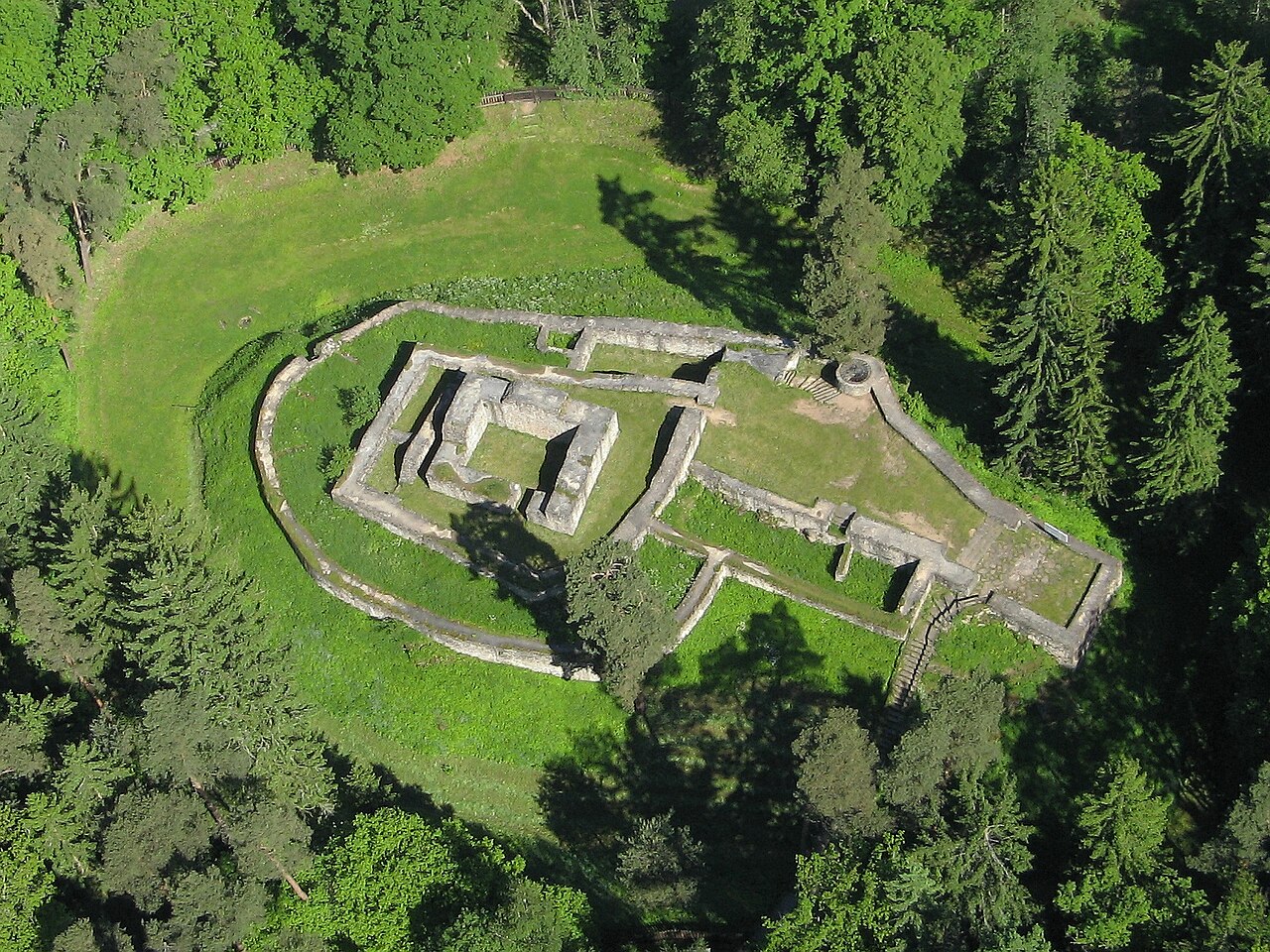
Kotnov Castle in Tábor
Kotnov Castle stands as a significant medieval fortress located in the historic town of Tábor, in the heart of Czechia. Constructed in the 13th century, this hill castle was originally established to protect the early settlement of Hradiště, which later evolved into the town of Tábor. Over centuries, Kotnov has witnessed numerous transformations, reflecting the turbulent history of the region, especially during the Hussite Wars.
The castle’s foundation dates back to the third quarter of the 13th century, attributed to the Vítkovci noble family, specifically Vítek IV of Klokot. This family was influential in medieval Bohemia, and their construction of Kotnov was part of a broader strategy to secure the area under the reign of King Přemysl Otakar II. The castle’s original purpose was defensive, guarding the settlement of Hradiště from external threats.
Architectural design and medieval fortifications
Kotnov Castle was designed with a distinctive pentagonal layout, a somewhat unusual plan that provided strategic advantages in defense. The fortress was surrounded by a double line of defensive walls, creating a layered defense system. The inner wall was notably taller and sturdier, while the outer wall served as a preliminary barrier. Between these walls lay a zwinger, a narrow defensive courtyard that enhanced protection by exposing attackers to defensive fire from multiple angles.
The castle featured at least four towers: two cylindrical and two square in plan. These towers were integrated closely with the curtain walls, which limited their ability to provide flanking fire but contributed to the compactness and strength of the fortification. Of particular note is the surviving cylindrical artillery tower, which rises approximately 25 meters and represents the castle’s adaptation to evolving military technology during the Hussite Wars.
The artillery tower and its features
This tower was reinforced to serve as an artillery platform, equipped with embrasures designed for cannon fire and smaller gun ports for handheld firearms. The embrasures are double-sided, allowing cannon fire in multiple directions, a sophisticated feature for the period. The upper floors contain vertical gun slits with ventilation to disperse smoke, indicating a well-thought-out design for active defense during battle. Access to the tower’s ground floor is through a winding corridor ending in a Gothic-Renaissance saddle-shaped doorway. Inside, faint traces of a rib vault survive beneath a modern wooden ceiling, hinting at the architectural styles layered over time.
Historical context and transformations
Following the death of King Přemysl Otakar II, Kotnov passed to the lords of Ústí, continuing its role as a noble residence and fortress. By the late 14th century, the original village of Hradiště had vanished, but the castle remained an important stronghold.
The castle’s most significant historical transformation occurred in the early 15th century when the settlement was rebuilt and renamed Tábor, becoming a center for the Hussite movement. From 1420 onward, the Taborites renovated Kotnov, integrating it into the town’s new defensive walls. The castle’s function shifted primarily to a military role, supporting the Hussite cause in their religious and social uprising.
After the Hussite Wars, Kotnov’s military importance declined. A devastating fire in 1532 caused significant damage, after which the castle was repurposed as a city prison. In the early 17th century, between 1612 and 1613, the castle buildings were adapted into a brewery, marking a shift from military to industrial use. The brewery operations expanded in the late 19th and early 20th centuries, including remodeling of the eastern wing in 1908.
Archaeological research and preservation
Extensive archaeological excavations conducted in the late 20th and early 21st centuries have revealed much about Kotnov’s complex history. Excavations from 1993 to 1994 and subsequent studies from 2002 to 2004 uncovered the castle’s layered development, from medieval fortress through Hussite military hub to industrial site.
Today, the castle’s remains provide valuable insights into medieval military architecture and urban defense systems. The surviving artillery tower is a highlight for visitors, showcasing adaptations to early firearms technology. Adjacent to the tower is the Bechyně Gate, part of the medieval city walls preserved in near-original condition. Built around 1420 as part of Hussite fortifications, the gate was restored in the late 19th century with stylistic influences from High Gothic architecture. It now serves as an exhibition space illustrating medieval society and linking the castle’s defensive role to the broader urban fabric of Tábor.
Castle layout and remaining structures
Within the castle enclosure, residential quarters included a quadrangular tower and a palace-like building with three main rooms on the eastern side. A long building along the northwest wall has been partially preserved. Many original structures were demolished or converted during the brewery period, but archaeological evidence helps reconstruct the castle’s original form and functions.
Kotnov castle in the heritage of tábor
Kotnov Castle remains a symbol of Tábor’s medieval and Hussite heritage. Its evolution from a royal fortress to a Hussite military bastion and later an industrial site reflects the dynamic history of the region. The castle’s architectural features, particularly the artillery tower and city gate, attract historians, architects, and visitors interested in medieval fortifications and Bohemian history.
Today, Kotnov serves not only as a historical monument but also as a cultural landmark, preserving the memory of Tábor’s past and its role in the Hussite movement. The castle’s integration into the town’s defensive system and its adaptations over centuries exemplify the intersection of military innovation, noble power, and urban development in medieval Central Europe.
Frequently asked questions (FAQ)
- When was Kotnov Castle built and by whom?
- Kotnov Castle was built in the third quarter of the 13th century by the Vítkovci noble family, likely Vítek IV of Klokot, under King Přemysl Otakar II's reign.
- What role did Kotnov Castle play during the Hussite Wars?
- During the Hussite Wars, Kotnov Castle was renovated and incorporated into Tábor's defensive walls, serving as a key military stronghold for the Taborites.
- What remains of Kotnov Castle can visitors see today?
- Visitors can see the well-preserved cylindrical artillery tower, parts of the defensive walls, and the Bechyně Gate, which is part of the medieval city fortifications.
- How was Kotnov Castle used after the Hussite Wars?
- After the Hussite Wars, Kotnov Castle was damaged by fire in 1532, later used as a city prison, and from the early 17th century, adapted into a brewery with further industrial modifications in the 19th and 20th centuries.
- Is Kotnov Castle accessible to the public and are there any exhibitions?
- The Bechyně Gate, part of the castle complex, houses exhibitions about medieval society, linking the castle's history with the urban environment of Tábor. Public access to other areas varies, so checking local visitor information is recommended.
Information
Website
Visit websiteSources & official resources
Verify the information above using these authoritative references.
Loading map...
Visitor reviews
No reviews yet. Been here? Write the first review and help other travelers!
Write the first reviewVisited this castle? Share your experience
Your review helps other travelers and adds first-hand knowledge to our encyclopedia.