Prácheň
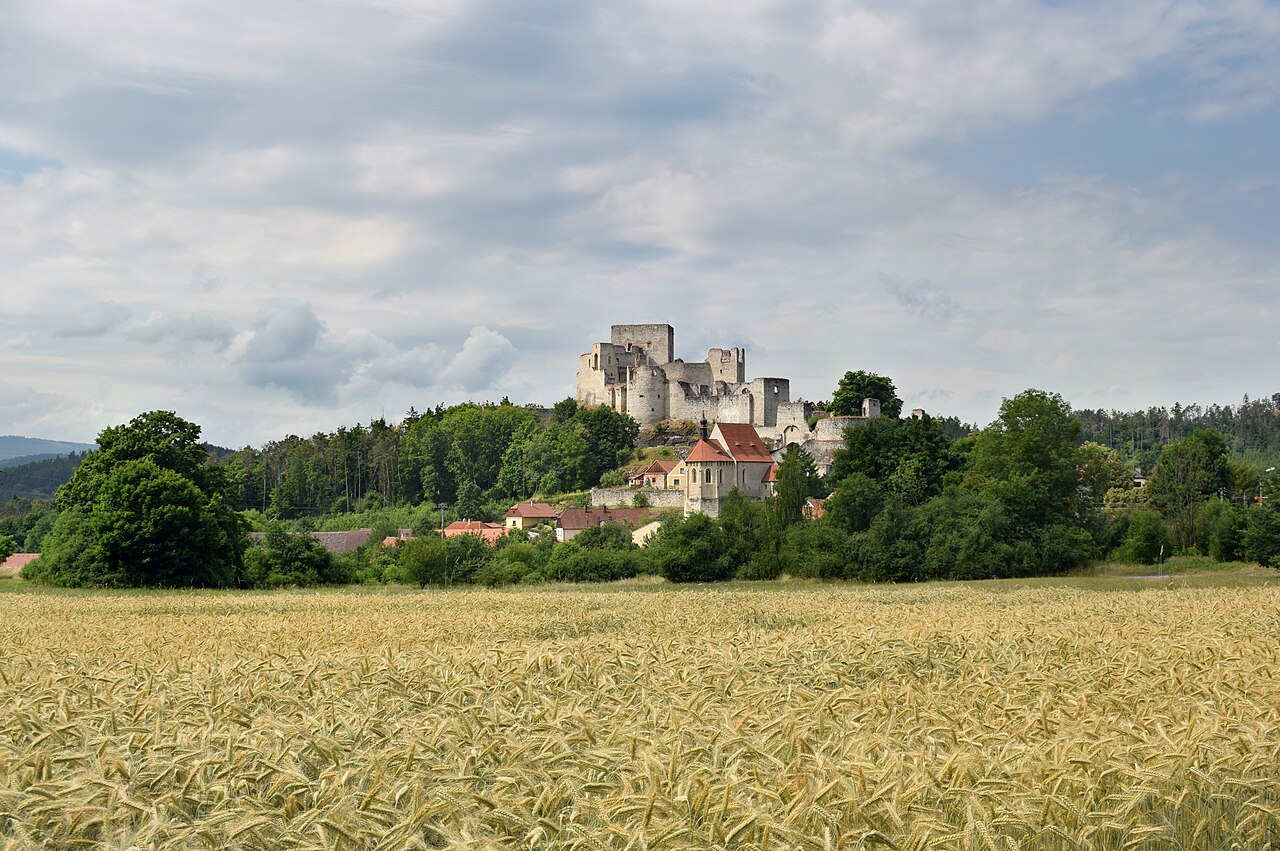
Prácheň Castle stands as a remarkable historic site in the Czech Republic, located near the municipality of Velké Hydčice-Horažďovice. Its origins trace back to an early medieval fortified settlement known as a hradiště, established before the mid-11th century by the early Czech civilization. This settlement was a significant regional center in Bohemia, governed by local Czech princes, reflecting the political and military organization of the time.
Initially thriving through the early medieval period, the settlement began to decline before the mid-13th century. By the late 13th century, the hradiště was abandoned as royal administration shifted to the nearby town of Písek. Despite this decline, the village church dedicated to St. Clement survived, serving as a lasting religious monument in the area.
The foundation and medieval transformation of Prácheň
In 1315, under the reign of King John of Luxembourg, Bavor III of Strakonice initiated the construction of a new stone castle on the site. This marked a significant transformation from the earlier wooden and earthwork fortifications to a Gothic stone castle. The castle became an important administrative hub for the historical Prácheň region, lending its name to the area now known as Prácheňsko.
Before the stone castle's construction, the site was overseen by notable medieval noble families. In 1184, Vítek I. of Prčice from the Vítkovci family served as castellan, and later ownership passed to the Bavors of Strakonice. This lineage highlights the castle's strategic and political importance in medieval Bohemia.
Architectural features and layout
Early medieval fortifications
The original early medieval fort spanned approximately 2.8 hectares on a promontory overlooking the Otava River at an elevation of about 504 to 505 meters. The terrain's steep slopes on the western and northern sides provided natural defense advantages. Archaeological excavations reveal a substantial defensive earthwork consisting of a rampart up to 15 meters wide and 6 meters high. This rampart combined a dry stone front wall about 1.5 meters thick with a timber-earth structure approximately 5.5 meters wide behind it. In front of the rampart lay a berm and a shallow ditch, enhancing the fort's defensive capabilities.
Gothic castle structure
The Gothic castle built in the early 14th century featured a complex three-part layout. The forecourt, now surviving only as fragmentary walls, served as the initial defensive zone. Behind this was a large central area dominated by a circular bergfried, a tall main tower typical of medieval castles, which served as a last refuge and lookout point.
Extending beyond the central area was a long courtyard flanked by two palace wings. These wings housed spacious halls and smaller residential chambers at their shorter ends, reflecting architectural styles from the era of King Přemysl Otakar II. Behind these palace wings, archaeologists identified the likely location of economic buildings and a second tower at the northern end, though details of this tower remain unclear.
The eastern facade of the palace was reinforced with additional defensive structures, including two pairs of towers—one pair round and one pair square. These towers provided flanking protection along the walls, characteristic of a castellum-type castle design where towers project outward to cover the curtain walls.
Historical ownership and decline
Throughout the 14th and 15th centuries, Prácheň Castle changed hands among prominent noble families such as Zdeněk of Rožmitál, the Lords of Hradec, and the Kocov brothers. During these transitions, the castle suffered periods of neglect leading to gradual deterioration.
In the early 16th century, Půta Švihovský of Rýzmberk undertook repairs to restore the castle. Despite these efforts, by 1558 the castle was documented as abandoned. It is believed that the castle was likely destroyed or rendered unusable during the Hussite Wars in the early 15th century, a time of significant religious and political upheaval in Bohemia.
Aside from the village church of St. Clement, no significant structures from the original village survived these conflicts. Archaeological investigations have confirmed the sequence of early medieval fortifications followed by the later Gothic phases, illustrating the site's evolving role over several centuries.
Present-day remains and preservation
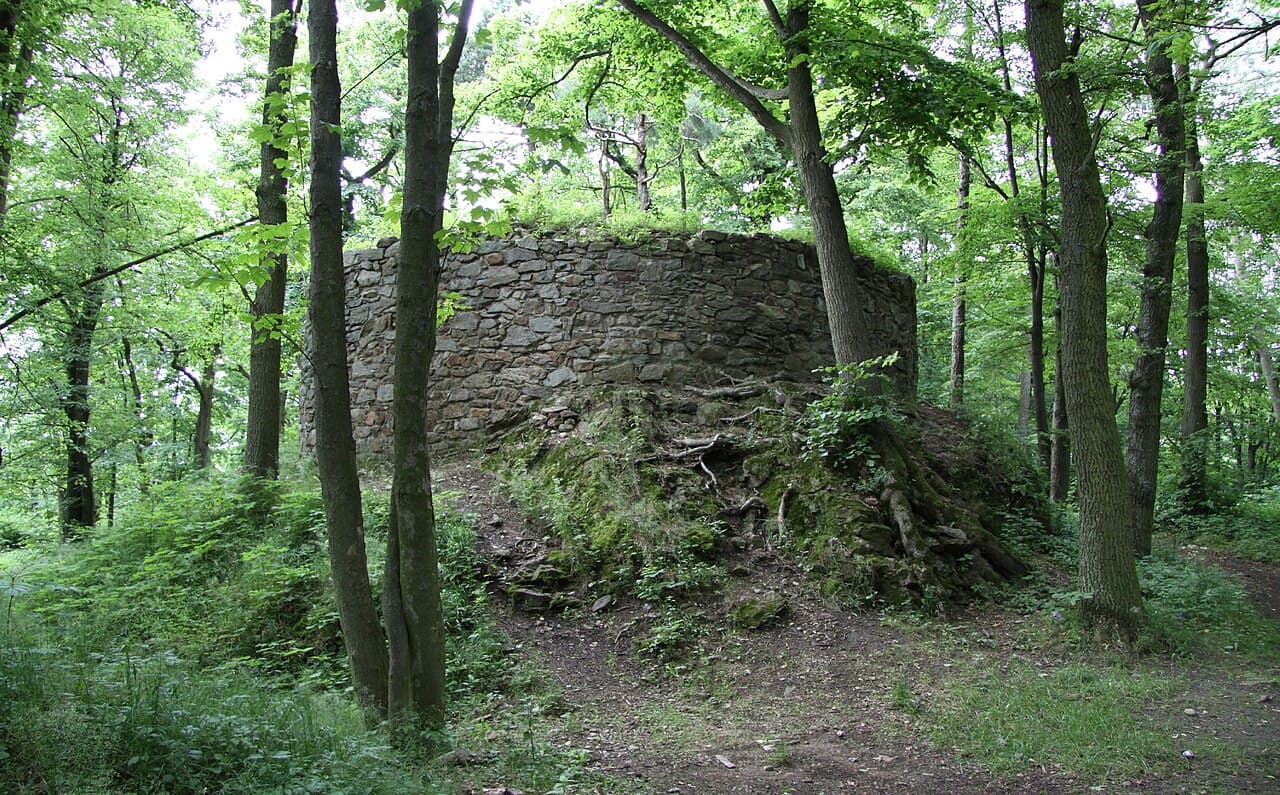
Today, remnants of the round bergfried and segments of the eastern curtain wall survive, including four bastions that once strengthened the castle's defense. Rubble mounds mark the locations of other parts of both the outer and inner walls.
Access to the castle was historically gained from the east by a gently ascending approach, with the associated village and forecourt established at the base of the hill. The nearby village church of St. Clement remains a prominent landmark, set apart from the rest of the area.
The site is currently protected as a nature reserve, preserving the layered history of Prácheň from its origins as an early medieval fort to its role as a Gothic regional stronghold. These surviving features and archaeological findings provide valuable insights into the military architecture and regional governance of medieval Bohemia.
Frequently asked questions (FAQ)
- How do I get to Prácheň Castle?
- Prácheň Castle is located near Velké Hydčice-Horažďovice in the Plzeň Region of Czechia. Visitors can reach the site by car or local transport, followed by a short walk up the hill to the castle ruins.
- What is the historical significance of Prácheň Castle?
- Prácheň Castle was a key regional center in medieval Bohemia, evolving from an early medieval fortified settlement to a Gothic stone castle. It played an important role in local governance and defense during the High Middle Ages.
- Can I visit the remains of Prácheň Castle?
- Yes, the castle ruins are accessible to the public. While much of the structure is in ruins, visitors can explore the surviving bergfried remains, curtain walls, and nearby village church of St. Clement.
- When was Prácheň Castle built?
- The original fortified settlement dates back to before the mid-11th century, with the stone Gothic castle constructed starting in 1315 under Bavor III of Strakonice.
- Is there an entrance fee to visit Prácheň Castle?
- There is no entrance fee to visit the castle ruins, as the site is an open nature reserve managed by the local municipality.

Information
Sources & official resources
Verify the information above using these authoritative references.
Loading map...
Visitor reviews
No reviews yet. Been here? Write the first review and help other travelers!
Write the first reviewVisited this castle? Share your experience
Your review helps other travelers and adds first-hand knowledge to our encyclopedia.