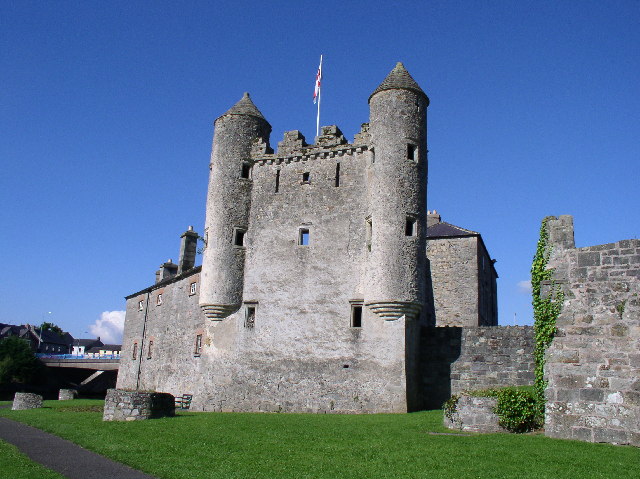
Portora Castle
Portora Castle stands as a significant historical monument just north of the town of Enniskillen in County Fermanagh, Northern Ireland. Nestled within the grounds of the former Portora Royal School for Boys, the castle occupies a strategic hilltop overlooking the narrow point where the Erne River expands into Lower Lough Erne. This location was historically crucial as an ancient crossing between the provinces of Connacht and Ulster, underscoring the castle's military and logistical importance.
Constructed in 1613 by Sir William Cole, the castle was part of a broader network of defensive strongholds erected during the early 17th century to secure the Ulster Plantation in Fermanagh. Other contemporaneous fortifications include Monea Castle, Tully Castle, and Castle Caldwell. Portora Castle exemplifies the Renaissance period's military architecture, designed to assert English control in a contested region.
Architectural design and defensive features
The castle was originally described in 1619 as a square bawn constructed from lime and stone, with walls approximately 4 meters high. It featured four circular flankers at each corner, which provided defensive firing positions, and a three-story stone house within the enclosure. These flankers, roughly 3 meters in diameter, contained multiple gun loops, reflecting the adaptation of the castle to accommodate firearms, a hallmark of Renaissance military architecture.
Despite its defensive purpose, the castle's internal features included domestic elements such as fireplace chimneys in the north and west walls, indicating its use as a residence as well as a fortress. The remaining ruins today include three of the original flankers, notably the two western towers that still flank the castle walls.
Historical context and notable residents
Following its construction, Portora Castle served as a residence for several prominent figures. In the 1620s, Dr. James Spottiswood, the Bishop of Clogher, became its first long-term occupant. The castle's military significance was reaffirmed during the 1641 Irish Rising, when it functioned as an effective military outpost for the garrison at Enniskillen.
In 1710, after a fire damaged their previous home at Enniskillen Castle, Sir Michael Cole and his family relocated to Portora Castle. They remained there until approximately 1764, when the family moved to the newly built Florence Court, commissioned by Sir Michael's son, John Cole.
Decline and current condition
The castle fell into disuse and gradually became derelict. In the late 19th century, it suffered further damage due to the reckless actions of truanting boys from the nearby Portora Royal School, who experimented with gunpowder and attempted to mine under the structure, causing significant structural harm. Additionally, a severe gale in 1894 inflicted further damage.
Today, Portora Castle remains a ruin, but it is freely accessible to visitors interested in exploring its historical remains. Although it is not a spectacular ruin compared to other castles, its location and historical significance make it a worthwhile stop for those visiting Enniskillen and the surrounding area.
Archaeological significance and surrounding landscape
The castle's position at an ancient ford on the Erne River highlights its long-standing strategic importance for controlling waterways and land routes. During the Erne Drainage Scheme between 1951 and 1960, archaeological finds such as a bronze dirk and stone axes were recovered near the site, indicating prehistoric activity in the area.
The castle's proximity to the waterways of Lower Lough Erne and its commanding views over the river narrows emphasize its role not only as a military fortification but also as a control point for trade and travel in the region.
Visitor information and accessibility
Portora Castle is open to the public without an entry fee. Visitors can explore the ruins at leisure, appreciating the surviving defensive structures and the castle's commanding position in the landscape. Its close proximity to Enniskillen Castle makes it convenient for a combined visit to two historically important sites in County Fermanagh.
Frequently asked questions (FAQ)
- How do I get to Portora Castle from Enniskillen town center?
- Portora Castle is located just north of Enniskillen town center, accessible by a short walk or drive along Lough Shore Road. It is well signposted and easy to find for visitors exploring the area.
- What is the historical significance of Portora Castle?
- Portora Castle was built in 1613 as part of the Ulster Plantation defensive network. It played a key role in controlling the Erne River crossing and served as a residence for notable figures like Sir William Cole and Bishop James Spottiswood.
- Can I visit Portora Castle for free?
- Yes, Portora Castle is freely accessible to the public with no admission charge. Visitors can explore the ruins at their own pace during daylight hours.
- When was Portora Castle built and by whom?
- The castle was built in 1613 by Sir William Cole, Constable of Enniskillen, to consolidate English control during the Ulster Plantation period.
- What remains of Portora Castle today?
- Today, three of the original circular flankers remain, along with portions of the bawn walls and internal chimneys. The castle is a ruin but retains key defensive features visible to visitors.
Information
Address
1 Lough Shore Road, Enniskillen, Northern Ireland
Loading map...
Visitor reviews
No reviews yet. Been here? Write the first review and help other travelers!
Write the first reviewVisited this castle? Share your experience
Your review helps other travelers and adds first-hand knowledge to our encyclopedia.