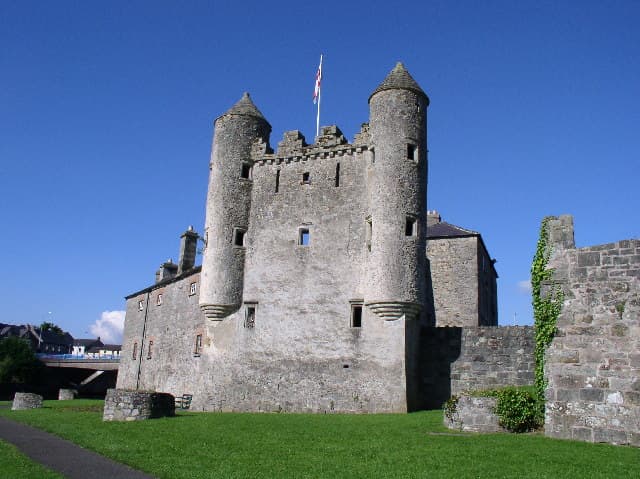
Enniskillen Castle
Enniskillen Castle is a historic fortress located in the town of Enniskillen, County Fermanagh, Northern Ireland. Situated strategically on an island in the River Erne, the castle guards a key passage into the province of Ulster. Originally built in the early 15th century, the castle has played a significant role in Irish history, witnessing numerous sieges, ownership changes, and architectural transformations. Today, it serves as a cultural hub, housing the Fermanagh County Museum and the Royal Inniskilling Fusiliers Regimental Museum, preserving the rich heritage of the region and its military past.
Early history and medieval origins
The first castle on this site was constructed around 1415 by Hugh Maguire, chief of the Maguire clan. This initial structure was a square tower house, a common defensive design of the period, built to control the vital waterways between Lower and Upper Lough Erne. Its placement on an island provided natural defensive advantages, making it a formidable stronghold against rival clans and invaders.
Throughout the 15th and 16th centuries, Enniskillen Castle was a focal point of conflict between the Maguires and other Gaelic families such as the O'Donnells and O'Neills. The castle changed hands multiple times, often seized by these clans but frequently retaken and rebuilt by the Maguires. Around 1508, the castle was likely expanded to a rectangular ground plan, enhancing its defensive capabilities and accommodating a growing garrison.
Conflicts and transformations during the nine years' war
The late 16th century was a turbulent time for Enniskillen Castle, especially during the Nine Years' War (1594-1603), a major rebellion against English rule in Ireland. The castle endured several sieges and was captured multiple times by English forces, only to be retaken by the Maguires. In 1594, the castle fell after an eight-day siege led by Captain John Dowdall, marking a significant moment in the conflict.
By 1602, the castle was deliberately dismantled to prevent its use by English troops. That same year, Niall Garbh O'Donnell, allied with the English, completed the destruction of the medieval fortress. Today, only the lower portions of the original keep remain, testifying to the castle's medieval origins and violent history.
Plantation era rebuilding and architectural features
Following the Flight of the Earls in 1607, which marked the end of Gaelic lordship in Ulster, the plantation town of Enniskillen was established on the island. The castle was rebuilt on the foundations of the medieval structure by Sir William Cole, the first Constable of Enniskillen. Cole's construction included the distinctive Watergate, a turreted riverside building completed around 1609. Despite its name, the Watergate was never a gate but served as a fortified residence and symbol of colonial authority.
The design of the Watergate and other castle elements reflects strong Scottish architectural influences, visible in features such as corbelled circular tourelles (small turrets) and stepped battlements. The castle's layout includes a central keep surrounded by a curtain wall strengthened with bartizans, small overhanging turrets typical of Scottish fortifications. These defensive features were complemented by strategic ditches excavated in the late 18th century to enhance protection against invasion threats.
Military role and adaptations in the 18th and 19th centuries
In response to the threat of a French invasion in 1796, Enniskillen Castle was refurbished as a barracks, marking a significant shift from a medieval fortress to a military installation. New buildings were constructed around this time, including barracks on the river-facing side, to accommodate troops. Large windows and other modifications dating from the reign of King William IV in the early 19th century indicate adaptations for improved living conditions while maintaining defensive capabilities.
The castle served as the home of the 27th Regiment of Foot from 1853 to 1875 and later housed the North Irish Horse, a Territorial Army cavalry unit, from 1939 until its decommissioning in 1950. After military use ceased, the castle was repurposed as a council depot before opening to the public as a heritage centre.
Current use and cultural significance
Today, Enniskillen Castle is a well-preserved historic site managed in part by the Fermanagh & Omagh District Council. It houses the Fermanagh County Museum, which showcases the region's prehistory, natural history, traditional rural life, crafts, and Belleek Pottery. The museum also highlights the history of the castle itself and the influential Maguire family.
The Inniskillings Museum, located within the castle complex, is the regimental museum for the Royal Inniskilling Fusiliers and the 5th Royal Inniskilling Dragoon Guards. It preserves the military heritage of these units, which have deep historical ties to Enniskillen and the wider area.
While the castle's exterior retains much of its historic charm, the interior primarily reflects its later military use, with many original medieval features lost or altered. However, the museum in the former keep provides valuable insights into the castle's medieval past and the region's turbulent history.
Architectural highlights and archaeological finds
The castle's layout is roughly square, rotated about 45 degrees, with a rounded southwest corner. The central donjon or keep is three stories high, though it originally featured battlements and an upper floor that have since been removed. Surrounding the courtyard are mainly two-story buildings dating from the early 19th century.
The Watergate stands out with its three stories, stepped battlements, and two corbelled round towers topped with conical stone roofs. This structure exemplifies the Scottish baronial style and is unique in the region. The curtain walls are reinforced with bartizans, enhancing the castle's defensive capabilities.
Archaeological discoveries at Enniskillen Castle include medieval carved stone figures and early Christian horn artifacts, which are displayed alongside exhibits on local history and military heritage. These finds enrich the visitor experience and deepen understanding of the castle's long occupation and cultural importance.
Visiting enniskillen castle
Enniskillen Castle is open to the public and offers a fascinating glimpse into Northern Ireland's medieval and military history. Visitors can explore the museums, view archaeological exhibits, and appreciate the castle's distinctive architecture and scenic riverside setting. The site is accessible for a small admission fee, making it an attractive destination for history enthusiasts and tourists alike.
The castle's location on Enniskillen Island provides picturesque views of the River Erne and the surrounding town. Its blend of medieval remnants and later military structures offers a unique narrative of adaptation and resilience through centuries of conflict and change.
Frequently asked questions (FAQ)
- How do I get to Enniskillen Castle?
- Enniskillen Castle is located in the heart of Enniskillen, making it easily accessible by car or public transport. If you are driving, there are parking facilities nearby, and regular bus services connect the castle with other towns in Northern Ireland.
- What is the historical significance of Enniskillen Castle?
- Enniskillen Castle dates back to the 16th century and played a crucial role in the defense of the region during various conflicts. It is a symbol of the heritage of County Fermanagh and now hosts the Fermanagh County Museum, showcasing the area's history and culture.
- When was Enniskillen Castle built?
- Enniskillen Castle was originally constructed in 1547 by the Gaelic chieftain, Conall O'Donnell, as a stronghold. Over the centuries, it underwent several modifications and expansions, reflecting changes in military architecture and local governance.
- Can I visit Enniskillen Castle year-round?
- Yes, Enniskillen Castle is open to visitors throughout the year, although opening hours may vary seasonally. It’s advisable to check the official website for the most current visiting hours and any special events that may affect access.
- Why is Enniskillen Castle a popular tourist attraction?
- Enniskillen Castle attracts visitors due to its stunning architecture and rich history, along with its picturesque setting by the River Erne. The castle also serves as a cultural hub, offering exhibitions and events that engage visitors of all ages.
- Is it possible to access Enniskillen Castle for visitors with disabilities?
- Yes, Enniskillen Castle is committed to accessibility and provides facilities for visitors with disabilities. There are ramps and designated pathways to ensure everyone can enjoy the castle's historic site and exhibitions.
- What are the ticket prices for visiting Enniskillen Castle?
- Ticket prices for Enniskillen Castle are generally affordable, with discounts available for children, seniors, and families. It’s best to check the official website for current pricing and any special promotions that may be available.
- What is the best time to visit Enniskillen Castle?
- The best time to visit Enniskillen Castle is during the spring and summer months when the weather is more favorable for outdoor exploration. Additionally, many events and activities take place during this time, enhancing the visitor experience.
- Are there any nearby attractions to visit after Enniskillen Castle?
- Yes, there are several attractions near Enniskillen Castle, including the beautiful Lough Erne and the historic town of Enniskillen itself. Visitors can explore other sites such as the Devenish Island and the nearby Marble Arch Caves for a full day of adventure.
Photo gallery

Information
Website
Visit websiteSources & official resources
Verify the information above using these authoritative references.
Loading map...
Visitor reviews
No reviews yet. Been here? Write the first review and help other travelers!
Write the first reviewVisited this castle? Share your experience
Your review helps other travelers and adds first-hand knowledge to our encyclopedia.



