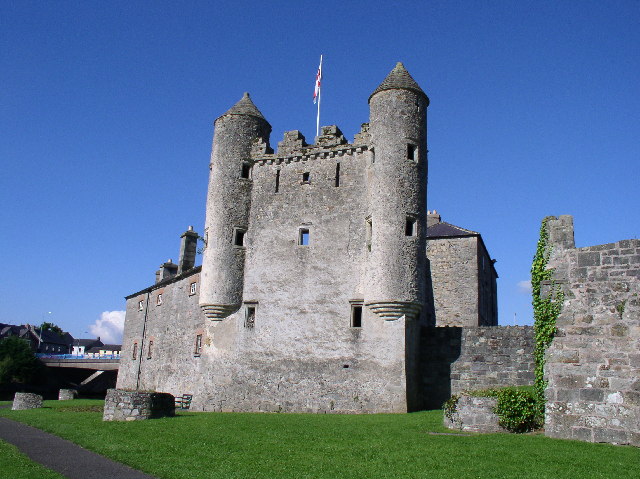
Parke's Castle
Parke's Castle, also known historically as Newtown Castle and O'Rourke's Castle, stands as a significant example of a 17th-century plantation era castle in County Leitrim, Ireland. Rising three storeys tall on the northeast shore of Lough Gill, this semi-fortified manor house occupies a site rich in layered history, originally hosting a 16th-century Gaelic tower house belonging to the O'Rourke (Uí Ruairc) clan.
Historical context and origins
The location of Parke's Castle was of strategic and cultural importance during the turbulent times of the late medieval and early modern periods in Ireland. The original O'Rourke tower house served as a stronghold for the Gaelic rulers of the region. Following the Plantation of Ulster and other parts of Ireland in the early 17th century, lands formerly under Gaelic control were redistributed to English and Scottish settlers loyal to the Crown.
By 1628, the site and surrounding lands had come into the possession of Robert Parke, who was granted these as part of the plantation efforts. It is believed that Parke began construction shortly thereafter, completing the fortified manor house by 1635. This manor was built on the foundations and footprint of the earlier Gaelic tower house, blending defensive features with the more domestic and residential needs of the plantation settlers.
Architectural features and restoration
Structure and design
The castle rises to three storeys and is characterized by its semi-fortified design, reflecting a transitional architectural style between medieval defensive castles and more comfortable manor houses. The building features thick stone walls, narrow windows suitable for defense, and a bawn—a walled courtyard typical of Irish tower houses and plantation fortifications.
The castle’s timber staircases and mortise and tenon oak roof showcase traditional 17th-century construction techniques, emphasizing craftsmanship and durability. The bawn was historically used as a farmyard and stabling area, highlighting the castle’s role as both a residence and a working estate.
20th-century restoration
After falling into ruin and remaining uninhabited for over three centuries, Parke's Castle was acquired by the Office of Public Works in 1935. Archaeological excavations led by Claire Foley between 1971 and 1975 uncovered the foundations of the original O'Rourke tower house and other structures within the bawn, providing valuable insights into the site’s layered history.
The castle underwent extensive and sensitive restoration between 1980 and 1988. Restoration efforts included reinstating the window glazing, and local artisans meticulously restored the timber staircases and oak roof using authentic 17th-century techniques. Since 1990, the castle has been open to the public seasonally, offering visitors a glimpse into plantation-era architecture and Irish history.
Historical ownership and usage
Following Robert Parke's tenure, the castle passed into the hands of the Gore family by the late 1670s. The manor house was last inhabited around 1700, after which it quickly fell into disuse and ruin. Despite the decay of the main building, the bawn remained functional as a farmyard and stables for the nearby village of Newtown well into the mid-20th century.
Cultural and heritage significance
Parke's Castle is an important heritage site that encapsulates the complex history of plantation Ireland, illustrating the transition from Gaelic lordship to English colonial settlement. Its preservation and restoration provide valuable educational opportunities about 17th-century architecture, construction methods, and the socio-political landscape of the time.
The castle’s location on Lough Gill also situates it within a rich natural environment that has inspired Irish poets and artists, adding layers of cultural resonance to the site.
Visitor experience and facilities
Today, visitors to Parke's Castle can explore the restored interiors, including the oak roof and timber staircases, and walk the perimeter of the bawn. Interpretive displays and guided tours provide context on the castle’s history, architecture, and the broader plantation era.
The castle’s scenic setting on the banks of Lough Gill offers picturesque views and opportunities for photography, making it a favored destination for those interested in Irish history and heritage tourism.
Frequently asked questions (FAQ)
- When was Parke's Castle built and by whom?
- Parke's Castle was built in the early 17th century by Robert Parke on the site of an earlier 16th-century Gaelic tower house belonging to the O'Rourke clan.
- What architectural style characterizes Parke's Castle?
- Parke's Castle is a semi-fortified manor house reflecting plantation era architecture with defensive features and domestic comforts.
- Is Parke's Castle open to visitors?
- Yes, the castle has been open to the public on a seasonal basis since 1990, offering guided tours and interpretive displays.
- What restoration work has been done on Parke's Castle?
- Extensive restoration took place between 1980 and 1988, including reinstating window glazing and restoring timber stairs and oak roof with traditional 17th-century techniques.
- What is the historical significance of Parke's Castle?
- Parke's Castle illustrates the transition from Gaelic lordship to English plantation settlement in 17th-century Ireland and preserves important architectural and cultural heritage.
Information
Sources & official resources
Verify the information above using these authoritative references.
Loading map...
Visitor reviews
No reviews yet. Been here? Write the first review and help other travelers!
Write the first reviewVisited this castle? Share your experience
Your review helps other travelers and adds first-hand knowledge to our encyclopedia.