Porto Palermo Castle
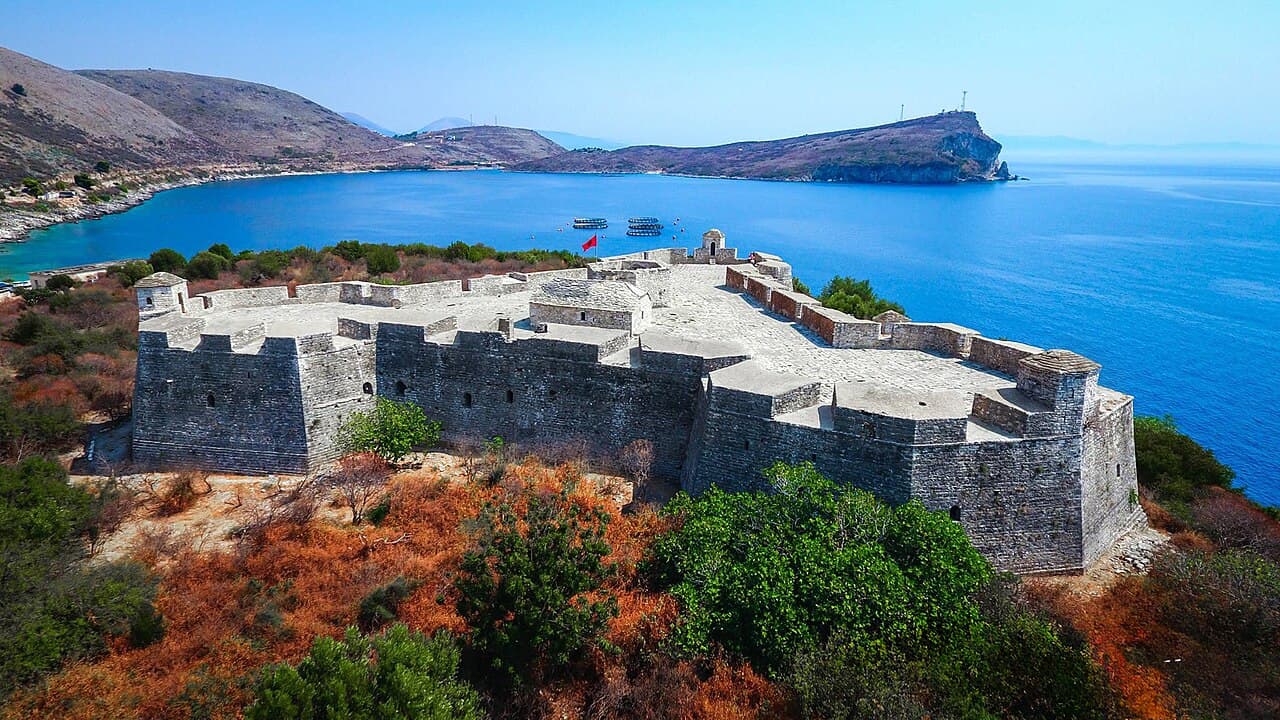
Porto Palermo Castle, also known locally as Kalaja e Porto Palermos, is a striking historic fortress located on a small peninsula near the town of Himarë in the county of Vlorë, Albania. This castle overlooks the beautiful Porto Palermo Bay along the Ionian coast, a site with a rich history of maritime activity dating back to antiquity. The fortress stands as a testament to the strategic importance of this coastal region throughout various periods, especially during the early 19th century.
The castle is widely attributed to Ali Pasha of Ioannina, an influential Albanian Ottoman ruler who exercised considerable autonomy in the region. Constructed between 1799 and 1804, the fortress was part of Ali Pasha's efforts to consolidate power and control key maritime routes. Although local legends and some sources suggest the involvement of French military engineers in its design, the castle's architectural features also hint at Venetian influences, reflecting the complex history of territorial control in the area.
Historical context and origins
The site of Porto Palermo Castle has long been recognized for its natural harbor, known in antiquity as Panormos Bay. Ancient Greek geographers such as Strabo and Ptolemy mentioned this harbor, highlighting its significance for the Chaonian tribe and later inhabitants. The bay served as a safe anchorage and trading point, with earlier fortifications possibly dating back to Venetian times. However, the current fortress primarily reflects the early 19th-century military architecture commissioned by Ali Pasha.
Historical records indicate that the castle was strategically positioned on what was originally an island about 30 meters from the mainland. Over time, a narrow isthmus was created to connect the island to the mainland, facilitating easier access. The fortress's triangular plan with large pentagonal bastions at each corner is characteristic of fortifications designed to mount artillery and defend against naval and land attacks.
Architectural features and layout
Fortress design and defensive elements
The castle's walls are constructed from thick stone, measuring up to three meters in width, designed to withstand cannon fire. Each corner of the near-equilateral triangular fortress is fortified with a large bastion capable of housing artillery pieces. These bastions provided overlapping fields of fire, a common feature in early modern military architecture aimed at maximizing defensive coverage.
Interior structures and facilities
Inside the fortress, visitors encounter a complex maze of rooms and corridors arranged around a central hexagonal vaulted rotunda. This rotunda features a domed ceiling supported by six massive pillars, serving as a pivotal architectural and functional space. Surrounding the rotunda are various vaulted chambers that historically served multiple purposes: living quarters for the garrison, storage rooms for weapons and powder, a kitchen, and a cistern system designed to collect and purify rainwater to supply the fortress.
Notably, the fortress contained a prison located in the northeast bastion, reflecting its role in detaining political prisoners during the 20th century. Additionally, there is mention of a harem and study attributed to Ali Pasha himself, illustrating the castle's dual function as a military and administrative center.
Access points and observation posts
The main entrance is situated on the southeastern wall, historically marked by a stone lintel bearing a Greek inscription warning against damaging the fortification. A secondary gate on the western side leads to a small courtyard and provides access to the shoreline. Above the rotunda, a staircase ascends to a roof terrace lined with guard posts and remnants of small buildings used for surveillance and defense.
The castle through history
Ali Pasha's era and early 19th century
Ali Pasha's construction of the fortress was part of his broader strategy to control the region's coastal areas and maritime routes. Despite its imposing design, the fortress was not heavily armed or garrisoned, indicating it served more as a regional stronghold than a major military base. In 1803, Ali Pasha even offered the castle and port to the British Royal Navy, suggesting a diplomatic use rather than purely military.
20th century uses and political significance
During the 20th century, the fortress's role shifted significantly. From the 1930s onward, it functioned as a prison, notably holding political opponents of King Zog I and prominent Albanian intellectuals such as historians Rexhep Krasniqi and Tajar Zavalani. This period marked the castle's transformation from a military installation to a site of political repression.
Following World War II, the fortress was declared a protected cultural monument in 1948. During the Cold War, the surrounding area became a restricted military zone due to the nearby Soviet and Chinese submarine bases, including the notable Porto Palermo Tunnel. Public access to the castle was closed until the mid-1990s, preserving its structure but limiting its role as a cultural site.
Present-day significance and visitor information
Today, Porto Palermo Castle is among the best-preserved fortifications in Albania, retaining much of its original form and defensive features. The castle is open to visitors for a small fee, offering a fascinating glimpse into early 19th-century military architecture and the complex history of the region.
Exploring the castle's interior reveals a labyrinth of rooms and hallways, each telling a part of its storied past. The nearby abandoned submarine base adds a layer of Cold War intrigue to the visit, making the site a unique destination for history enthusiasts. The castle's location on the Ionian coast also provides stunning views of the bay and surrounding landscape.
Efforts continue to preserve the fortress as a cultural monument, highlighting its importance as a symbol of Albania's diverse historical heritage. Visitors are encouraged to explore both the castle and the surrounding area to fully appreciate the strategic and cultural significance of Porto Palermo throughout history.
Frequently asked questions (FAQ)
- How do I get to Porto Palermo Castle?
- Porto Palermo Castle is located near the town of Himarë in Vlorë County, Albania. It is accessible by road from Himarë, with local signage directing visitors to the site.
- What is the historical significance of Porto Palermo Castle?
- The castle was built in the early 19th century by Ali Pasha of Ioannina and reflects the strategic importance of the Ionian coast. It also served as a prison during the 20th century and is a protected cultural monument.
- Can I visit the interior of Porto Palermo Castle?
- Yes, the castle is open to visitors for a small fee. Inside, you can explore a maze of rooms, including the vaulted rotunda, bastions, and prison cells.
- What architectural style is Porto Palermo Castle built in?
- The castle features a triangular plan with large bastions at its corners, typical of early modern military fortifications. It combines elements influenced by Venetian and early 19th-century Ottoman architecture.
- Is the castle well preserved?
- Yes, Porto Palermo Castle is one of the best-preserved fortresses in Albania, maintaining much of its original defensive structure and interior features.
Photo gallery

Information
Website
Visit websiteSources & official resources
Verify the information above using these authoritative references.
Loading map...
Visitor reviews
No reviews yet. Been here? Write the first review and help other travelers!
Write the first reviewVisited this castle? Share your experience
Your review helps other travelers and adds first-hand knowledge to our encyclopedia.