Portchester Castle
Portchester Castle, located in the town of Portchester in Hampshire, England, presents a unique historical tapestry as one of the most complete examples of a Roman Saxon Shore fort combined with a medieval castle. Originally constructed between 285 and 290 AD under the reign of Roman Emperor Diocletian, the site was known as Portus Adurni and served as a critical coastal defense against Saxon sea raids. It also functioned as a base for the Classis Britannica, the Roman naval fleet operating in the English Channel. The massive Roman stone walls enclosing the fort remain the most intact of any Saxon Shore fort north of the Alps, making Portchester an invaluable site for understanding Roman military architecture and coastal defense strategies.
Following the withdrawal of Roman forces in the early 5th century, the fort's strategic location ensured continued use through the early medieval period. By the 10th century, archaeological evidence shows that a hall and tower were established within the Roman walls, indicating its adaptation into a residence for Saxon elites. In 904 AD, King Edward the Elder captured and fortified the site as a burh, part of a wider network of fortified settlements designed to defend against Viking incursions. This marks an important transitional phase from Roman military installation to Anglo-Saxon fortified town.
Medieval transformation and Norman influence
The medieval castle that visitors see today was founded within the Roman fort's enclosure in the late 11th century, likely by William Maudit, a Norman nobleman. Initially, the inner ward was protected by a wooden palisade and moat situated in the northwest corner of the Roman fort. Over the early 12th century, these wooden defenses were replaced with stone structures, reflecting the Norman emphasis on durable fortifications. The masonry of this period closely resembles that of the nearby St. Mary's Church, constructed within the outer bailey in the 1130s, demonstrating a coordinated phase of building activity.
Ownership of the castle passed through the Maudit family and subsequently to William Pont de l’Arche, who founded an Augustinian priory within the castle walls in 1128. Although the priory relocated to Southwick by 1150 before completing many buildings, its brief presence highlights the castle's role not only as a military site but also as a religious center. The first documented mention of the castle appears in 1153 when Henry Plantagenet, soon to become King Henry II, granted it to Henry Maudit. From this time onward, Portchester remained a royal possession, serving multiple functions including a fortress, hunting lodge, and prison.
Military significance and royal connections in the 12th to 15th centuries
Throughout the 12th century, Portchester Castle played a vital role in England's military and political landscape. During the revolt of 1173–1174, the castle was defended by a garrison of knights and equipped with catapults, underscoring its strategic importance. It endured a siege in 1216 during the First Barons’ War, when French forces supporting Prince Louis captured it temporarily. English forces retook the castle the following year after King John's death, reaffirming its loyalty to the crown.
The 14th century brought significant repairs and expansions under King Edward II between 1320 and 1326, aimed at strengthening defenses against French threats. In 1346, King Edward III assembled his army at Portchester before embarking on the campaign that culminated in the Battle of Crécy, a pivotal moment in the Hundred Years' War. Later in the century, royal apartments were constructed for King Richard II by master mason Walter Walton, reflecting a shift towards more comfortable and prestigious residential quarters within the fortress.
The castle's role continued into the 15th century with King Henry V using it to imprison conspirators involved in the Southampton Plot in 1415. However, as the nearby port of Portsmouth expanded in importance, Portchester's military role diminished. By 1441, it was described as being in disrepair, although it still hosted royal visitors such as Margaret of Anjou in 1445. Repairs were undertaken towards the end of the century, and King Henry VIII made a notable visit in 1535, the first reigning monarch to do so in over a century.
Later uses and decline from the 16th to 19th centuries
During the late 16th and early 17th centuries, the castle was maintained in good condition amidst rising tensions with Spain under Queen Elizabeth I. In 1603, Sir Thomas Cornwallis remodeled parts of the castle, adding lodging chambers and offices, reflecting administrative as well as residential functions. Ownership passed from the crown in 1632 when Charles I sold the property to Sir William Uvedale. The castle briefly housed Parliamentarian forces during the English Civil War in 1644.
From the late 17th century onward, Portchester Castle's primary function shifted to that of a prison. It held prisoners from the Second Anglo-Dutch War in 1665, with many confined in the church within the outer bailey. Fires caused by prisoners damaged the church, which was repaired approximately forty years later. The castle continued to serve as a detention site during the War of the Spanish Succession in the early 18th century, with detailed prisoner records dating from the mid-1700s.
In the 19th century, the castle held large numbers of prisoners of war, including over 7,000 French captives from the Napoleonic Wars. A prison hospital operated on Hospital Lane, now known as Portchester House, a private residence. Some prisoners who died were buried in the tidal mudflats south of the walls, and their remains have occasionally been uncovered by storms, adding a somber aspect to the castle's history.
Architectural features and preservation
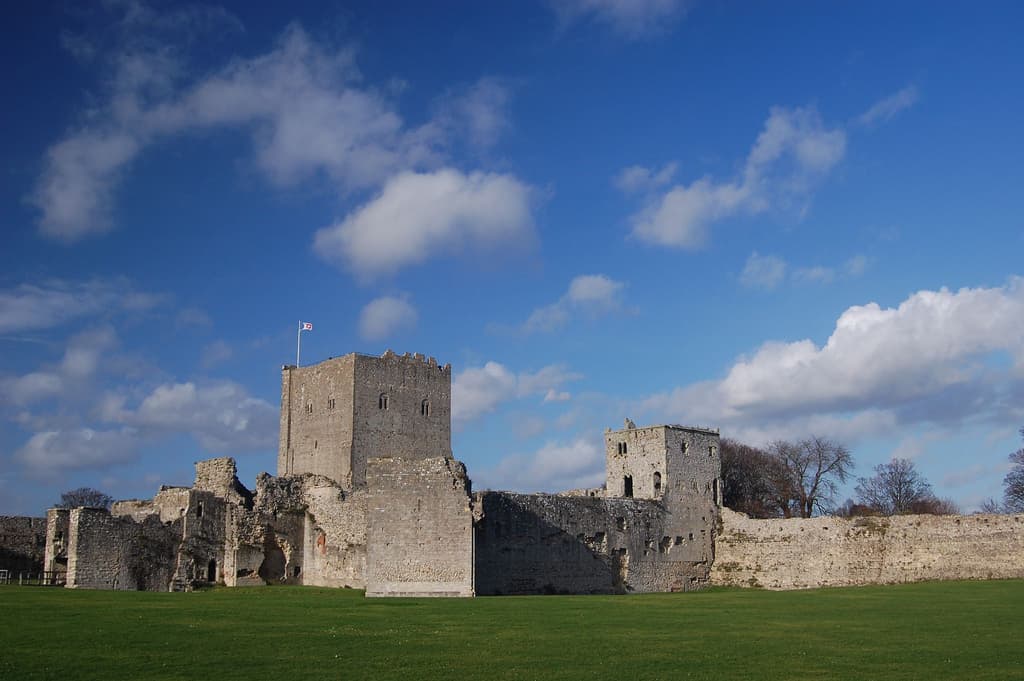
The castle's site is dominated by the remarkably preserved Roman Saxon Shore fort of Portus Adurni, whose original stone walls define the outer enclosure of the medieval castle. These massive Roman ramparts, dating from the late 3rd century AD, are constructed from durable stone and enclose a near-rectangular area designed for coastal defense. The walls feature towers at regular intervals and gatehouses that controlled access, illustrating advanced Roman military engineering.
Within the Roman walls lies the medieval inner ward, primarily occupying the northwest section of the fort. This area was initially protected by a wooden palisade and moat, later replaced with stone structures in the early 12th century. The keep, or donjon, completed by the mid-12th century, was the main stronghold and exemplifies medieval military architecture. By 1183, separate royal apartments existed, indicating the castle's dual role as a fortress and noble residence.
Defensive features included catapults and a growing garrison of knights, which increased during times of conflict such as the 1173–1174 revolt. A wooden tower was added in the late 13th century to the Roman eastern wall to bolster defenses. The 14th century saw remodeling of inner ward buildings and extension of the outer gatehouse, although some parts suffered from sea damage and neglect.
The late 14th-century royal apartments constructed for King Richard II, attributed to master mason Walter Walton, survive in a ruined state. These apartments mark a transition towards more refined living spaces within a military fortress, combining defense with comfort. Later modifications in the 16th and 17th centuries under Sir Thomas Cornwallis added lodging chambers and administrative offices, reflecting changing uses.
Within the outer bailey stands the Norman St. Mary's Church, a significant religious structure that suffered damage from prisoner fires in the 17th century but was restored about forty years later. The church remains under the care of the Anglican Diocese of Portsmouth. Nearby, Hospital Lane was the site of the prison hospital during the castle's use as a detention facility; the building survives today as Portchester House, linking the castle's healthcare history to the present.
Portchester Castle commands a strategic position at the head of Portsmouth Harbour, with its location once including a medieval harbor associated with the fortress's function. The castle is protected as a Scheduled Monument and a Grade I listed building, ensuring the preservation of its extensive historical fabric and significance. Today, it stands as a testament to over 1,700 years of continuous military, religious, and institutional history, attracting scholars, tourists, and heritage enthusiasts alike.
Legends and cultural significance
Local legend associates Portchester Castle with Pontius Pilate, claiming he was brought here in his later years as a place of refuge. Although this tradition lacks historical evidence, it contributes to the castle's rich tapestry of myth and history. The site has inspired various cultural works and remains an important symbol of England's layered past.
Visitors to Portchester Castle today can explore the extensive Roman walls, the medieval keep, the ruins of royal apartments, and the Norman church, gaining insight into the evolution of military architecture and the castle's multifaceted roles through history. The site offers a unique opportunity to witness the continuity of occupation from Roman times through the medieval period and into the modern era.
Frequently asked questions (FAQ)
- How do I get to Portchester Castle?
- Portchester Castle is located in the village of Portchester, Hampshire, easily accessible by car and public transport. The nearest train station is Portchester railway station, a short walk from the castle.
- What are the opening hours of Portchester Castle?
- The castle is typically open to visitors daily from 10:00 to 17:00, but hours may vary seasonally. It is advisable to check the official website before planning your visit.
- Is there an entrance fee to visit Portchester Castle?
- Yes, there is an admission fee to visit Portchester Castle. Ticket prices vary, with discounts available for children, seniors, and families. Check the official site for current pricing.
- What historical periods does Portchester Castle represent?
- Portchester Castle uniquely represents multiple historical periods, including Roman, Saxon, Norman, and medieval eras, showcasing over 1,700 years of continuous occupation and architectural evolution.
- Can I explore the Roman walls and medieval keep during my visit?
- Yes, visitors can walk along the remarkably preserved Roman walls and explore the medieval keep and inner ward, gaining a firsthand experience of the castle's defensive and residential structures.
- Are there guided tours available at Portchester Castle?
- Guided tours are often available, providing detailed insights into the castle's history, architecture, and significance. Check with the visitor center for tour schedules and availability.
Photo gallery

Information
Website
Visit websiteSources & official resources
Verify the information above using these authoritative references.
Loading map...
Visitor reviews
No reviews yet. Been here? Write the first review and help other travelers!
Write the first reviewVisited this castle? Share your experience
Your review helps other travelers and adds first-hand knowledge to our encyclopedia.