Porta Maggiore
The Porta Maggiore, also known as Porta Prenestina, is one of the most significant and architecturally impressive gates in the Aurelian Walls that surround the city of Rome. Constructed in the 3rd century AD during the reign of Emperor Aurelian, these walls were built to defend the expanding city against external threats. The Porta Maggiore served as a critical eastern gateway through which two important ancient Roman roads passed: the Via Praenestina and the Via Labicana.
The Via Praenestina led eastward to the ancient town of Praeneste (modern-day Palestrina), a notable religious and commercial center in Roman times. Meanwhile, the Via Labicana (now known as the Via Casilina) extended southeast from Rome, providing access to other regions of Latium and beyond. The Porta Maggiore's strategic location at the intersection of these roads made it a vital point of transit and defense.
Architectural features and construction
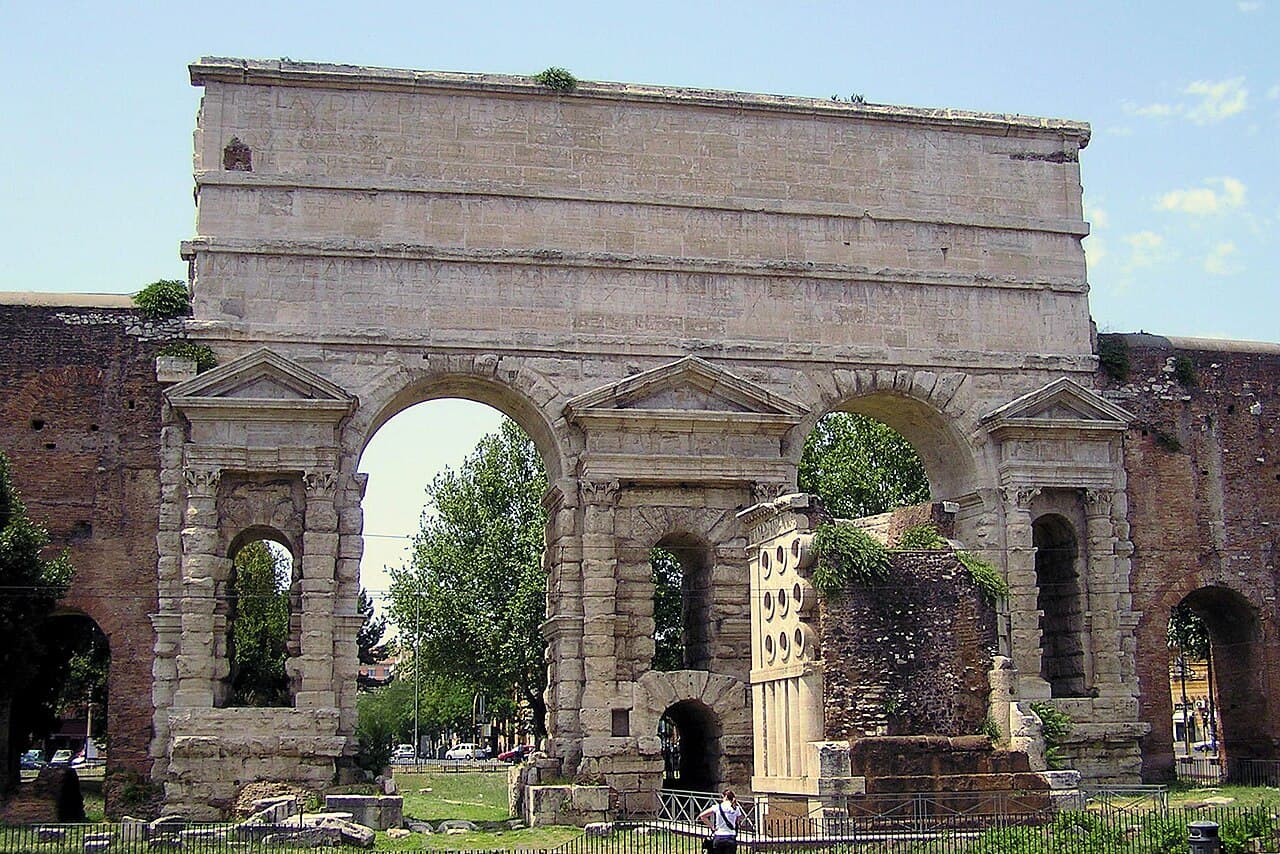
The Porta Maggiore is a remarkable example of Roman engineering and fortification architecture. Unlike many city gates that were primarily military structures, this gate was built as a monumental double archway, combining both function and grandeur. The gate is constructed from travertine stone, a durable material commonly used in Roman construction, which has contributed to its excellent state of preservation.
The gate features two large arches side by side, each corresponding to one of the ancient roads it served. Above the arches, the structure includes a robust bastioned fortress-like wall segment, which integrates defensive elements such as battlements and walkways for guards. This design allowed soldiers to monitor and control traffic entering and exiting the city effectively.
One of the unique aspects of the Porta Maggiore is that it also functions as an aqueduct bridge. It supports the Aqua Claudia and Anio Novus aqueducts, two of Rome's major water supply channels. These aqueducts run on top of the gate, demonstrating the Romans' skill in combining infrastructure with military architecture.
Historical context and significance
The construction of the Porta Maggiore occurred during a period when Rome faced growing external pressures from various tribes and needed to strengthen its defenses. Emperor Aurelian initiated the building of the walls and gates between 271 and 275 AD as a response to these threats, marking a shift from the earlier open city concept to a fortified urban center.
Porta Maggiore's role extended beyond military defense; it was also a symbol of Rome's power and engineering prowess. The gate's monumental scale and integration with vital aqueducts underscored the city's sophistication and control over its resources.
Throughout the centuries, the Porta Maggiore has witnessed numerous historical events, including sieges and urban transformations. Its survival in a well-preserved state offers valuable insights into late Roman military architecture and urban planning.
Preservation and current status
Today, the Porta Maggiore stands as one of the best-preserved gates of the Aurelian Walls. Its well-preserved condition allows visitors to appreciate the original Roman construction techniques and the gate's imposing presence. It remains a prominent landmark in Rome, attracting historians, architects, and tourists alike.
The gate is located in the eastern part of Rome, near the intersection of the Via Praenestina and Via Labicana (Via Casilina), accessible to the public for viewing from the outside. While it is not a castle in the traditional sense, its classification as a bastioned fortress reflects its fortified nature and defensive purpose within the city's ancient walls.
Architectural legacy and influence
The Porta Maggiore has influenced later military and civic architecture by demonstrating how functional infrastructure can be combined with defensive fortifications. Its dual role as a gate and aqueduct support is a testament to Roman innovation.
Modern studies of the gate contribute to understanding the evolution of city defenses and the integration of urban infrastructure in antiquity. The gate remains a key example of how the Romans balanced utility, defense, and monumental aesthetics in their construction projects.
Frequently asked questions (FAQ)
- What is the historical significance of Porta Maggiore in Rome?
- Porta Maggiore is a major eastern gate in Rome's Aurelian Walls, built in the 3rd century AD to protect the city and control access via two important ancient roads.
- Can visitors enter Porta Maggiore?
- Porta Maggiore is primarily an external monument and is not open for interior tours, but it can be viewed and photographed from the outside at any time.
- How does Porta Maggiore integrate with ancient Roman aqueducts?
- The gate uniquely supports the Aqua Claudia and Anio Novus aqueducts, combining military architecture with vital water infrastructure.
- When were the Aurelian Walls and Porta Maggiore constructed?
- The Aurelian Walls and Porta Maggiore were constructed between 271 and 275 AD under Emperor Aurelian to defend Rome from external threats.
- Where is Porta Maggiore located within Rome?
- Porta Maggiore is located in the eastern part of Rome, near the junction of the Via Praenestina and Via Labicana (now Via Casilina).
Photo gallery

Information
Loading map...
Visitor reviews
No reviews yet. Been here? Write the first review and help other travelers!
Write the first reviewVisited this castle? Share your experience
Your review helps other travelers and adds first-hand knowledge to our encyclopedia.