Servian Wall
The Servian Wall (Latin: Murus Servii Tullii; Italian: Mura Serviane) stands as one of the most significant ancient defensive structures of Rome, constructed in the early 4th century BC. This formidable fortification was built to protect the city of Rome during a period when the city was expanding and facing increasing threats from neighboring tribes and enemies. The wall was primarily constructed using volcanic tuff, a durable stone abundant in the region, which contributed to its impressive strength and longevity.
Stretching approximately 11 kilometers (6.8 miles) in length, the Servian Wall enclosed an area of about 246 hectares (610 acres). Its height reached up to 10 meters (33 feet) in certain sections, while the base width was around 3.6 meters (12 feet), making it a massive and imposing barrier. The wall featured roughly 16 main gates, which served as controlled entry points into the city. Today, only a few of these gates remain, with most having been lost or incorporated into later constructions.
Historical context and construction
The Servian Wall was built during the Early Medieval period of Rome's history, though its origins trace back to the Roman Republic era. It is traditionally attributed to the reign of the Roman king Servius Tullius, who ruled in the 6th century BC, but archaeological evidence dates the wall's construction to the early 4th century BC, following the sack of Rome by the Gauls in 390 BC. This catastrophic event exposed the vulnerability of the city and prompted the Romans to undertake a large-scale defensive project.
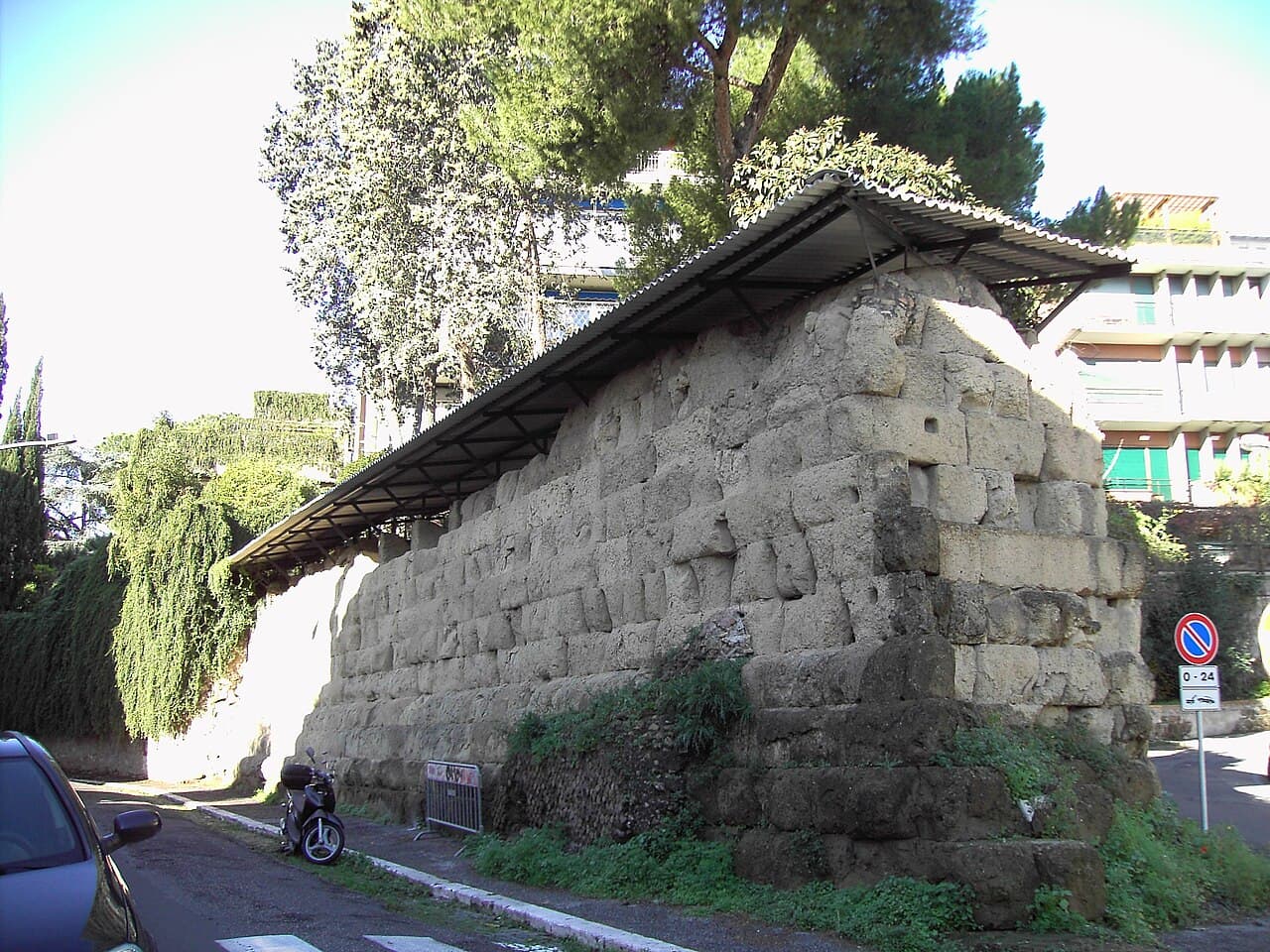
The wall's construction utilized opus quadratum masonry techniques, whereby large blocks of tuff were carefully cut and fitted without mortar in many sections. This method provided both strength and flexibility, allowing the wall to withstand seismic activity and attacks. The choice of volcanic tuff was practical due to its availability from nearby quarries, and it also gave the wall a distinctive appearance.
Architectural features and layout
The Servian Wall was designed as a bastioned fortress type of fortification, incorporating bastions or protruding defensive towers at strategic points along its length. These bastions allowed defenders to cover adjacent sections of the wall with crossfire, enhancing the overall defensive capability.
The wall enclosed the seven hills of Rome and additional surrounding areas, marking the boundaries of the early city. The gates served not only as access points but also as customs checkpoints and places for military control. Some of the better-known gates included the Porta Capena, Porta Esquilina, and Porta Collina. The wall also featured battlements and walkways for soldiers to patrol and defend the city.
Gates and towers
The surviving gates of the Servian Wall provide valuable insight into Roman military architecture. These gates were often flanked by towers that allowed defenders to observe and repel attackers. The gates were constructed with heavy stone arches and sometimes featured multiple doorways for better control of traffic.
Later history and significance
By the 3rd century AD, the city of Rome had expanded well beyond the boundaries of the Servian Wall, necessitating the construction of the much larger Aurelian Walls. These new fortifications incorporated more advanced military architecture and enclosed a significantly larger area, reflecting Rome's growth and changing defensive needs.
Despite being superseded, the Servian Wall remained a prominent feature in Rome's urban landscape for centuries. Portions of the wall were integrated into later buildings and fortifications, preserving fragments that survive to this day. Archaeological excavations have uncovered sections of the wall, which remain an important subject of study for understanding ancient Roman engineering and urban planning.
Preservation and modern-day relevance
Today, the Servian Wall is classified as partially preserved, with visible remains scattered throughout Rome, particularly in areas such as the Campus Martius and near the Termini railway station. These remnants attract historians, archaeologists, and tourists interested in Rome's ancient defenses.
The wall's construction techniques and strategic design continue to be studied for their innovative use of materials and military engineering principles. The Servian Wall not only represents a critical phase in Rome's defensive history but also offers a tangible connection to the city's early development and resilience.
Architectural legacy
The Servian Wall influenced subsequent Roman fortifications and set a precedent for urban defense in the ancient world. Its combination of massive stone construction, strategic placement of gates and towers, and integration with the city's topography exemplifies Roman military architecture's sophistication during the Republic era.
As an archaeological site, the Servian Wall provides valuable lessons on the evolution of city fortifications and the challenges faced by ancient urban centers in protecting their inhabitants. It remains a testament to Rome's enduring historical and cultural heritage.
Frequently asked questions (FAQ)
- How do I get to the Servian Wall?
- The Servian Wall is located in the heart of Rome, Italy, making it easily accessible by public transportation. You can take the Metro to the nearest stations, such as Termini or Repubblica, and enjoy a short walk to reach this historic site.
- What is the historical significance of the Servian Wall?
- The Servian Wall dates back to the 4th century BC and is one of the oldest fortifications in Rome. It represents a critical phase in the city's expansion and defense, reflecting the strategic military architecture of ancient Rome.
- When was the Servian Wall built?
- Construction of the Servian Wall began around 378 BC and was completed in the early 4th century BC. It was named after the sixth king of Rome, Servius Tullius, who is traditionally credited with its construction.
- Can I walk along the Servian Wall?
- Yes, visitors can walk along certain sections of the Servian Wall. While some parts are integrated into the urban landscape, there are designated paths that allow you to explore its impressive remnants and appreciate its historical significance.
- Why is the Servian Wall important to visitors?
- The Servian Wall is important because it offers a glimpse into Rome's ancient past and showcases the engineering prowess of early Roman civilization. Visitors can learn about the city's history while enjoying the scenic views and unique architectural features of the wall.
- Is it possible to visit the Servian Wall year-round?
- Yes, the Servian Wall is accessible to visitors year-round, although some sections may be less accessible during adverse weather conditions. It's always a good idea to check local guidelines before your visit to ensure a smooth experience.
- What are the opening hours for visiting the Servian Wall?
- The Servian Wall is not an enclosed site with fixed opening hours, as it is a part of the cityscape. Visitors can explore the wall at any time, but it's best to visit during daylight hours for safety and to fully appreciate the structure.
- Are there any ticket prices to visit the Servian Wall?
- There is no admission fee to visit the Servian Wall, making it an accessible attraction for everyone. However, guided tours may be available for a fee, providing deeper insights into its history and significance.
- What is the best time to visit the Servian Wall?
- The best time to visit the Servian Wall is during the spring or fall when the weather is mild and pleasant for walking. Early mornings or late afternoons can also provide a more serene experience with fewer crowds.
- What nearby attractions can I visit along with the Servian Wall?
- Nearby attractions include the Baths of Diocletian, the Basilica of Santa Maria degli Angeli, and the stunning Piazza della Repubblica. These sites complement a visit to the Servian Wall and provide a deeper understanding of Rome's rich history.
Photo gallery

Information
Loading map...
Visitor reviews
No reviews yet. Been here? Write the first review and help other travelers!
Write the first reviewVisited this castle? Share your experience
Your review helps other travelers and adds first-hand knowledge to our encyclopedia.