Porkhov Fortress
Porkhov fortress stands as a significant example of late medieval fortification architecture in the Russian Federation. Located on the right bank of the Shelonj river in the town of Porkhov, it was originally established as a wooden stronghold in the early 13th century and later rebuilt in stone in 1387. The fortress played a crucial role in the defense of the Novgorod Republic's southwestern borders and witnessed numerous military actions, including sieges by Lithuanian forces armed with early artillery.
Early wooden fortifications and strategic location
The earliest record of the fortress dates back to 1239 in the Novgorod chronicles. It was established by the Novgorod knight Alexander Jaroslavovitch, known as Nevsky, who created a network of wooden fortifications along the Shelonj river to secure the trade route between Novgorod and Pskov. These initial defenses consisted of two lines of earthen ramparts with ditches and wooden walls atop the ramparts, forming a typical early medieval wooden fortification system. Porkhov was one of several such strongpoints designed to control river access and protect the Novgorod lands from incursions.
Sieges and military challenges in the 14th and 15th centuries
In 1346, the fortress faced a significant threat when Olgerd, the Grand Duke of Lithuania, invaded the Novgorod territory. Lithuanian forces captured nearby fortresses Luga and Shelonj and laid siege to Porkhov. Despite the siege, Porkhov withstood the attack, and the Lithuanians accepted a war indemnity of 300 rubles before withdrawing. This event demonstrated the fortress's strategic importance and defensive capabilities even in its wooden form.
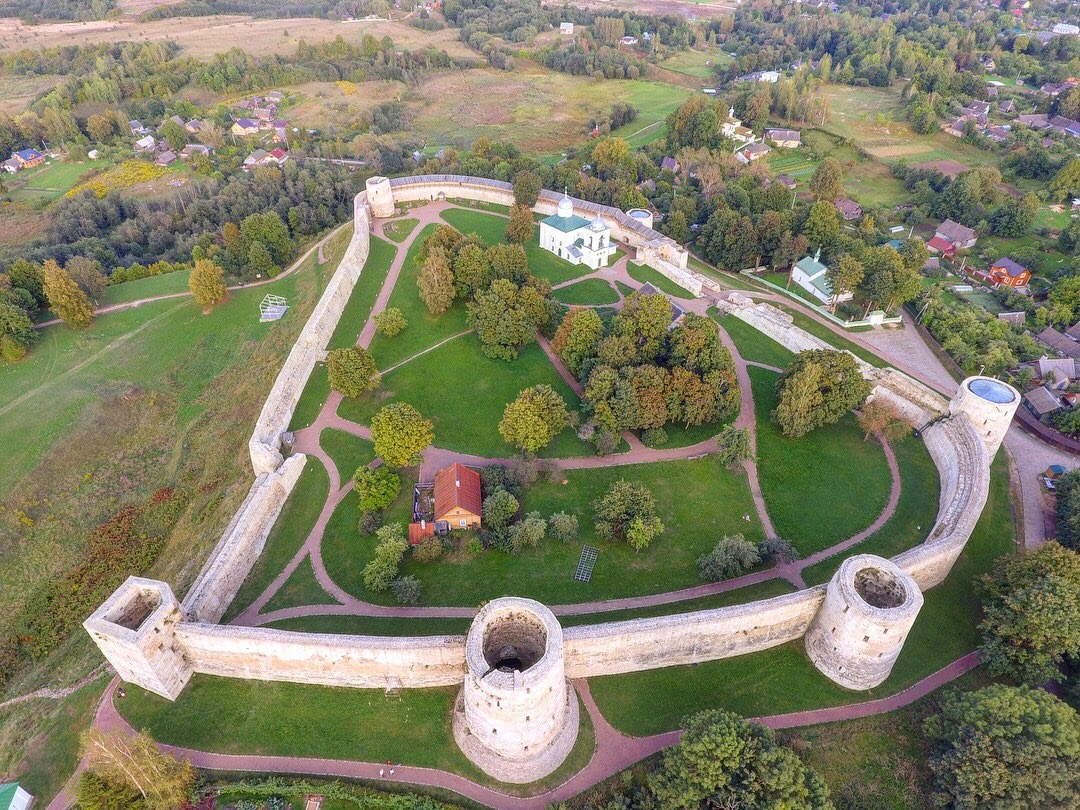
By 1387, recognizing the need for stronger defenses, the Novgorod authorities commissioned the construction of a new stone fortress on the same site. The stone fortress featured four towers, each rising 15 to 17 meters high with 4 to 6 wooden floors inside. The walls were thick, measuring between 1.4 and 2 meters, and stood about 7 meters tall. The towers projected outward from the curtain walls, allowing defenders to flank attackers approaching the walls, a common feature in medieval military architecture aimed at maximizing defensive coverage.
In July 1428, the fortress endured one of its most notable military tests during a siege by Vitovt, the Lithuanian Grand Duke. This siege is historically significant as it was among the first in Russia to involve mass artillery bombardment. The siege lasted eight days but failed to capture the fortress, though it caused considerable damage. Following this, in 1430, the fortress underwent major reconstruction, with wall thickness increased up to 4.5 meters in the most vulnerable sections and the installation of portcullises at the gates to enhance defensive strength.
Decline in military importance and preservation
After Moscow annexed the Novgorod and Pskov territories in 1478 and 1510 respectively, the state border shifted westward, moving far from Porkhov. This relocation removed the fortress from the frontline of military conflicts, and it no longer faced sieges or attacks. Consequently, its fortifications gradually lost their military significance but remained largely intact due to the absence of later extensive rebuilding or modernization efforts that often altered medieval fortresses.
The surrounding settlement grew into a trade city, and by 1776 Porkhov became an administrative center of the region. The town expanded rapidly in the late 19th century following the construction of the Pskov-Dno railway, which enhanced its connectivity. Despite this growth, the fortress itself began to deteriorate, with only minor repair works undertaken in 1912.
20th century history and current condition
During World War II, Porkhov was occupied by German forces for four years. The Nikolskaya Church within the fortress remained active during this period. Its abbot, Father Pavel, was known for his links to partisan groups and for sheltering escapees from German prisoner-of-war camps. In February 1944, German troops set fire to the city before retreating.
Today, Porkhov is a small provincial town with few surviving historic buildings outside the fortress. The fortress itself has been partially restored. The riverbank walls have been reconstructed and are accessible to visitors. However, the towers remain in a ruined state without roofs or floors and can only be explored at one's own risk. Inside the fortress are a small local museum and a botanical garden, which add cultural value to the site. The Nikolskaya Church, closed in the 1930s, has been reopened and is currently in use.
Architectural features and defensive design
The fortress's four towers are its most prominent architectural elements. Their height of up to 17 meters and multiple wooden floors inside provided vantage points for surveillance and defense. The towers' projection beyond the curtain walls allowed defenders to cover the base of the walls with crossfire, a defensive tactic to prevent attackers from approaching without exposure.
The thick stone walls, especially after the 1430 reconstruction, were formidable barriers against siege engines and artillery. The addition of portcullises at the gates improved the fortress's ability to resist direct assaults. The location on the riverbank provided a natural defensive advantage and access to water, which was critical during sieges.
Fortress layout and surrounding environment
The fortress's position on the right bank of the Shelonj river was strategic for controlling river traffic and protecting the trade route between Novgorod and Pskov. The surrounding earthen ramparts and ditches of the original wooden fortress were replaced by stone fortifications, but the natural landscape continued to serve as a defensive asset.
Preservation challenges and visitor experience
Visitors today can explore the reconstructed walls along the riverbank and visit the small museum that provides insights into the fortress's history and the region's medieval past. The botanical garden within the fortress grounds offers a peaceful contrast to the fortress's military past. However, the ruined condition of the towers means that access is limited and requires caution.
Frequently asked questions (FAQ)
- How do I get to Porkhov Fortress?
- You can reach Porkhov Fortress by taking a train or bus to Porkhov from major cities like Pskov or St. Petersburg. Once in Porkhov, the fortress is a short walk from the town center, making it easily accessible for visitors.
- What is the historical significance of Porkhov Fortress?
- Porkhov Fortress, built in the 15th century, played a vital role in the defense against invasions and was an important military stronghold in the region. Its strategic location allowed it to control the routes between Novgorod and Pskov, making it a key player in the historical conflicts of the area.
- When was Porkhov Fortress constructed?
- Construction of Porkhov Fortress began in 1485 under the orders of Ivan III. It was completed in the late 15th century and has since witnessed numerous historical events, including battles and sieges.
- Can I visit Porkhov Fortress year-round?
- Yes, Porkhov Fortress is open to visitors year-round, but the best time to visit is from late spring to early autumn when the weather is pleasant. During winter, some areas may be less accessible due to snow, but the fortress still offers a unique atmosphere.
- Why is the architecture of Porkhov Fortress unique?
- The architecture of Porkhov Fortress is notable for its robust stone walls and distinctive defensive structures, which reflect the military styles of the late medieval period. Its design incorporates elements that were necessary for fortification, making it a fascinating example of Russian defensive architecture.
- Is it possible to take guided tours of Porkhov Fortress?
- Yes, guided tours are available at Porkhov Fortress, providing visitors with in-depth knowledge about its history and architecture. These tours are led by knowledgeable guides who can share interesting anecdotes and facts about the fortress.
- What are the opening hours for Porkhov Fortress?
- Porkhov Fortress is typically open to visitors from 9 AM to 6 PM, but hours may vary depending on the season. It is advisable to check the official website or contact local tourism offices for the most accurate and current information.
- What are the ticket prices for visiting Porkhov Fortress?
- Ticket prices for Porkhov Fortress are generally affordable, with discounts available for students and seniors. It is recommended to check the fortress's official website or local tourist information for the latest pricing and any special offers.
- Are there any nearby attractions to visit along with Porkhov Fortress?
- Yes, nearby attractions include the historic town center of Porkhov, with its charming architecture and local museums. Additionally, the scenic countryside offers beautiful landscapes perfect for hiking and exploring the natural beauty of the region.
Loading map...
Visitor reviews
No reviews yet. Been here? Write the first review and help other travelers!
Write the first reviewVisited this castle? Share your experience
Your review helps other travelers and adds first-hand knowledge to our encyclopedia.