Pokrzywno
Pokrzywno Castle stands as a remarkable example of a high medieval hill castle built by the Teutonic Order in the late 13th century in what is now Poland. Its ruins occupy a strategic location at the confluence of the Marusza River and a small stream, a site previously occupied by a Slavic stronghold. The original Slavic fortification was granted in 1222 by Prince Konrad of Mazovia to the missionary bishop Christian. In 1231, the bishop transferred ownership of the Pokrzywno lands to the Teutonic Knights, who initially constructed a wooden and earth fortification named Engelsburg, or "Castle of the Angel."
By the mid-13th century, the Knights began erecting a stone castle on the site, adapting the design to the natural terrain rather than following the later typical four-winged convent castle layout. The castle was built on an irregular polygonal plan, making it one of the oldest stone castles in the Chełmno Land. Its construction incorporated remnants of the earlier Slavic fortifications, emphasizing its strategic importance.
Architectural layout and defensive features
The castle complex consisted of three main parts: the upper castle (the inner ward), the middle castle (the inner bailey), and the outer bailey, which was separated by a moat. The upper castle was located on the summit of a steep hill, surrounded on three sides by water, providing a natural defense. Access was gained from the east through the middle castle, where the hill's slope was gentler.
The upper castle's courtyard was irregularly polygonal and surrounded by five or six wings along with a gate tower. The earliest structures included the defensive walls and the northern wing, a multi-story building housing the chapel of St. Lawrence. This chapel was notable for its exceptionally thick walls at the ground level, reaching up to 8 meters. The initial construction materials were fieldstones, later supplemented with brickwork.
The gate tower was situated at the southeast corner of the walls and featured a vaulted passage. It was protected by an elaborate foregate and a dry moat with a drawbridge. The eastern wing, built after the gate tower and chapel, was the most representative part of the castle, containing the sacristy, refectory, and chapter house. Due to later demolitions, the layout and function of other buildings in the upper castle remain uncertain.
Middle castle and outer bailey
The middle castle, constructed between 1283 and 1300, was enclosed by a wall following the hill's edge in an irregular polygonal shape. It contained various service buildings and living quarters for the garrison, all positioned along the walls. Numerous loopholes allowed defenders to fire upon attackers effectively, making this area a strong defensive position.
Entry to the middle castle's courtyard was through a complex gate system, likely strengthened by a gate tower and a drawbridge over the moat separating it from the outer bailey. The outer bailey was also enclosed by walls adapted to the hill's contours and housed economic buildings such as stables, barns, and coach houses. It had two gates, one to the north and one to the south, facilitating access to the castle grounds.
Historical significance and events
The castle served as the seat of a Teutonic commandery, first mentioned in 1278. It played a vital role in the military and administrative organization of the region. After the Battle of Grunwald in 1410, the castle was briefly occupied by Polish forces. The Teutonic Knights quickly reclaimed it, repairing war damages and strengthening the walls.
During the Hunger War of 1414, Polish troops again captured Pokrzywno, but the Knights regained control two years later. The damage inflicted on the commandery's estates led to its dissolution, with its properties managed by the local vogt in Rogoźno. Subsequently, the castle functioned mainly as the residence of a cellar master overseeing the estate and brewery.
In the Thirteen Years' War (1454–1466), the castle was taken by members of the Prussian Confederation. Following the Second Peace of Toruń in 1466, Pokrzywno and the entire Chełmno Land were incorporated into the Kingdom of Poland. The castle then became the seat of Polish starosts until the First Partition of Poland in 1772.
Decline and ruin
The 17th century brought destruction through several fires. The first, in 1611, devastated the entire complex, including the chapel. Another fire in 1657 occurred during the Swedish occupation in the Second Northern War. Despite these setbacks, the castle was rebuilt and remained in use for some time.
After the region was annexed by Prussia in 1772, the castle underwent systematic dismantling. Despite protests from the Bishop of Chełmno, the castle chapel was demolished in 1789. Continued demolition reduced the structure to ruins. It was only in 1934 that conservation authorities recognized the remains as a protected monument. Restoration and stabilization efforts took place in the 1960s, focusing mainly on the upper castle.
Present condition and notable remains
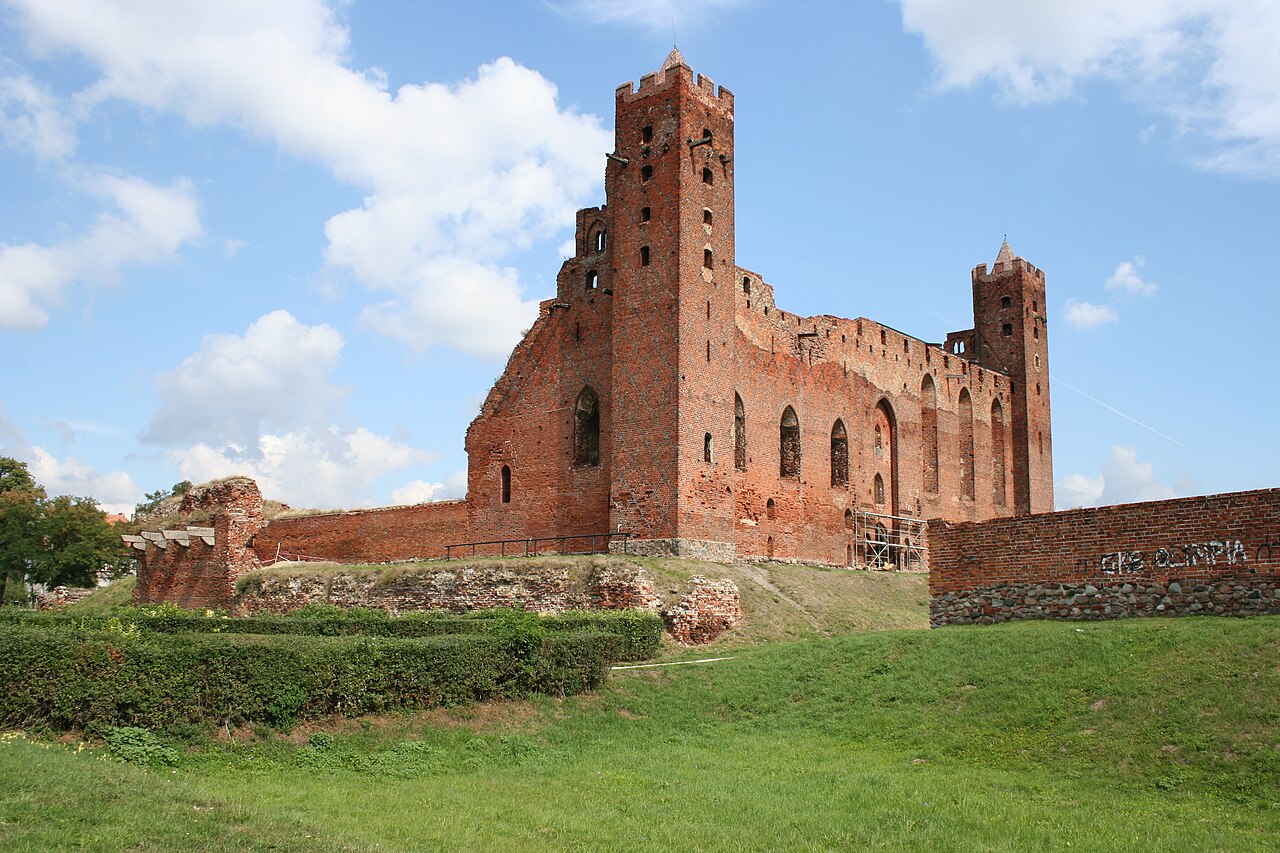
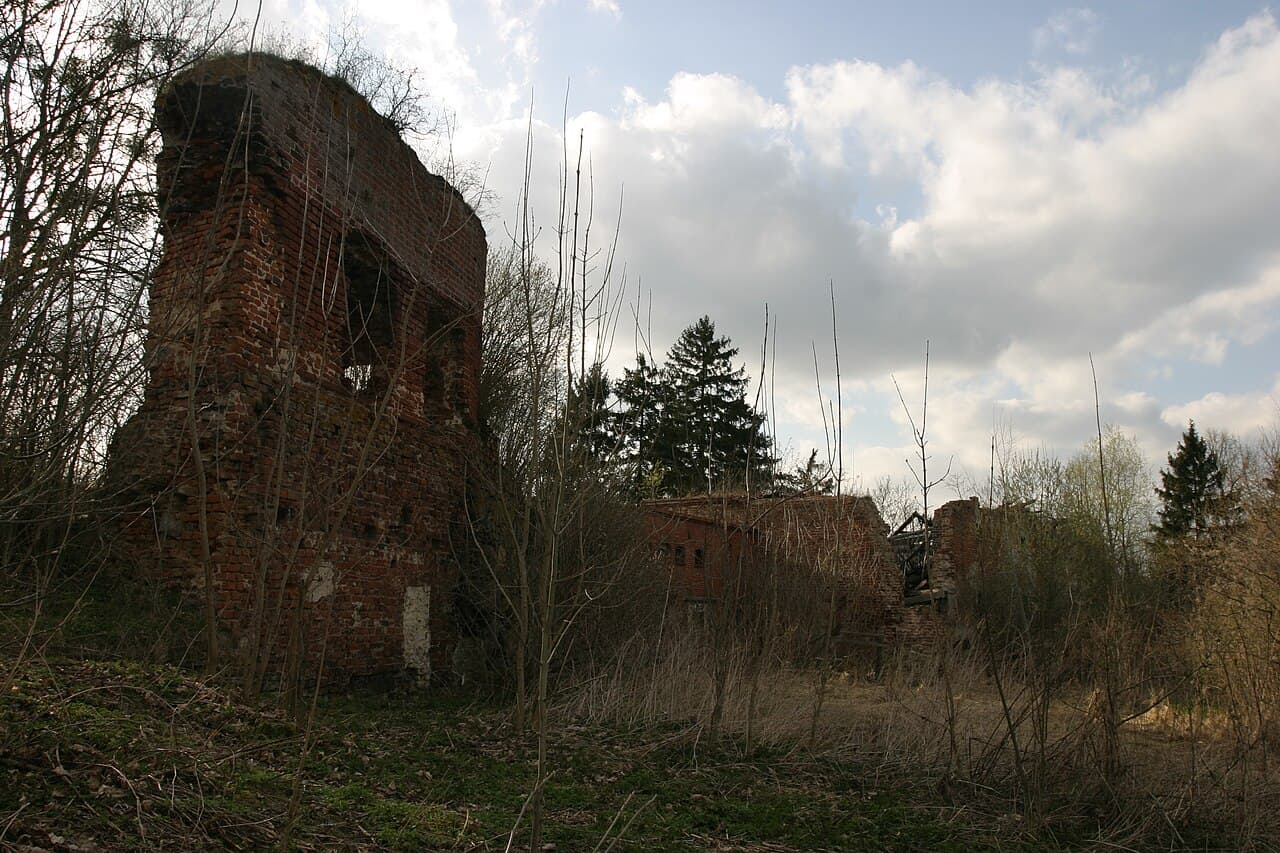
Today, Pokrzywno Castle is in a state of ruins, with significant sections of the outer bailey walls still standing. A road connecting Grudziądz and Radzyń Chełmiński passes through these walls. In the northwest corner of the outer bailey stands a barn with bricked-up loopholes, hinting at its former defensive role.
The middle castle houses a large 14th-century brick granary, historically used as a malt drying facility. Visitors can also see fragments of walls, a brick gate with a pointed arch portal, and partially filled vaulted medieval cellars. The upper castle retains a partially restored gate tower with an upper chamber preserved up to the second floor, along with remnants of the foregate.
Remains of the eastern and northern wings survive, alongside faint traces of other wings. Vaulted cellars accessible from the courtyard are linked to underground tunnels, which legend suggests were used by the Teutonic Knights for secret sorties against besieging enemies.
Architectural and cultural importance
Pokrzywno Castle is a valuable example of early Teutonic military architecture that predates the Order's classic four-wing convent castle design. Its adaptation to the landscape and incorporation of earlier Slavic fortifications demonstrate a blend of cultural influences and strategic ingenuity. The castle's layered history reflects the turbulent political and military struggles in the region through the Middle Ages and early modern period.
The site offers insights into the evolution of defensive structures, from wooden earthworks to stone fortifications with complex gate systems, thick walls, and multi-purpose wings. Although in ruins, the castle remains an important cultural heritage monument, attracting historians, archaeologists, and visitors interested in medieval architecture and the history of the Teutonic Order in Poland.
Frequently asked questions (FAQ)
- When was Pokrzywno Castle originally built?
- Pokrzywno Castle was constructed between 1283 and 1300 by the Teutonic Knights on the site of an earlier Slavic stronghold.
- What architectural style characterizes Pokrzywno Castle?
- The castle features early medieval military architecture with an irregular polygonal layout, thick defensive walls, and a gate tower, predating the typical Teutonic four-wing convent style.
- Is Pokrzywno Castle open to visitors today?
- The castle is privately owned and in ruins, but visitors can explore the remains of the walls, gate tower, and vaulted cellars on the site.
- What historical events affected Pokrzywno Castle?
- The castle was involved in the Battle of Grunwald (1410), the Hunger War (1414), the Thirteen Years' War, and suffered damage during Swedish occupation in the 17th century.
- Are there any underground tunnels at Pokrzywno Castle?
- Vaulted cellars connected by underground tunnels exist beneath the upper castle, believed to have been used by the Teutonic Knights for secret movements during sieges.
Photo gallery

Information
Current owner
Private owner
Loading map...
Visitor reviews
No reviews yet. Been here? Write the first review and help other travelers!
Write the first reviewVisited this castle? Share your experience
Your review helps other travelers and adds first-hand knowledge to our encyclopedia.