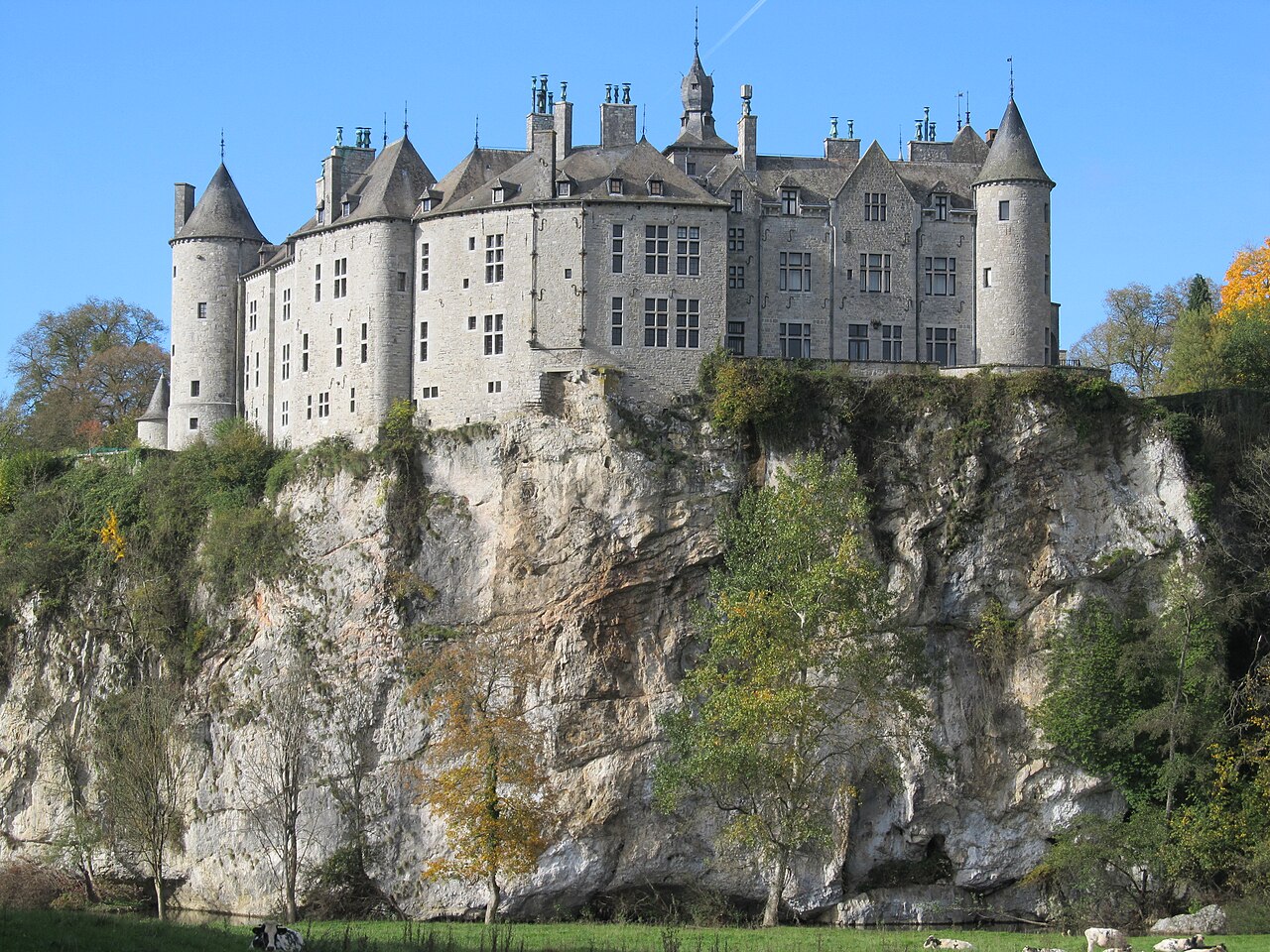
Poilvache Castle
Poilvache Castle, also known locally as Château de Poilvache, is a remarkable medieval fortress perched on a clifftop above the village of Houx in the Walloon region of Belgium, within the municipality of Yvoir. This imposing site overlooks the river Meuse and represents one of the most significant fortified complexes of the High Medieval period in the Meuse valley. The castle's ruins today evoke a rich history of strategic military importance, economic prosperity, and dramatic sieges that shaped the region's medieval landscape.
The exact foundation date of Poilvache Castle remains uncertain, but it is traditionally linked to the era of Charlemagne, with legends associating it with the mythical Montessor Castle built for the Four Sons of Aymon, legendary figures in medieval folklore. The earliest documented mention of the castle dates back to 1228, when it was referred to as Château d'Émeraude (Emerald Castle). This early reference coincides with the castle's ownership by Isabelle of Bar, who inherited it from her mother, Ermesinde, Countess of Luxembourg, in 1226. During Isabelle's tenure, the castle underwent substantial fortification enhancements, reflecting its growing strategic importance.
Early history and strategic significance
In the early 13th century, Poilvache Castle was a focal point of regional power struggles. In 1238, it endured a siege led by John of Eppes, the Prince-Bishop of Liège, after Isabelle's husband, Waleran de Montjoie, violated a peace treaty. The siege ultimately failed, and John died during his retreat, underscoring the castle's formidable defenses. Following Waleran's death, Isabelle transferred ownership to her half-brother, Henry V, Count of Luxembourg, in 1254, at which time the castle was known as Château de Méraude.
Under the rule of Henry VIII, Count of Luxembourg, later Holy Roman Emperor, in the late 13th century, Poilvache Castle and its surrounding village flourished. Henry VIII established a mint in the village, a testament to its economic vitality. The castle itself was expanded to become one of the largest and most robust fortifications in the Meuse valley, strategically positioned between the influential cities of Dinant (part of the Prince-Bishopric of Liège) and Bouvinges (within the County of Namur). This location made Poilvache a critical military and economic hub during this period.
Sieges, ownership changes, and decline
The castle's turbulent history continued into the 14th century. Around 1312, Poilvache was besieged and damaged by troops from Dinant, reflecting ongoing regional conflicts. In 1342, the castle and its village were sold to the County of Namur, marking a shift in control. The Counts of Namur maintained possession until 1421, when John III sold the county to Philip the Good, Duke of Burgundy. Philip fortified the castle further, anticipating hostilities with the Prince-Bishopric of Liège.
In 1430, the castle faced its most devastating siege. John of Heinsberg, Prince-Bishop of Liège, led an army estimated at 30,000 men, including forces from Liège, Dinant, and Huy, to capture Poilvache. Despite its formidable defenses, the castle fell after a determined assault. The victorious bishop ordered the castle and the adjacent village to be dismantled and demolished, effectively ending Poilvache's role as a military stronghold.
The destruction was compounded in 1554 when invading French troops ravaged the remaining structures. Subsequently, the ruins and territory remained under noble ownership until 1782, when they were sold to a commoner. During the Brabant Revolution in 1790, Austrian troops utilized the site to bombard rebel positions across the river, demonstrating the site's continued strategic value even in the early modern era.
Architectural features and layout
Today, the ruins of Poilvache Castle encompass not only the remains of the fortress itself but also the extensive walls of the once-thriving walled village it protected. The castle was constructed on a rocky spur overlooking the Meuse, which provided natural defensive advantages. The fortress controlled the only access point to the village from the east, with robust curtain walls, towers, and gatehouses forming a formidable barrier against invaders.
The castle complex included various defensive and residential structures, such as battlements, dungeons, and courtyards, designed to support both military and domestic functions. The village itself was fortified with its own walls, indicating the combined military and economic importance of the site. The presence of a mint within the village highlights its role as a center of commerce and governance during its peak.
Fortifications and defenses
The castle's fortifications were periodically enhanced, particularly under the Counts of Luxembourg and later the Dukes of Burgundy. These improvements included thickening of walls, construction of additional towers for better surveillance and defense, and reinforcement of the main gate. Despite these efforts, the castle ultimately succumbed to overwhelming siege forces in the 15th century.
Cultural and historical legacy
Poilvache Castle holds a significant place in Belgian medieval history as a symbol of regional power struggles and feudal conflicts. Its association with the legendary Four Sons of Aymon adds a layer of cultural mystique, while its documented history reflects the complex political dynamics of the Meuse valley during the High Medieval and early Late Medieval periods.
The castle's dramatic fall in 1430 and subsequent destruction mark a turning point in the history of the region, illustrating the shifting allegiances and territorial disputes that characterized medieval Europe. The ruins serve as a poignant reminder of the area's turbulent past and are a valuable cultural heritage site.
Visiting poilvache castle today
Today, Poilvache Castle is accessible to visitors for a modest fee, offering a compelling glimpse into medieval fortification architecture and history. The site provides spectacular views over the Meuse river and surrounding landscapes, making it a popular destination for history enthusiasts and tourists alike.
Visitors can explore the extensive ruins, including the remains of the castle's defensive walls and the walled village, gaining insight into the medieval way of life and the strategic importance of the site. The location also offers opportunities for hiking and photography, with panoramic vistas that capture the natural beauty and historical significance of the region.
From the castle's vantage point, one can also observe the isle in the Meuse river where German armored divisions crossed during the early days of World War II on 13 May 1940, adding a layer of modern historical interest to the site.
Poilvache Castle remains a testament to the enduring legacy of medieval fortifications in Belgium and continues to attract visitors eager to connect with the country's rich historical tapestry.
Frequently asked questions (FAQ)
- How do I get to Poilvache Castle?
- Poilvache Castle is located in Yvoir, Belgium, easily accessible by car or public transport. If driving, you can find parking nearby, and for public transport, local buses connect Yvoir with major cities.
- What is the historical significance of Poilvache Castle?
- Poilvache Castle dates back to the 13th century and played a crucial role in the defense of the region. Its strategic location overlooking the Meuse River made it an important stronghold during various conflicts in medieval times.
- When was Poilvache Castle built?
- Construction of Poilvache Castle began in the early 13th century, with significant modifications made in the following centuries. The castle has witnessed numerous historical events, making it a fascinating site for history enthusiasts.
- Can I take guided tours of Poilvache Castle?
- Yes, guided tours are available for visitors who want to learn more about the castle's history and architecture. These tours are typically offered during the peak tourist season and can be booked in advance.
- Why is Poilvache Castle an architectural highlight?
- Poilvache Castle showcases a blend of medieval military architecture and stunning views of the surrounding landscape. Its ruins reflect the craftsmanship of the time, featuring impressive stonework and defensive structures.
- Is it possible to visit Poilvache Castle year-round?
- While Poilvache Castle is open to visitors year-round, certain areas may be restricted during inclement weather or maintenance periods. It’s best to check ahead for any seasonal restrictions.
- What are the opening hours for Poilvache Castle?
- Poilvache Castle typically opens to the public from 10 AM to 6 PM during the summer months. Hours may vary in the off-season, so it is advisable to check the official website for the most current information.
- What are the ticket prices for visiting Poilvache Castle?
- Admission prices for Poilvache Castle are quite reasonable, usually ranging from €5 to €8 for adults, with discounts available for children and seniors. Group rates may also apply, making it an affordable option for families and school visits.
- What are some nearby attractions to Poilvache Castle?
- Visitors to Poilvache Castle can also explore the charming town of Yvoir, which offers beautiful walks along the Meuse River. Additionally, nearby attractions include the scenic Dinant and the impressive Caves of Han, both of which enrich the experience of the area.
Information
Address
Chemin de Poilvache, Belgium
Loading map...
Visitor reviews
No reviews yet. Been here? Write the first review and help other travelers!
Write the first reviewVisited this castle? Share your experience
Your review helps other travelers and adds first-hand knowledge to our encyclopedia.