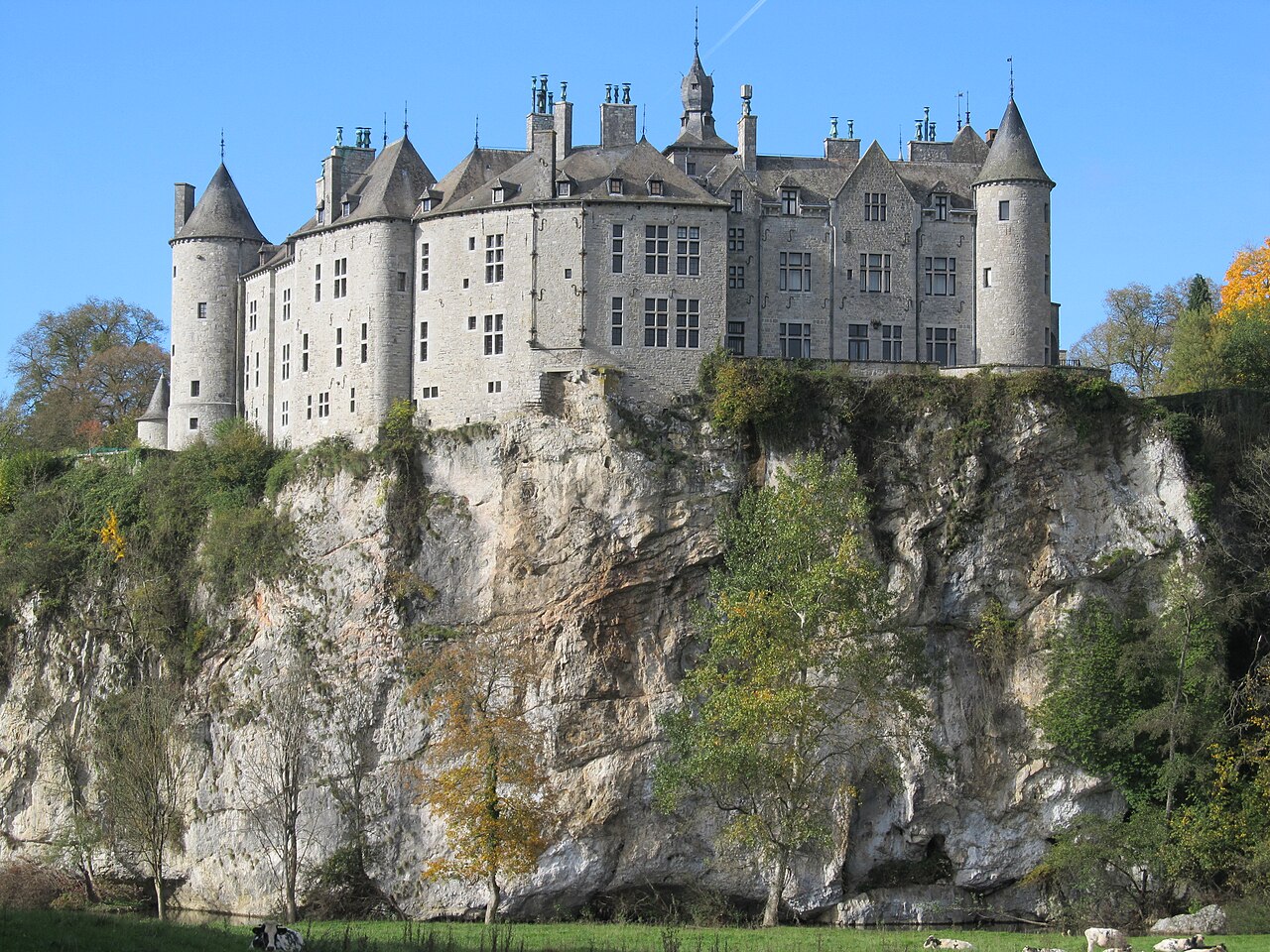
Crèvecœur Castle
Crèvecœur Castle, also known as Château de Crèvecœur, is a striking late medieval fortress ruin perched on a high rock cliff overlooking the Meuse River near the town of Bouvignes-sur-Meuse, part of the city of Dinant in the Wallonia region of Belgium. This castle is renowned for its dramatic history of sieges and conflicts, its strategic location, and its evocative ruins that attract visitors interested in medieval architecture and regional history.
Originally constructed around 1320 as a defensive stronghold for the fortified town of Bouvignes, Crèvecœur Castle was built in response to the ongoing hostility between the towns of Bouvignes and Dinant. These rival towns were divided not only by the Meuse River but also by political and ecclesiastical allegiances: Bouvignes was aligned with the Church of Namur, while Dinant was linked to the Church of Liège. The castle served as a vital military installation in this regional power struggle.
The castle's core structure is a square keep erected on a separate rock outcrop, a typical feature of hill castles designed for defense and surveillance. Over the 14th and 15th centuries, Crèvecœur was extensively modified and expanded. Notably, in 1388, the master builder Godefroid de Bofiaule added significant fortifications, including a semi-circular bastille that enhanced the castle's defensive capabilities. These additions reflect the evolving military architecture of the late medieval period, as castles adapted to new siege technologies and tactics.
The medieval rivalry and sieges
The castle's history is marked by numerous sieges, reflecting the turbulent political landscape of medieval Belgium. Early on, in the late 11th century, a fortress was established by Godfrey I, Count of Namur, with substantial walls added by his son Henry the Blind. The castle endured a siege in 1188 by Baldwin V, Count of Hainaut, with assistance from knights of Champagne, illustrating its strategic importance.
In the early 14th century, the castle faced threats from the people of Liège, with an unsuccessful siege in 1321. The construction of the square tower around 1320 was a direct response to the nearby Montorgueil Tower built by Dinant on the opposite bank of the river. This architectural duel underscored the ongoing rivalry between the two towns.
The wars of Liège and the 1429 siege
One of the most significant conflicts occurred during the Wars of Liège (1429-1431). The castle's captain, Jean le Blondel (Blondeau), attempted a daring night assault on the Montorgueil Tower in February 1429. In retaliation, the Prince-Bishop of Liège, John of Heinsberg, launched a siege against Crèvecœur. Despite the attackers using a medieval siege engine known as a cat, the castle withstood the assault. Eventually, the arrival of Philip the Good, Duke of Burgundy, led to a truce, preserving the castle's integrity for the time being.
The tragic 1554 siege and the castle's decline
The castle's most poignant episode came during the 1554 siege by the troops of King Henry II of France. After sacking both Bouvignes and Dinant, the French forces besieged Crèvecœur, which was heavily damaged by artillery. The defenders, running out of ammunition, were led in a remarkable act of defiance by three wives of fallen officers who took command and ultimately chose to leap from the castle walls rather than surrender. This tragic event gave the castle its name, Crève Cœur, meaning "breaking heart".
Following this siege, the castle was abandoned as a military fortress and fell into ruin. It was partially rebuilt between 1567 and 1580 to serve as a watchtower, but its strategic importance waned. The French captured it again in 1655, and it was dismantled in 1672 under the supervision of François d'Otreppe.
Architectural features and layout
The castle is situated approximately eighty meters above the Meuse River on a precipitous cliff, providing commanding views of the valley and surrounding landscape. The square keep from circa 1320 forms the core of the castle and measures approximately 15 by 11.5 meters. It was designed for defense and as a stronghold for the lord or captain of the castle.
Attached to the keep are two staircases leading to the semi-circular bastille added in the 15th century, extending the castle's defensive perimeter to about 40 meters in length. This bastille exemplifies the adaptation of castle architecture to resist artillery and improve defensive coverage.
Below Crèvecœur lies the remnants of the old count's castle, which is three times as long and spread across three terraces. The highest terrace contains the oldest structures, including a Romanesque keep. The middle terrace housed a farmstead expanded in the 13th century, including a well-preserved cellar, Saint Catherine's Chapel, a coinage facility, and the large hall that functioned as the town hall. The lowest terrace abuts the Sint-Lambertus Church, integrating the castle complex with the town's religious architecture.
Modern status and visitor information
Today, Crèvecœur Castle is a well-preserved ruin that is freely accessible year-round, allowing visitors to explore its evocative remains and enjoy panoramic views of the Meuse valley. The woodland path leading from Bouvignes to the castle offers a scenic approach, enhancing the visitor experience.
The castle's ruins stand as a testament to the complex medieval history of the region, illustrating the evolution of military architecture and the enduring legacy of local conflicts. Its dramatic story, combined with its picturesque setting, makes Crèvecœur Castle a significant cultural and historical landmark in Belgium.
Frequently asked questions (FAQ)
- How do I get to Crèvecœur Castle?
- Crèvecœur Castle is located in Dinant, Belgium, and can be easily reached by car or public transport. If you are traveling by train, the nearest station is Dinant, from where you can take a short taxi ride or walk to the castle.
- What are the opening hours of Crèvecœur Castle?
- Crèvecœur Castle is typically open to visitors from 10 AM to 6 PM during the summer months. In the off-season, it may have reduced hours, so it's best to check the official website for the most current information before your visit.
- Can I buy tickets online for Crèvecœur Castle?
- Yes, you can purchase tickets online through the official website of Crèvecœur Castle. Buying tickets in advance is recommended to avoid long queues, especially during peak tourist seasons.
- When was Crèvecœur Castle built?
- Crèvecœur Castle dates back to the 14th century and has a rich history that reflects the architectural styles of various periods. It was originally constructed as a defensive fortification and has undergone several renovations over the centuries.
- Is it possible to tour the inside of Crèvecœur Castle?
- Yes, visitors can explore the interior of Crèvecœur Castle during guided tours. These tours provide insights into the castle's history, architecture, and the lives of those who once inhabited it.
- Why is Crèvecœur Castle historically significant?
- Crèvecœur Castle is historically significant as it played a crucial role in the defense of the region during various conflicts. Its architectural features and well-preserved structures offer a glimpse into medieval life and military strategies.
- What is the best time to visit Crèvecœur Castle?
- The best time to visit Crèvecœur Castle is during the late spring and early autumn when the weather is pleasant for outdoor exploration. Additionally, these seasons often feature fewer crowds compared to the peak summer months.
- Are there any nearby attractions to visit after Crèvecœur Castle?
- Yes, after visiting Crèvecœur Castle, you can explore the beautiful town of Dinant, which is home to the Collegiate Church of Notre Dame and the iconic Dinant Citadel. The surrounding Meuse Valley also offers picturesque hiking and cycling opportunities.
- Is Crèvecœur Castle accessible for visitors with disabilities?
- Crèvecœur Castle is committed to providing accessibility for all visitors. There are designated pathways and facilities to assist those with mobility challenges, but it is advisable to contact the castle staff ahead of your visit for specific requirements.
Information
Address
Near Place de la Trompette, Bouvignes-sur-Meuse, Dinant, Belgium
Loading map...
Visitor reviews
No reviews yet. Been here? Write the first review and help other travelers!
Write the first reviewVisited this castle? Share your experience
Your review helps other travelers and adds first-hand knowledge to our encyclopedia.