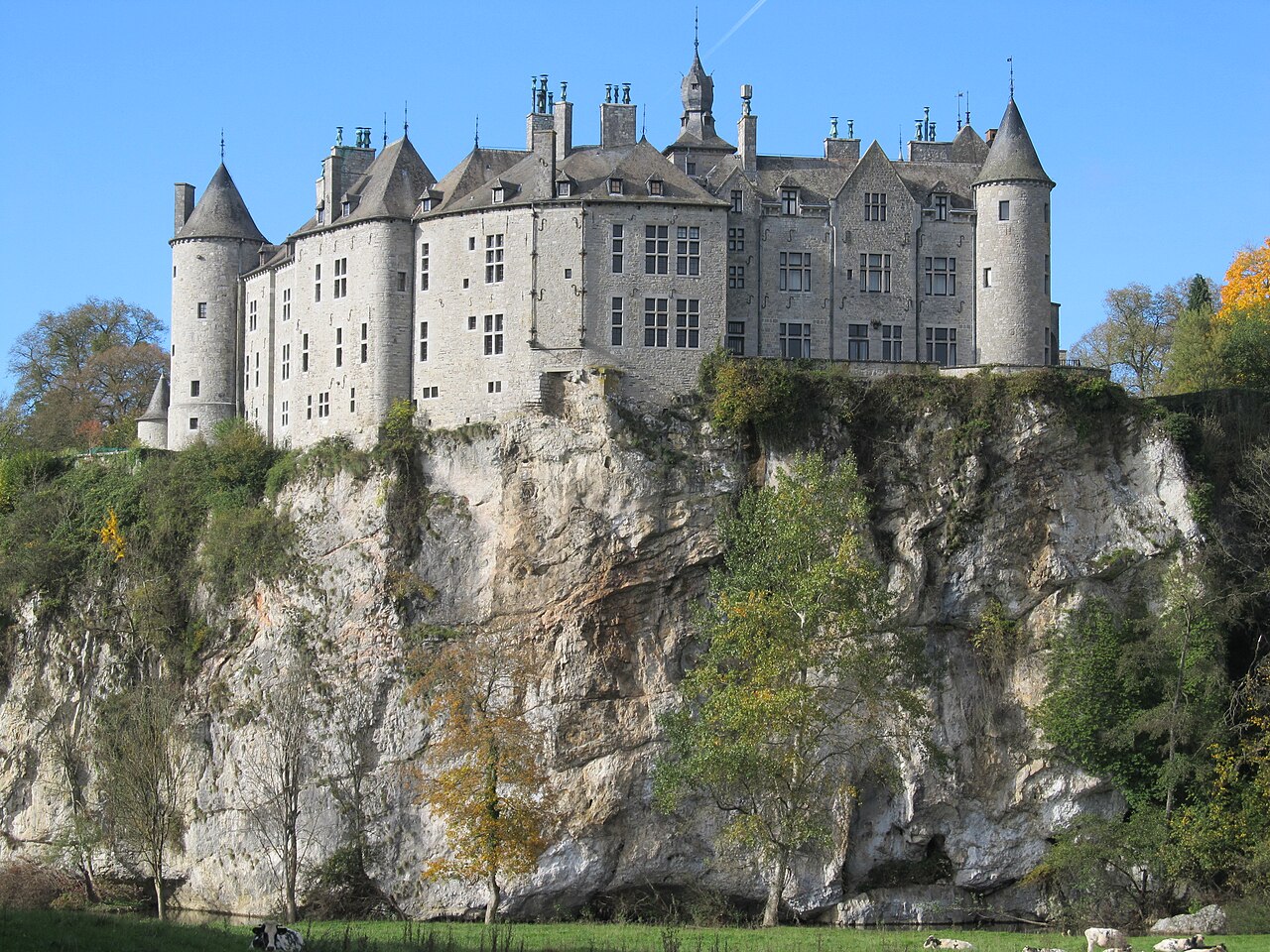
Dinant Citadel
Dinant Citadel, locally known as Citadelle de Dinant, is a prominent fortress perched on a 100-meter high rocky outcrop overlooking the town of Dinant and the Meuse River in the province of Namur, within Belgium's Wallonia region. It is one of the four famed Meuse Citadels, alongside those of Huy, Liège, and Namur, which collectively represent a strategic defensive network controlling the Meuse valley.
The earliest fortifications on the site date back to the mid-11th century, when a castle was constructed by Prince-bishop Nithard of Liège. This initial stronghold was strategically positioned to oversee river traffic and provide defense for the town below. However, this medieval castle was destroyed in 1466 during the Sack of Dinant by Charles the Bold, Duke of Burgundy, a significant event that marked the town's turbulent history.
Reconstruction and expansion in the 16th century
Following its destruction, the castle was rebuilt on a grander scale in the early 16th century under the direction of Érard de la Marck, the then Prince-bishop of Liège. This reconstruction transformed the fortress into a more formidable structure, reflecting advancements in military architecture of the period. The new fortifications included strengthened walls and expanded defensive works to better withstand emerging artillery technologies.
Vauban's influence and 17th-century fortifications
In the late 17th century, the fortress underwent significant modifications under the supervision of Sébastien Le Prestre de Vauban, the renowned French military engineer serving Louis XIV. Vauban visited Dinant in 1692 and redesigned the town's and castle's fortifications to improve their defensive capabilities against the evolving art of siege warfare. His work included the enhancement of bastions, ramparts, and other military features characteristic of Vauban-style fortifications.
Despite these improvements, the fortress was destroyed again in 1703 by retreating French troops during the War of the Spanish Succession, reflecting the ongoing strategic importance of Dinant in European conflicts.
19th-century reconstruction and Dutch influence
After the defeat of Napoleon Bonaparte in 1815, Dinant became part of the United Kingdom of the Netherlands. Between 1818 and 1821, the Dutch constructed a new citadel on the ruins of the earlier castles. This structure, which largely defines the current appearance of the Dinant Citadel, was designed to serve as a modern fortress suited to the military needs of the time.
Following the Belgian Revolution of 1830–31, the citadel became Belgian property. By 1868, the fortress was demilitarized and repurposed for civilian use, including as storage facilities, reflecting changing military strategies and technologies that rendered such fortifications less critical.
Role in 20th-century conflicts
During World War I, Dinant suffered significant devastation in the Sack of Dinant in 1914, when German troops partially destroyed the town and occupied the citadel. The fortress's strategic position made it a focal point during the conflict.
In World War II, the citadel was defended by French forces against the advancing 7th Panzer Division led by General Erwin Rommel in 1940. Despite the defense, German forces captured the fortress. Later, in 1944, retreating German troops and Allied bombing caused severe damage to both the town and the citadel.
Architectural features and access
The current Dinant Citadel retains elements from its various phases of construction, including 19th-century fortifications built atop medieval ruins. Its position atop a steep cliff provides commanding views of the Meuse valley and the town below, a critical factor in its defensive role.
Visitors can access the citadel via a long stairway from the town, a cable car offering panoramic views, or by road from the opposite side. The fortress today serves as a museum and cultural site, offering insights into its layered history and military architecture.
Cultural and historical significance
Dinant Citadel stands as a testament to the strategic importance of the Meuse valley through the High Medieval period and beyond. Its successive reconstructions reflect evolving military technologies and political powers, from the Prince-bishops of Liège to the French monarchy, the Dutch kingdom, and modern Belgium.
The fortress is part of a network of Meuse citadels that collectively illustrate the region's turbulent history of conflict, defense, and shifting sovereignties. Today, it is a key heritage site attracting visitors interested in military architecture, European history, and the scenic beauty of the Wallonia region.
Frequently asked questions (FAQ)
- How do I get to Dinant Citadel from the town?
- You can reach Dinant Citadel from the town by climbing a long stairway, taking a cable car that offers scenic views, or driving up from the opposite side.
- What is the historical significance of Dinant Citadel?
- Dinant Citadel has been a strategic military fortress since the 11th century, playing key roles in regional conflicts including the Sack of Dinant and both World Wars.
- When was the current citadel built?
- The current structure was built between 1818 and 1821 by the Dutch on the ruins of earlier medieval fortifications.
- Is Dinant Citadel open to visitors year-round?
- Yes, Dinant Citadel is open daily from 9:00 to 18:00, allowing visitors to explore its historical and architectural features throughout the year.
- Are there guided tours available at Dinant Citadel?
- Guided tours are available at Dinant Citadel, providing detailed insights into its history, architecture, and role in European conflicts.
Information
Opening hours
9:00-18:00, daily
Ticket prices
€8 adult, €5 child
Current owner
Municipality
Address
Chemin de la Citadelle 1, Dinant, Belgium
Loading map...
Visitor reviews
No reviews yet. Been here? Write the first review and help other travelers!
Write the first reviewVisited this castle? Share your experience
Your review helps other travelers and adds first-hand knowledge to our encyclopedia.