Poenari Castle
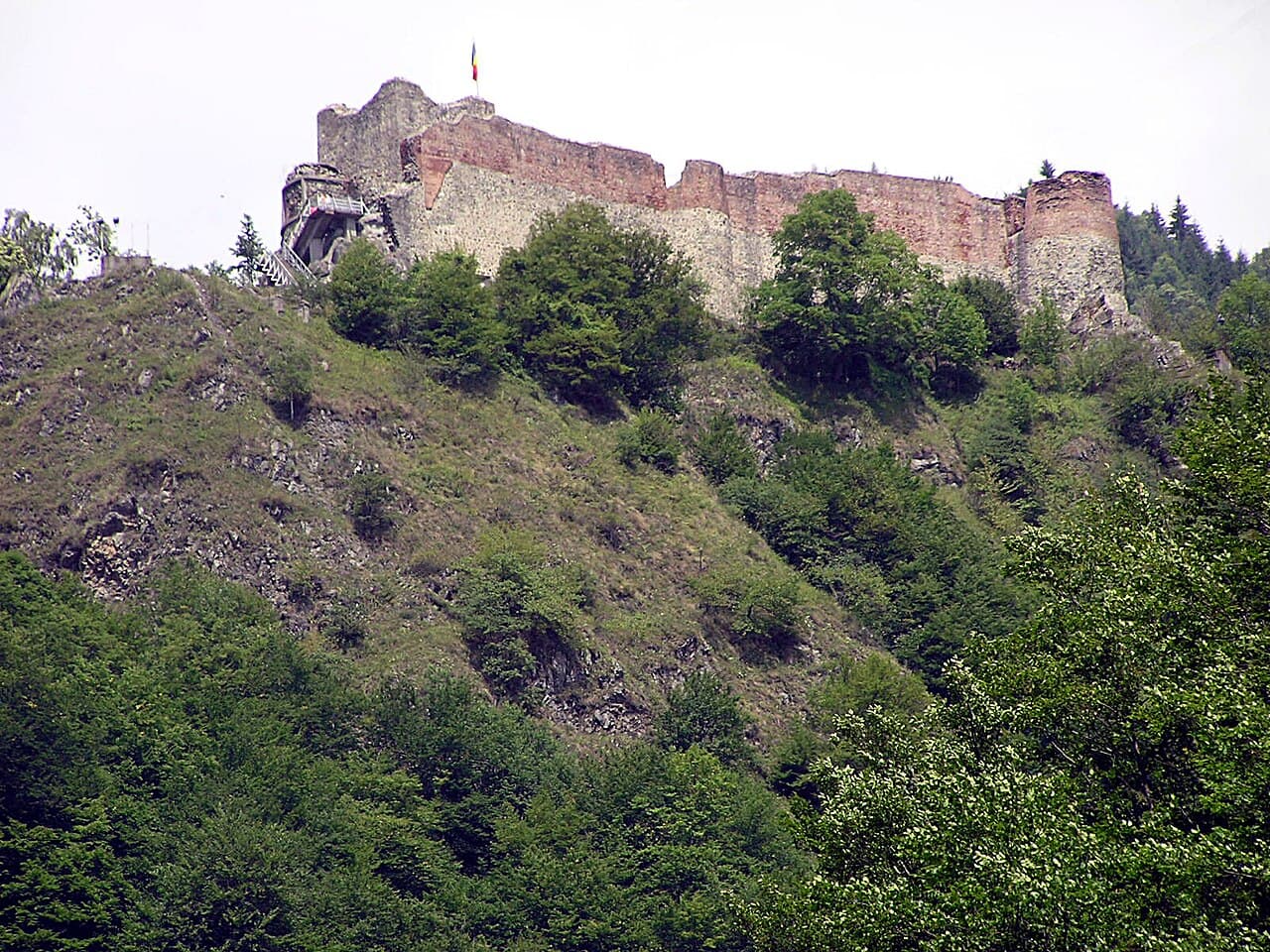
Poenari Castle, perched dramatically atop Mount Cetatea in Arges, Romania, stands as a formidable symbol of medieval military architecture and the turbulent history of Wallachia. Originally built in the early 13th century, the fortress gained its prominence in the 14th century during the Negru Voda Age, evolving from a modest stronghold with a single tower into a sprawling defensive complex. Its strategic location overlooking the Argeș River valley, at an altitude of approximately 850 meters, provided commanding views and natural protection, making it a critical bastion against invading forces, particularly the Ottoman Empire.
The castle's historical significance is closely tied to Vlad III Dracula, known as Vlad the Impaler, who extensively rebuilt and expanded the fortress in the mid-15th century. Vlad transformed Poenari into one of his primary residences and a military stronghold, reinforcing its walls and towers to withstand sieges and serve as a refuge during his campaigns. The fortress is often referred to as the "nest of vultures," a testament to its imposing presence and the fear it inspired among enemies.
Early construction and medieval origins
The initial construction of Poenari Castle dates back to the early 1200s, with the earliest fortifications likely consisting of simple stone and wood structures. The castle as it stood in the 14th century featured a solitary tower, thought to be a donjon or keep, characteristic of early medieval fortresses. This tower exhibits architectural elements reminiscent of the 11th and 12th centuries, suggesting that parts of the structure may have been built or influenced by earlier designs.
During the 14th century, Poenari served as a key defensive site for the Basarab dynasty, which ruled Wallachia. Its position on a steep cliff made it naturally defensible and a formidable obstacle to any invading army. The fortress was part of a larger network of fortifications intended to protect the northern borders of Wallachia from incursions.
Vlad the impaler’s restoration and expansion
In the 15th century, particularly around 1459, Vlad the Impaler undertook significant restoration and expansion of Poenari Castle. Following damage caused by the 1446 earthquake, Vlad saw the strategic importance of the fortress and ordered its reconstruction and strengthening. He expanded the walls, added towers, and enhanced the defensive capabilities of the castle to serve both as a military fortress and a residence.
According to historical chronicles such as the Letopiseţ Cantacuzinesc, Vlad forced boyars—members of the noble class who were disloyal or politically opposed to him—to work on the fortress's construction as a form of punishment. This labor was harsh, and many did not survive the ordeal. Merchants from Târgoviște were also compelled to contribute to the building efforts. This labor-intensive restoration reflects Vlad's determination to consolidate his power and fortify Wallachia against external threats.
Architectural features added by vlad
The reconstruction under Vlad included the addition of robust stone walls approximately two to three meters thick, designed to withstand artillery and siege engines. The fortress's layout was elongated, adapting to the natural contours of the cliff, with five towers integrated into the defensive perimeter—four round and one prismatic. The buildings within the walls were constructed directly on the rock, with oak beams used to level the foundations on the steep slopes, a sophisticated technique for the period.
Strategic importance and military history
Poenari Castle was a crucial defensive point against the advancing Ottoman forces during the 15th century. Its elevated position and strong fortifications allowed it to serve as a refuge and command center for Vlad the Impaler during his campaigns. The fortress was also used to imprison boyars who were deemed traitorous, reinforcing Vlad's control over his domain.
The fortress's nickname, "nest of vultures," reflects both its high, inaccessible location and the fierce reputation of its lord. Legend holds that Vlad escaped from pursuing Ottoman troops by clever tactics involving his horses, further cementing Poenari's role as a symbol of resistance.
Sieges and legends
One of the most enduring legends associated with Poenari involves Vlad's wife, whose name is debated among historians. During a siege by Vlad's Muslim brother, Radu Bey, she is said to have thrown herself from the castle's towers into the Argeș River below, preferring death to captivity. This tragic story adds a human dimension to the fortress's grim history.
Decline and modern restoration efforts
After Vlad's death in 1476, Poenari continued to be used for several decades, serving administrative and defensive functions, including as a treasury. However, by the early 16th century, the fortress began to decline in importance and was eventually abandoned in the first half of that century.
Natural disasters, including earthquakes in 1913, 1940, and 1977, along with landslides, caused significant damage to the fortress walls and structures. Much of the northern wall collapsed following the 1915 earthquake, and parts of the fortress have been in ruins since.
Between 1969 and 1972, restoration efforts were undertaken to stabilize and preserve the remaining structures. Concrete steps were constructed to improve access, allowing visitors to ascend the 1,480 steps through the surrounding beech forest to reach the castle. The Argeș County Museum currently manages the site, which is recognized as a monument of national importance. Plans for further restoration have been proposed, including a project seeking funding to enhance preservation.
Architectural and cultural significance
Poenari Castle is a remarkable example of medieval fortress architecture adapted to a challenging mountainous terrain. Its combination of early medieval donjon elements and 15th-century fortifications illustrates the evolution of military architecture in Wallachia. The use of natural rock formations for foundations and the integration of multiple towers into the defensive walls demonstrate advanced construction techniques for the period.
The castle's association with Vlad the Impaler adds a layer of cultural intrigue and attracts visitors interested in the history of Dracula and medieval Eastern Europe. Despite its ruined state, Poenari remains a powerful symbol of Romanian heritage and resistance against Ottoman expansion.
Visitor experience and access
Visiting Poenari Castle involves a challenging ascent of nearly 1,500 steps through dense beech forests, rewarding visitors with breathtaking views of the Argeș River valley and the surrounding mountains. The castle ruins offer a tangible connection to the past, with visible walls, towers, and foundation stones that evoke the fortress's former strength.
The site provides an immersive historical experience for those interested in medieval fortifications, Romanian history, and the legend of Vlad the Impaler. Its remote location and rugged terrain contribute to the sense of adventure and discovery.
Frequently asked questions (FAQ)
- What is the historical significance of Poenari Castle?
- Poenari Castle is famously known as the fortress of Vlad the Impaler, the inspiration for Bram Stoker's Dracula. Built in the 15th century on a cliff, it played a crucial role in defending the region against invading forces.
- When was Poenari Castle built?
- The construction of Poenari Castle began in the 14th century, with significant enhancements made in the 15th century under Vlad the Impaler. Its strategic location and robust architecture were pivotal during its time.
- How do I get to Poenari Castle?
- Poenari Castle is located near the town of Arefu in Muntenia, Romania. It is accessible by car, and there is a parking area nearby, followed by a hike up approximately 1,480 steps to reach the castle.
- What are the opening hours for Poenari Castle?
- Poenari Castle is typically open for visitors from 9 AM to 6 PM during the summer months and from 9 AM to 4 PM in the winter months. It is advisable to check the official website for any seasonal changes or special closures.
- Can I buy tickets in advance for Poenari Castle?
- Yes, tickets for Poenari Castle can be purchased on-site upon arrival. There are no advanced online ticket sales, so it's recommended to arrive early, especially during peak tourist seasons.
- Is it possible to explore the castle on my own?
- Absolutely! Visitors can explore Poenari Castle independently, allowing for a personal experience of its historical architecture and stunning views. However, guided tours are also available for those who prefer a more informative visit.
- What is the best time to visit Poenari Castle?
- The best time to visit Poenari Castle is during the late spring to early autumn months when the weather is warm and pleasant. This period not only offers beautiful views but also allows you to enjoy the lush surrounding landscapes.
- Are there any nearby attractions to Poenari Castle?
- Yes, nearby attractions include the picturesque village of Arefu and the stunning Transfagarasan Highway, known for its breathtaking mountain scenery. Additionally, the historic city of Sibiu is a short drive away, offering further cultural exploration.
- Is Poenari Castle accessible for visitors with mobility issues?
- Due to its location on a steep cliff and the necessity of climbing approximately 1,480 steps, Poenari Castle may not be suitable for visitors with mobility issues. It's recommended to consider alternative attractions that offer easier access.
Photo gallery

Information
Website
Visit websiteSources & official resources
Verify the information above using these authoritative references.
Loading map...
Visitor reviews
No reviews yet. Been here? Write the first review and help other travelers!
Write the first reviewVisited this castle? Share your experience
Your review helps other travelers and adds first-hand knowledge to our encyclopedia.