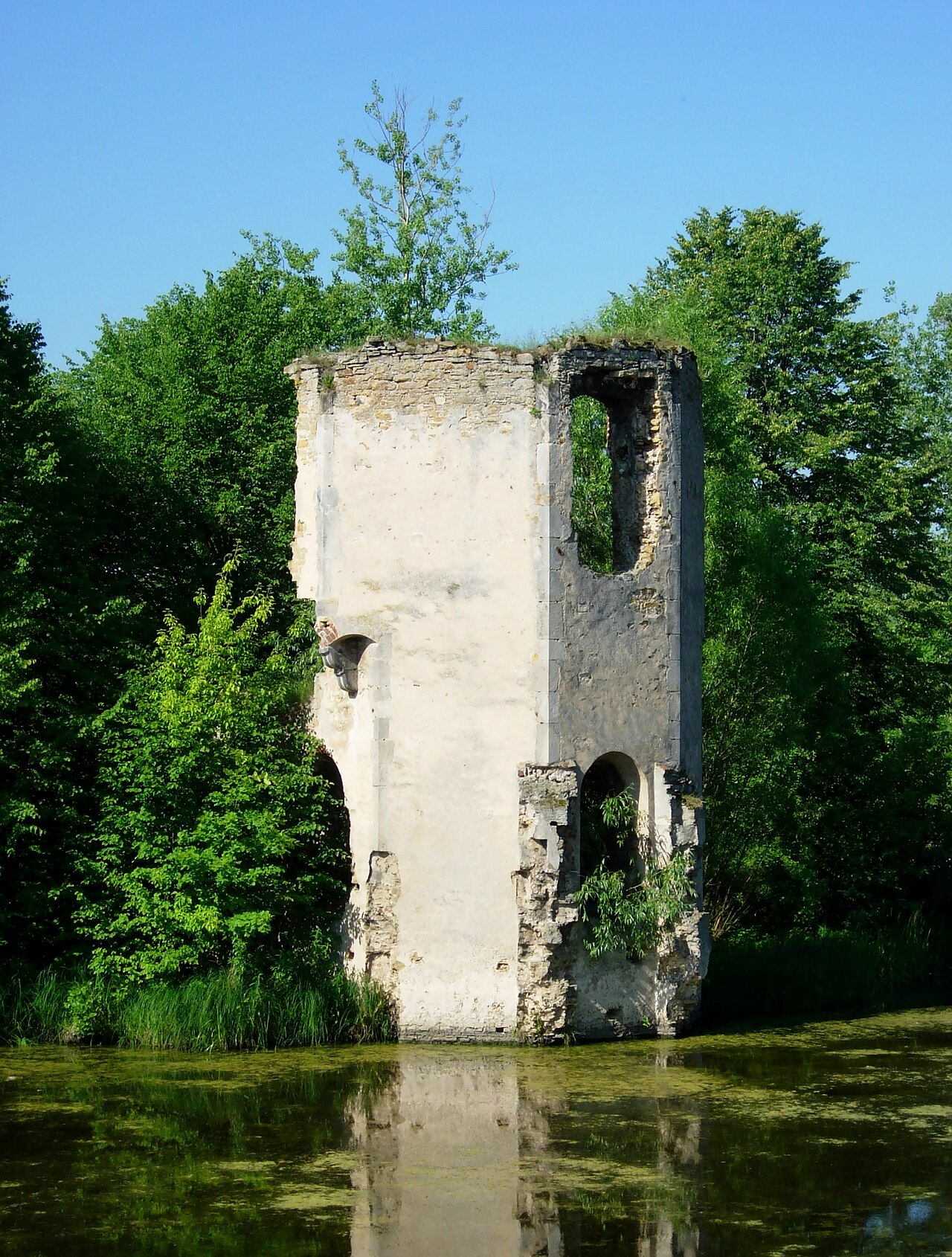
Located approximately 2 kilometers from the town of Ćmielów in Poland, the Podgrodzie castle ruins stand as a testament to the region's late medieval fortification efforts. This bastioned fortress was strategically constructed on the edge of a promontory whose steep slopes descend sharply into the valley of the Kamienna River. Despite its imposing position, the castle's history remains shrouded in mystery due to scarce historical records and limited archaeological research.
The construction of Podgrodzie castle likely began in the 14th century, with some scholars suggesting the mid-1300s as the starting point. A significant historical document from 1388 references a castrum Ćmielów, which many historians believe pertains to the castle at Podgrodzie. This document records the sale of the castle by brothers Marcin and Mikołaj to Gniewosz of Dalewice, who later became the castellan of Sandomierz. However, the exact identity of the castle's original founder remains unknown, adding to the enigmatic nature of the site.
Architectural design and fortifications
The castle was ingeniously built on a natural elevation formed by a promontory, which was further isolated by excavating a deep moat that cut off the tip of the spur. This defensive ditch created a roughly circular plateau approximately 25 meters in diameter, perfectly suited for a compact fortress. Archaeological excavations have revealed that the castle's layout was adapted to the shape of the hill, resulting in a near-circular plan.
The perimeter was fortified with a circular curtain wall over one meter thick, primarily preserved along the northern and western edges of the plateau. In the southwest corner, remnants of a small tower measuring 4 by 4.8 meters have survived, indicating the castle's defensive capabilities. However, the full circuit of the walls has not been reconstructed, leading to the hypothesis that the castle might never have been fully completed.
This theory is supported by archaeological findings of large piles of limestone blocks intended for construction, suggesting that building works were halted prematurely. Contrarily, a variety of artifacts unearthed at the site imply that the castle was occupied for some time, even if it remained unfinished. This duality has led researchers to propose that Podgrodzie castle may have been inhabited despite its incomplete state.
Historical context and significance
Podgrodzie castle's position overlooking the Kamienna River valley would have offered strategic control over local trade routes and defense against potential invaders. The castle's ownership by Gniewosz of Dalewice, a notable figure in the region, underscores its importance during the late medieval period. Yet, due to the scarcity of documents and limited archaeological investigation, much of the castle's role in regional politics and military history remains speculative.
Its classification as a bastioned fortress reflects the architectural trends of the time, combining natural topography with man-made fortifications to create a defensible stronghold. The use of bastions and thick curtain walls would have enhanced its ability to withstand sieges and attacks, a common necessity in the turbulent medieval landscape of Poland.
Current condition and preservation
Today, the site is recognized as ruins, with only faint traces of the original stone walls visible atop the hill. The remnants provide valuable insight into medieval military architecture and the challenges of fortress construction on difficult terrain. The deep moat and the surviving tower base remain key features that attract historians and visitors alike.
Ongoing and future archaeological research may shed further light on the castle's construction phases, usage, and eventual decline. Enhanced study could reveal more about the daily life within the fortress, its architectural innovations, and its place within the broader network of medieval Polish castles.
Visiting Podgrodzie castle ruins
While the ruins are not extensively developed for tourism, the site offers a compelling destination for enthusiasts of medieval history and castle architecture. Visitors can explore the natural landscape and imagine the fortress that once stood here, appreciating the strategic ingenuity of its builders.
Given the limited infrastructure, visitors should prepare for a modest hiking experience and bring suitable footwear. The serene surroundings and panoramic views of the Kamienna River valley provide a rewarding backdrop for exploration and photography.
Frequently asked questions (FAQ)
- What is the historical significance of Podgrodzie castle?
- Podgrodzie castle was a strategic bastioned fortress from the late medieval period, controlling the Kamienna River valley and linked to regional nobility like Gniewosz of Dalewice.
- When was Podgrodzie castle built?
- The castle was likely constructed in the 14th century, with historical records from 1388 mentioning its sale, indicating it was established by then.
- What remains can visitors see at Podgrodzie castle today?
- Visitors can see faint remnants of stone walls, a deep moat, and the base of a small tower, all situated on a hilltop promontory.
- Is Podgrodzie castle fully preserved?
- No, the castle is in ruins with only partial wall remains and archaeological traces visible, suggesting it may never have been fully completed.
- Can I visit Podgrodzie castle easily?
- The site is accessible but lacks developed tourist infrastructure, so visitors should be prepared for a moderate hike and bring appropriate footwear.
Information
Loading map...
Visitor reviews
No reviews yet. Been here? Write the first review and help other travelers!
Write the first reviewVisited this castle? Share your experience
Your review helps other travelers and adds first-hand knowledge to our encyclopedia.