Pniv Castle
Pniv Castle stands as a significant historic fortress located in the municipality of Nadvirna, Ukraine. This hill castle was constructed by the noble Kurapatwa family, of Hungarian origin, during the late medieval period. The family's acquisition of the surrounding lands was a reward from the Polish prince Władysław Opolczyk for their loyal service to the Polish crown. The castle’s strategic position on a hill overlooking the western bank of the Bystrytsia River allowed it to control and protect a vital trade route linking Hungary through the Zakarpattia region to the important cities of Halych, Lviv, and Kraków.
The exact founding date of Pniv Castle remains uncertain, with historical sources suggesting construction either in the late 14th century or during the second half of the 16th century. Regardless of the precise date, the castle quickly became an important customs post and military stronghold. Its location on the borderland region known as Pokuttya made it a focal point in regional conflicts throughout the 17th century.
Historical significance and military role
Pniv Castle played a critical role in the defense and administration of the borderlands between Poland and neighboring powers. The castle’s position on a prominent hill enabled surveillance over the surrounding valleys and control over trade and military movements. Throughout the 17th century, the fortress was repeatedly tested in warfare and local unrest.
Conflicts and sieges
In 1621, the castle was captured and partially destroyed by local bandits led by Hryni Kardash, illustrating the volatile nature of the region. Later, during the widespread Cossack uprisings, forces under Semen Vysochan attacked and damaged the fortress in 1648. The castle’s resilience was further tested in 1676 during the Polish-Turkish wars when Ottoman troops and their Tatar allies laid siege to it, though they failed to capture the stronghold.
Ownership and decline
Ownership of Pniv Castle shifted among several prominent Polish noble families. In 1745, the estate passed first to the Sieniawski magnates and later to the Cetner family. Following the region’s incorporation into the Austrian Empire in the late 18th century, the castle’s military importance diminished. It was eventually abandoned, and local inhabitants dismantled much of its structure, repurposing the stone for other buildings.
During the Soviet era, the ruins of Pniv Castle received formal recognition as an architectural monument under the Ukrainian SSR (inventory number 240). Conservation efforts resumed in 2018, with proposals submitted in 2021 to secure European Union funding aimed at restoration and preservation alongside other regional fortresses.
Architectural features and layout
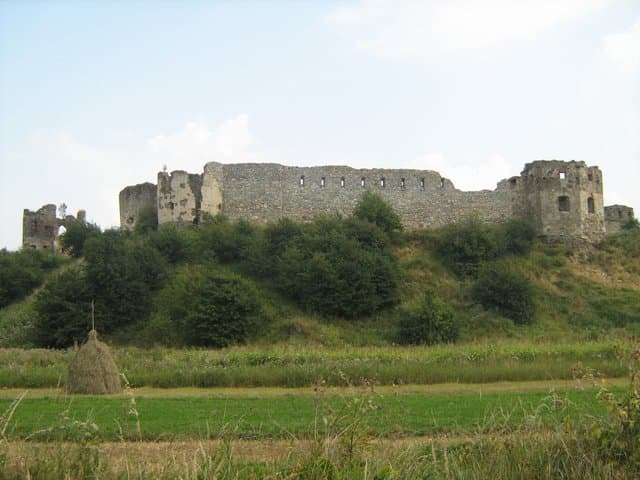
The castle occupies a flat hill north of the village of Pniv, designed as an irregular pentagon fortified by five defensive towers placed at its corners and entrance. These towers exhibit varied architectural forms: the eastern tower was round, the northern and southern towers hexagonal, and the western tower semicircular. One of the towers functioned as the main gate tower.
The fortress walls were primarily built from large, carefully cut gray stone blocks sourced from the nearby Carpathian Mountains. Red brick was used on the inner wall surfaces and in later reconstruction phases, contributing to the castle’s layered architectural history. The walls are approximately 1.5 meters thick, providing formidable defense against attacks.
Surrounding part of the castle was an artificial moat, originally crossed by a drawbridge. Remnants of the masonry still reveal openings for the chains that supported the drawbridge, offering valuable insight into the fortress’s former access system. Defensive features included battlements with loopholes, narrow vertical slits in the walls and towers that allowed defenders to fire while remaining protected. The southern side was further protected by a man-made ditch, while the eastern side dropped steeply into a deep ravine with a stream below, enhancing natural defenses.
Condition of the ruins
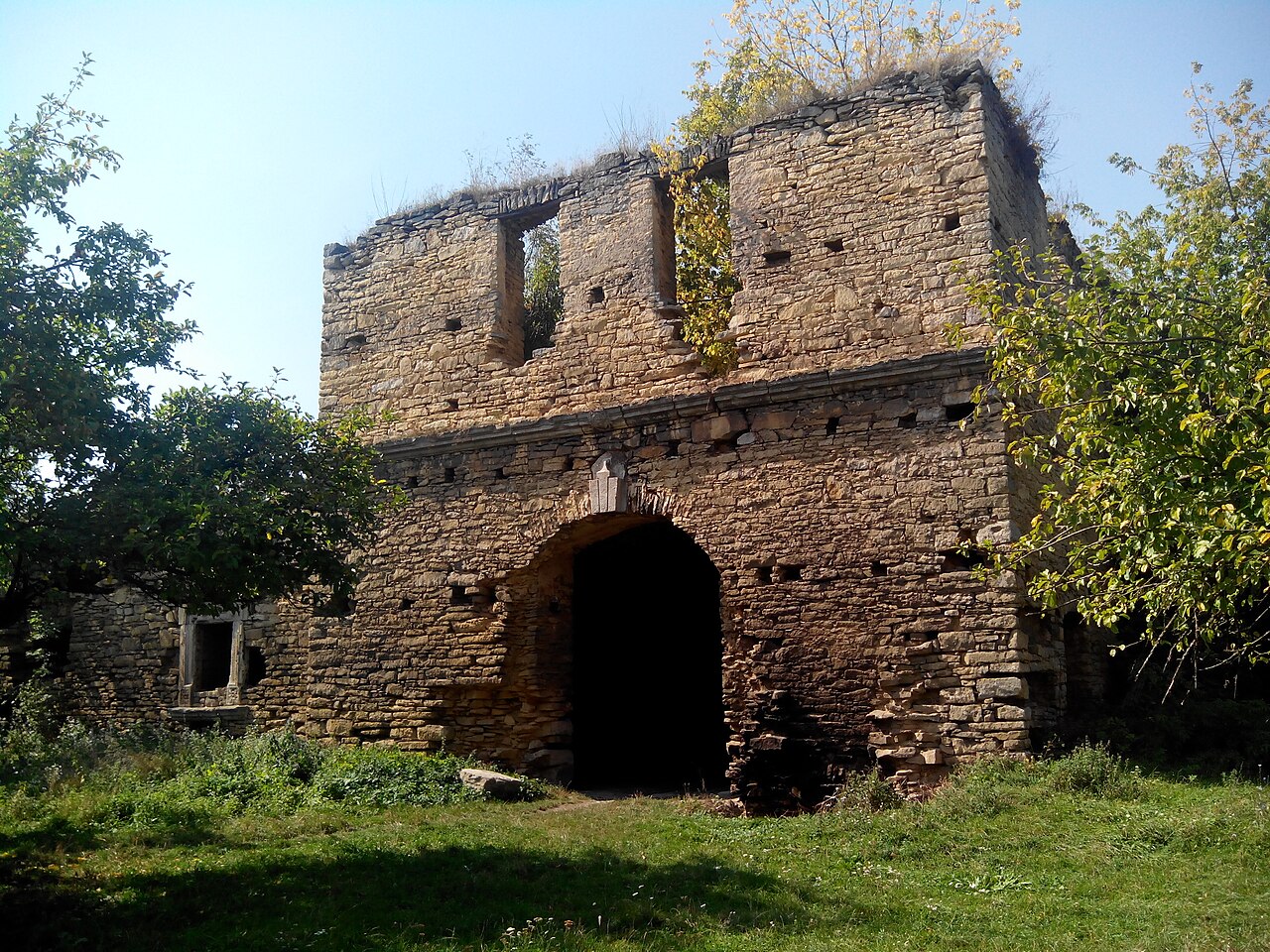
Today, the northern wall is the best preserved, retaining its original height and still connected to the eastern wall by surviving plaster layers. The eastern wall shows a marked difference in ground levels, with the outside face rising to twice the height of the interior, indicating deliberate defensive earthworks. Other walls and towers exhibit signs of deterioration, including cracks, shifts, and partial collapses. Notably, the eastern round tower collapsed in June 2010 following flooding.
Within the castle complex, remains of the Kurapatwa family’s residential buildings survive, including vaulted underground casemates that likely served as storage or shelter during sieges. The towers originally rose multiple stories, with wooden floors supported by beams set into niches within the walls. Fragments of these beams remain, providing a glimpse into the castle’s internal structure.
Cultural and archaeological importance
The ruins of Pniv Castle offer a vivid archaeological record of late medieval military architecture and the region’s turbulent history. The combination of natural and artificial defenses, varied tower designs, and well-preserved masonry techniques illustrate the castle’s evolution and strategic significance. Conservation efforts that began in 2018 aim to stabilize and preserve these features, ensuring the site remains accessible for future study and tourism.
As a monument, Pniv Castle embodies the legacy of the Polish-Hungarian nobility, the complex political dynamics of the borderlands, and the architectural ingenuity of the late medieval period. Its location in the scenic Carpathian foothills adds to its cultural and touristic appeal, attracting visitors interested in history, architecture, and regional heritage.
Frequently asked questions (FAQ)
- How do I get to Pniv Castle?
- Pniv Castle is located near the village of Pniv, north of Nadvirna in Ivano-Frankivsk Oblast, Ukraine. Visitors can reach the site by car or local transport from Nadvirna, followed by a short walk uphill to the castle ruins.
- What is the historical significance of Pniv Castle?
- Pniv Castle was a key military stronghold and customs post in the late medieval period, controlling vital trade routes and serving as a defensive fortress in the borderland region of Pokuttya.
- Can I visit the interior of Pniv Castle?
- As the castle is in ruins, visitors can explore the remains of the walls, towers, and underground chambers, but there are no fully intact interior rooms accessible due to safety and preservation concerns.
- When is the best time to visit Pniv Castle?
- The best time to visit Pniv Castle is during the late spring to early autumn months when weather conditions are favorable for hiking and outdoor exploration of the ruins.
- Is there an entrance fee to visit Pniv Castle?
- Currently, there is no entrance fee to visit the ruins of Pniv Castle, but visitors should check locally for any updates or guided tour options.
Photo gallery

Information
Loading map...
Visitor reviews
No reviews yet. Been here? Write the first review and help other travelers!
Write the first reviewVisited this castle? Share your experience
Your review helps other travelers and adds first-hand knowledge to our encyclopedia.