Ploskovice Castle
Ploskovice Castle stands as a remarkable example of Baroque architecture nestled in the municipality of Ploskovice, Czechia. This castle's history spans several centuries, evolving from a defensive medieval fortress into an elegant noble residence. Its architectural and historical significance make it a prominent cultural monument in the Czech Republic.
The early origins and medieval transformations
The site of Ploskovice Castle originally hosted a defensive structure built during the 12th century by early medieval inhabitants. This initial fortification was primarily military in function, designed to protect the region. Over the following centuries, the original fort was replaced by a Gothic fortress, reflecting the architectural styles and defensive needs of the High and Late Medieval periods. This fortress laid the groundwork for the site's later transformation into a residential castle.
Renaissance transition and decline
In the 16th century, the fortress was replaced by a Renaissance residence, signaling a shift from purely military purposes to a more representative noble dwelling. This Renaissance castle embodied the stylistic and cultural shifts of the era, emphasizing comfort and aesthetics alongside defense. However, by the early 19th century, the Renaissance structure had fallen into disrepair and was demolished in 1816.
Construction of the Baroque castle
The current Baroque palace was constructed between approximately 1720 and 1730. This major building project was initiated by Anna Maria Francesca of Saxony-Lauenburg, widow of Giovanni Gastone de’ Medici, who chose Ploskovice as her residence. She personally oversaw the construction, ensuring the castle reflected the grandeur and elegance characteristic of the Baroque era.
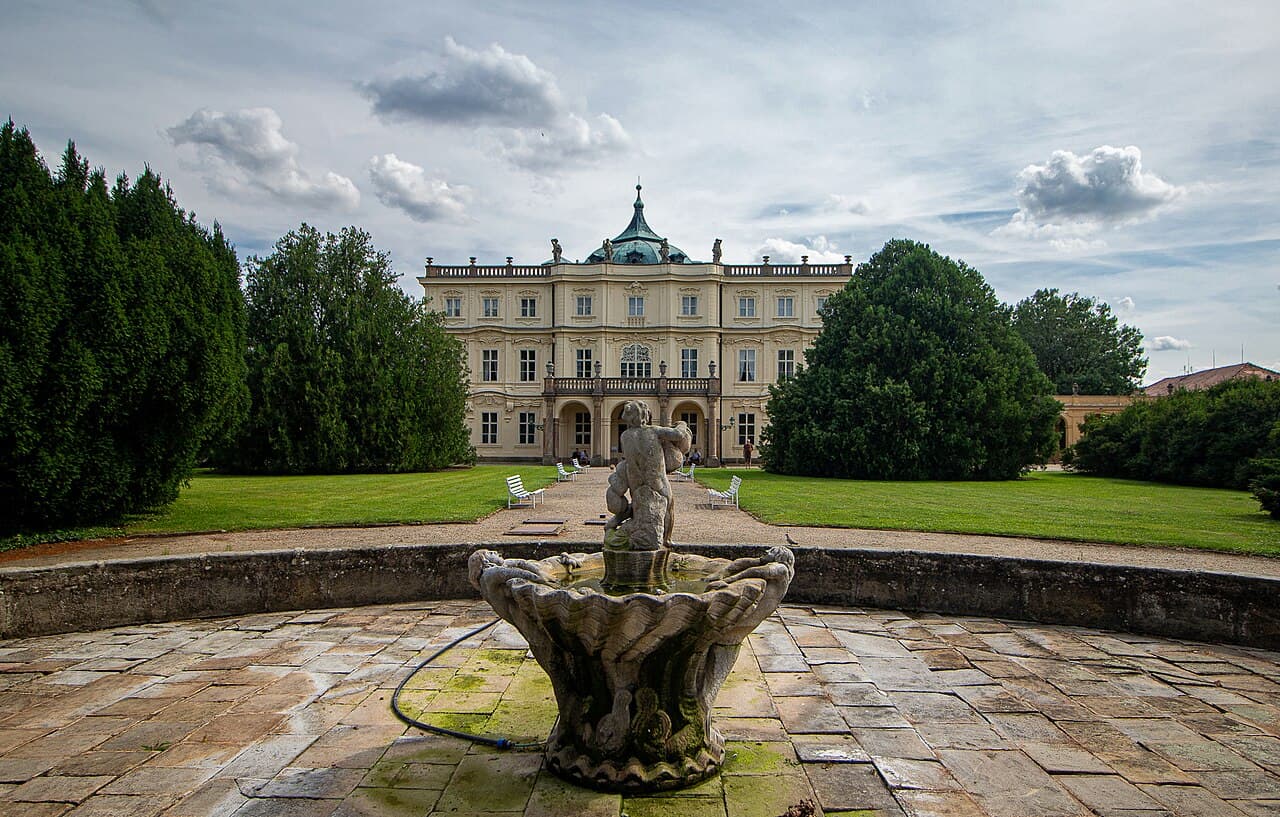
While the exact architect remains uncertain, several candidates have been proposed, including Octavio Broggio, Kilian Ignaz Dientzenhofer, and Václav Špaček. The castle's design is notable for its rectangular floor plan and the distinctive layout featuring a central building connected by open arcaded galleries to two flanking pavilions, creating a harmonious and spacious architectural ensemble.
19th-century modifications and imperial ownership
From 1848, Ploskovice Castle served as a summer residence for Emperor Ferdinand I of Austria. During this period, the castle underwent significant modifications under the direction of architect Jan Bělský. These renovations included adding an additional floor to the main building and constructing a pavilion intended for the imperial entourage.
The castle's ownership history is complex, passing through several noble families such as the Šliks and Trauchburgs, and later aligning with the Bavarian electors and the Habsburg dynasty. This lineage reflects the castle's importance within the broader political and social landscape of Central Europe.
20th-century history and restoration efforts
During World War II, the castle was repurposed by the occupying Nazi regime as a political school, which caused damage to parts of the building, notably the chapel. After the war, the castle's functions shifted to public uses, including a school and a state-operated farm. Starting in 1952, restoration efforts began to preserve and rehabilitate the castle, culminating in its reopening to the public in the 1960s.
Today, Ploskovice Castle and its surrounding park are recognized as a national cultural monument of the Czech Republic, celebrated for their historical, architectural, and cultural value.
Architectural features and interior design
Exterior composition and layout
The castle is a two-story Baroque palace with a rectangular floor plan. Its most unusual feature among Czech castles is the layout where the central building is connected to two side pavilions by open arcaded galleries. This arrangement creates a balanced and elegant architectural composition.
The southern main façade is characterized by nine evenly spaced window axes, while the northern façade mirrors the southern side's composition but features a different arrangement of access staircases. The main entrance is adorned with stucco-decorated windows and tripartite glass doors embellished with naturalistic vegetal motifs.
A prominent architectural highlight is the large Baroque dome rising above the central risalit of the garden façade. This dome features ten dormers and is crowned by a slender quadrangular extension topped with a small bulb-shaped finial, serving as a visual focal point of the castle.
Interior spaces and artistic decorations
Inside, the vaulted hall on the ground floor forms an oval space richly decorated with delicate stuccoes and frescoes. These frescoes depict scenes from aquatic mythology and romantic landscapes, making the hall the dominant interior feature. The vaulted ground floor hall also includes white-blue landscapes and sculptural scenes representing ancient temple ruins.
The castle's interiors are furnished in late Rococo and Neo-Baroque styles. The second floor is notably less decorated than the principal floors below, emphasizing the grandeur of the main reception areas.
The vaulted cellars beneath the castle contain two grottos richly decorated with sculptures and integrated fountains. These grottos include sculpted figures of giants and functioning fountains, contributing to the elaborate Baroque artistic program of the estate.
19th-century additions and artistic contributions
The 19th-century renovations raised the main building by one floor and replaced the original chapel with a staircase. A new chapel was created on the ground floor of the western wing, featuring an altar painting of St. John of Nepomuk by Vilém Kandler.
Decorative elements on the façades, including stuccoes and sculptures, were crafted by artists such as Václav Levý and M. Effenberger. The original Baroque interior paintings were executed by Václav Vavřinec Reiner, with later 19th-century repaintings by Josef Navrátil, blending Baroque and later stylistic influences.
Castle complex and surrounding park
The castle complex includes two arcaded galleries extending east and west from the central building. The eastern gallery ends with a pavilion constructed for the emperor’s entourage, while the western gallery connects to a classicist building that historically housed kitchens, a confectionery, and servants’ quarters. The side pavilions have undergone changes and have not been restored to their original design.
Surrounding the castle is an extensive Baroque-style park covering approximately eight to ten hectares, laid out along a central north-south axis. The garden features a water reservoir, an oval fountain basin, and a Baroque gloriette with three domes. Originally, the gloriette served as a viewpoint and later as an entrance gate to the park.
Among the park's botanical highlights is one of the oldest Paulownia tomentosa trees in Bohemia. Beyond the garden’s boundary, the main axis extends as a poplar-lined avenue leading toward the railway station, which once ended with a statue of the Virgin Mary.
Visiting Ploskovice Castle
Today, Ploskovice Castle is open to the public, offering visitors a chance to explore its richly decorated interiors, the unique architectural ensemble, and the beautifully maintained Baroque park. The castle's historical layers and artistic treasures provide insight into Central European aristocratic life from the medieval period through the 19th century.
Visitors can admire the castle’s vaulted halls, frescoed ceilings, and the intricate stucco work that adorns many rooms. The surrounding park offers a peaceful setting for strolls, with its historic trees, water features, and classical garden structures enhancing the experience.
Frequently asked questions (FAQ)
- What are the opening hours for Ploskovice Castle?
- Ploskovice Castle is typically open to visitors from April to October, with varying hours depending on the month. Generally, the castle is open from 9 AM to 5 PM on weekdays and weekends. It is advisable to check the official website for any updates or changes to the schedule before planning your visit.
- Can I take guided tours of Ploskovice Castle?
- Yes, guided tours are available at Ploskovice Castle, providing an in-depth look at its rich history and architectural features. Tours usually last about an hour and are conducted in Czech, with some options for English-speaking guides. It's recommended to book in advance during peak tourist seasons.
- What is the historical significance of Ploskovice Castle?
- Ploskovice Castle dates back to the 18th century and serves as a fine example of Baroque architecture. Originally a hunting lodge, it became a summer residence for the noble families of the region. The castle's significance lies not only in its architectural beauty but also in its connection to Czech history and culture.
- Is it possible to access Ploskovice Castle with a wheelchair?
- Yes, Ploskovice Castle is equipped with facilities to accommodate visitors with mobility challenges. Ramps and accessible restrooms are available, making it easier for wheelchair users to explore the grounds. However, some areas of the castle may have limited access due to their historical structure.
- When is the best time to visit Ploskovice Castle?
- The best time to visit Ploskovice Castle is during the spring and early autumn months when the weather is mild, and the gardens are in full bloom. Visiting during weekdays can also help you avoid larger crowds. Special events and exhibitions are often held in these seasons, enhancing your experience.
- What are the ticket prices for Ploskovice Castle?
- Ticket prices for Ploskovice Castle are generally affordable, with discounts available for students and seniors. Adults can expect to pay around 100 CZK, while children under 15 may enter for a reduced fee or even free of charge. Group rates are also available for larger parties, making it a great option for school trips or family outings.
- Are there any nearby attractions to visit along with Ploskovice Castle?
- Yes, there are several attractions near Ploskovice Castle that you can explore. The beautiful gardens surrounding the castle are perfect for a leisurely stroll, and nearby, you can find the picturesque town of Litoměřice, known for its charming architecture and historic sites. Other attractions in the area include the Elbe River and various hiking trails that offer stunning views of the landscape.
Photo gallery

Information
Website
Visit websiteSources & official resources
Verify the information above using these authoritative references.
Loading map...
Visitor reviews
No reviews yet. Been here? Write the first review and help other travelers!
Write the first reviewVisited this castle? Share your experience
Your review helps other travelers and adds first-hand knowledge to our encyclopedia.