Theresienstadt Small Fortress
The Small Fortress (Czech: Malá pevnost, German: Kleine Festung) is a prominent bastioned fortress located in the town of Terezín in Czechia. Constructed in the 18th century as part of the larger fortified town of Terezín, it was strategically positioned on the right bank of the Ohře River. This fortress was designed to complement the main fortress of Terezín, serving as a military stronghold with extensive defensive features characteristic of the post-Renaissance period.
Architectural design and fortifications
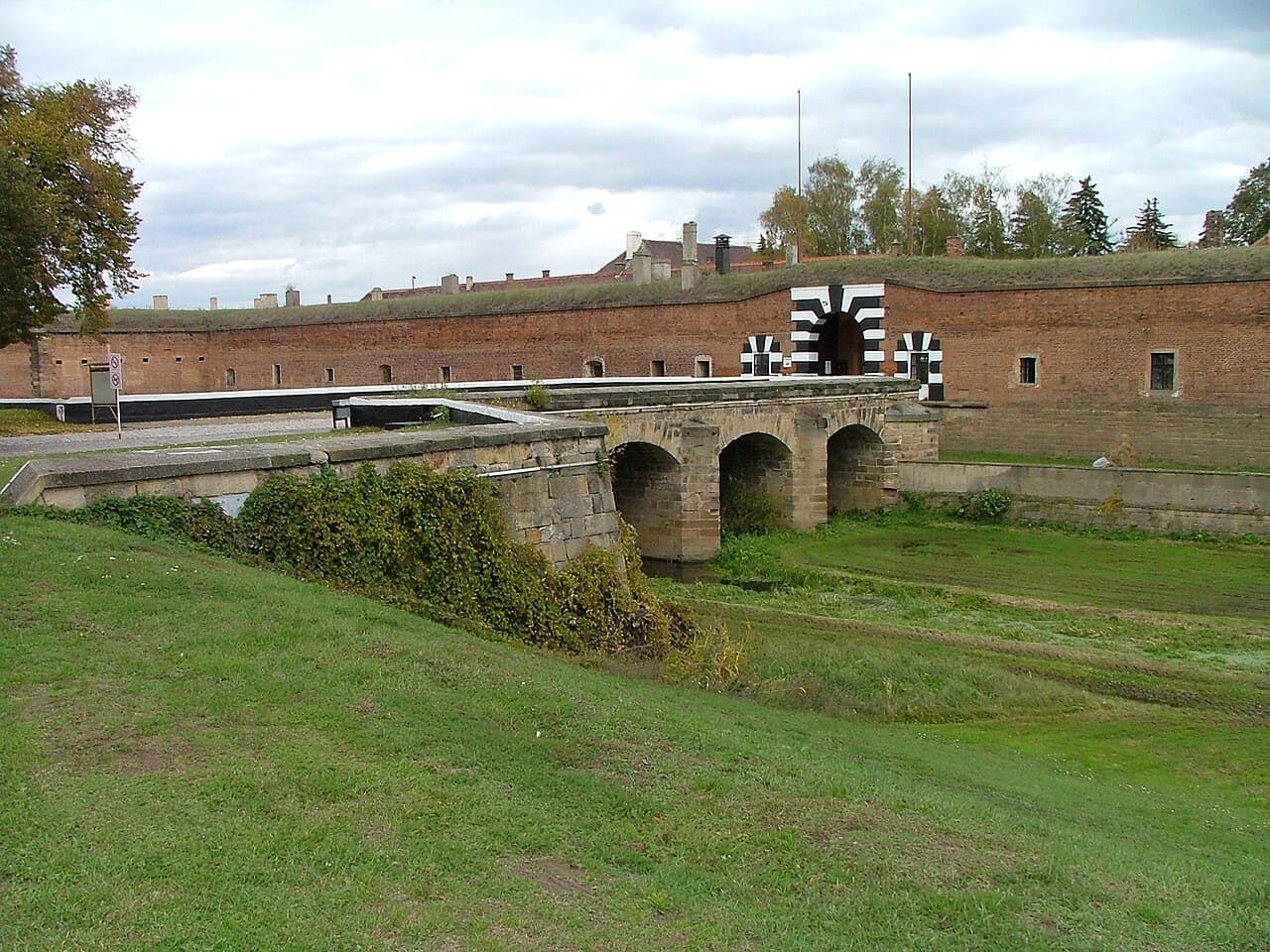
The Small Fortress is an example of 18th-century bastioned fortress architecture, a style that evolved to meet the demands of artillery warfare. Its layout includes a series of star-shaped bastions and curved defensive walls designed to provide overlapping fields of fire, minimizing blind spots and maximizing defensive coverage. The fortress's thick walls and angled bastions were constructed to withstand cannon fire and to repel infantry assaults effectively.
The fortress complex includes moats and ramparts that further enhance its defensive capabilities. The design reflects the military engineering principles of the post-Renaissance era, emphasizing geometry and the strategic placement of defensive elements. The fortress's layout also features gates, guardhouses, and internal courtyards that served both military and administrative functions.
Historical significance and use
Military role
Originally, the Small Fortress was built to serve as a military bastion protecting the larger Terezín fortress and the surrounding region. Its strategic location on the Ohře River allowed control over key transportation routes and provided a defensive barrier against potential invaders. Throughout the 18th and 19th centuries, it functioned primarily as a military installation.
Prison history
In the 19th century, the fortress was repurposed as a prison facility. It gained notoriety as a place of detention for political prisoners and other inmates. One of its most infamous prisoners was Gavrilo Princip, the young Bosnian Serb nationalist who assassinated Archduke Franz Ferdinand of Austria in 1914, an event that triggered the outbreak of World War I. Princip was held in the Small Fortress before his trial.
20th-century history
During the Second World War, the Small Fortress was used by the Nazi Gestapo as a prison and interrogation center. It became a site of harsh imprisonment and torture, primarily for Czech resistance members and other political prisoners. The fortress's role during this period marks a dark chapter in its history, reflecting the broader context of Nazi occupation in Czechoslovakia.
Preservation and current status
Today, the Small Fortress is well preserved and serves as a museum and memorial site. It offers visitors insight into its complex history, from military fortress to prison and wartime detention center. Exhibits include original prison cells, historical artifacts, and documentation related to its use during the 20th century. The site is an important place of remembrance for victims of political persecution during the Nazi era.
The fortress is accessible to the public, with guided tours available that explore its architectural features and historical significance. It stands as a solemn reminder of the turbulent history of the region and the resilience of those who suffered within its walls.
Location and accessibility
The Small Fortress is situated within the town of Terezín, in the Ústí nad Labem Region of Czechia. The town itself is known for its historical military fortifications and its role in European history. Visitors can reach the fortress by road and public transportation, with nearby amenities supporting tourism and education.
Frequently asked questions (FAQ)
- How do I visit the Theresienstadt Small Fortress?
- The Small Fortress in Terezín is open to visitors year-round, with guided tours available. It is accessible by car and public transport, located within the town of Terezín in the Ústí nad Labem Region.
- What is the historical significance of the Small Fortress?
- The Small Fortress served as a military bastion, a prison for political detainees including Gavrilo Princip, and a Nazi Gestapo prison during World War II, reflecting its complex and somber history.
- Can I see original prison cells at the Small Fortress?
- Yes, the fortress museum includes original prison cells and exhibits documenting its use as a detention and interrogation center during the Nazi occupation.
- When was the Small Fortress built?
- The Small Fortress was constructed in the 18th century as part of the fortified town of Terezín, designed in the bastioned fortress style typical of the post-Renaissance period.
- Is the Small Fortress well preserved?
- Yes, the Small Fortress is well preserved and maintained as a museum and memorial site, offering visitors a detailed look at its architectural and historical features.
Photo gallery

Information
Loading map...
Visitor reviews
No reviews yet. Been here? Write the first review and help other travelers!
Write the first reviewVisited this castle? Share your experience
Your review helps other travelers and adds first-hand knowledge to our encyclopedia.